Related Research Articles

Kent is a town in Litchfield County, Connecticut, United States. Located alongside the border with New York, the town's population was 3,019 according to the 2020 census. The town is part of the Northwest Hills Planning Region. Kent is home to three boarding schools: Kent School, the Marvelwood School, and South Kent School. The Schaghticoke Indian Reservation is also located within town borders. The town was also home to former U.S. Secretary of State Henry Kissinger.

Morris is a town in Litchfield County, Connecticut, United States. The population was 2,256 at the 2020 census. The town is part of the Northwest Hills Planning Region.
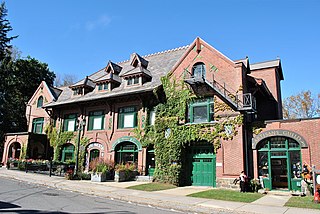
Norfolk is a town in Litchfield County, Connecticut, United States. The population was 1,588 at the 2020 census. The town is part of the Northwest Hills Planning Region. The urban center of the town is the Norfolk census-designated place, with a population of 553 at the 2010 census.

Washington is a rural town in Litchfield County, Connecticut, in the New England region of the United States. The population was 3,646 at the 2020 census. Washington is known for its picturesque countryside, historic architecture, and active civic and cultural life. The town has strong ties to New York City, and is home to many cultural and business elites. The town is part of the Northwest Hills Planning Region.

A chess problem, also called a chess composition, is a puzzle set by the composer using chess pieces on a chess board, which presents the solver with a particular task. For instance, a position may be given with the instruction that White is to move first, and checkmate Black in two moves against any possible defence. A chess problem fundamentally differs from over-the-board play in that the latter involves a struggle between Black and White, whereas the former involves a competition between the composer and the solver. Most positions which occur in a chess problem are 'unrealistic' in the sense that they are very unlikely to occur in over-the-board play. There is a good deal of specialized jargon used in connection with chess problems.
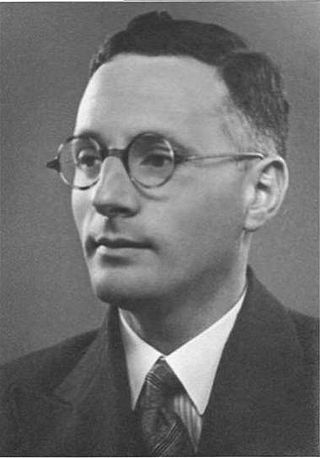
Erich Ernst Zepler, later known as Eric Ernest Zepler, was a German-born electronics expert, lecturer, and chess problem composer. He was a Christian, but of Jewish race. He fled Germany in 1935, with his family and most of his possessions. He settled in England, dropping the H in his first name, and adding an E to his middle name, to become Eric Ernest Zepler.
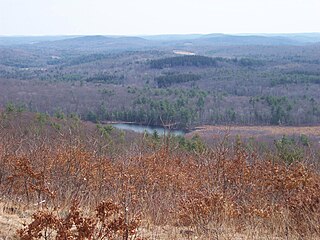
Mohawk State Forest, also known as Mohawk State Forest/Mohawk Mountain State Park, encompasses over 4,000 acres (1,600 ha) in the towns of Cornwall, Goshen, and Litchfield in the southern Berkshires of Litchfield County, Connecticut. As overseen by the Connecticut Department of Energy and Environmental Protection, the area is used for hiking, picnicking, and winter sports by the public, while being actively managed to produce timber and other forest products.
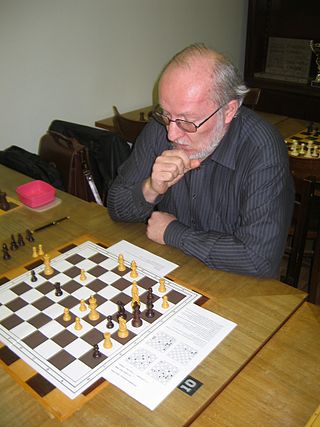
Marko Klasinc is a Slovenian chess problemist.
A joke chess problem is a puzzle in chess that uses humor as an element. Although most chess problems, like other creative forms, are appreciated for serious artistic themes, joke chess problems are enjoyed for some twist. In some cases the composer plays a trick to prevent a solver from succeeding with typical analysis. In other cases, the humor derives from an unusual final position. Unlike in ordinary chess puzzles, joke problems can involve a solution which violates the inner logic or rules of the game.

Thomas Rayner Dawson was an English chess problemist and is acknowledged as "the father of Fairy Chess". He invented many fairy pieces and new conditions. He introduced the popular fairy pieces grasshopper, nightrider, and many other fairy chess ideas.

Kent Falls State Park is a public recreation area located in the town of Kent, Connecticut, within the Litchfield Hills region of the southern Berkshires. The state park is home to Kent Falls, a series of waterfalls on Falls Brook, a tributary of the Housatonic River. The falls drop 250 feet (76 m) in under a quarter mile. The largest cascade drops more than 70 feet (21 m) into a reflecting pool, before traveling over the lesser falls.

Michel Caillaud is a French chess problemist.

Bull's Bridge is a single-lane vehicular wooden covered bridge across the Housatonic River in the town of Kent, Connecticut, close to the state border with New York. The first instance of a bridge at this location was constructed by Jacob and Isaac Bull in 1760, which gave the bridge its name. Popular legend suggests that George Washington crossed the bridge with the Bulls' assistance while still under construction. The current bridge was built in 1842 from timber, with additional supports added in the 19th and 20th centuries. Built with a Town lattice design, the bridge has reinforced trusswork visible on the interior. At the time of its nomination to the National Register of Historic Places the roof had wood shingles. It is historically significant as one of three surviving covered bridges in Connecticut, and was listed on the National Register of Historic Places in 1972.
Ehrick Kensett Rossiter was an American architect known for the country homes he designed.
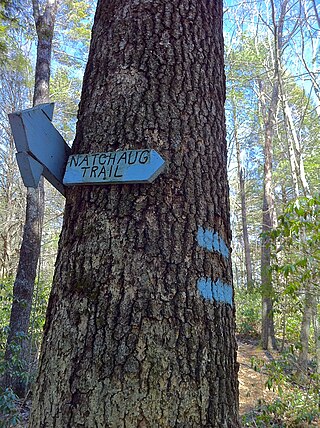
The Natchaug Trail is a Blue-Blazed hiking trail "system" which meanders through 19.5 miles (31.4 km) of forests in northeast Connecticut—primarily in Windham County. It is maintained by the Connecticut Forest and Park Association. Its southern trailhead begins in the James L. Goodwin State Forest in the towns of Chaplin, Connecticut and Hampton, Connecticut and the northern terminus is at its intersection with the Nipmuck Trail in Natchaug State Forest in Eastford, Connecticut.

The White Memorial Foundation is an organization dedicated to environmental conservation located in Litchfield, Connecticut. The Foundation owns approximately 4,000 acres of wetlands and uplands, including recreational trails, two camping areas, and a conservation center dedicated to education, research, conservation, and recreation.

The White Memorial Conservation Center is a natural history museum and nature center in Litchfield, Connecticut, United States, supported by the White Memorial Foundation. The museum is currently housed in Whitehall, the former residence of White Memorial Foundation founders Alain and May White.

The Mattatuck Trail is an 42.2-mile (67.9 km) Blue-Blazed hiking trail that winds through Litchfield County and New Haven County in Western Connecticut.

Bantam Lake is the largest natural lake in Connecticut, covering 947 acres (383 ha) in the towns of Morris and Litchfield. Much of the land at the northern end of the lake, including the peninsula of Marsh Point, is protected by the White Memorial Foundation and home to a wide array of bird species. It is lined by campgrounds, camps for kids and has facilities for various water sports. The lake also has two public beaches, Morris Town Beach and Sandy Beach.
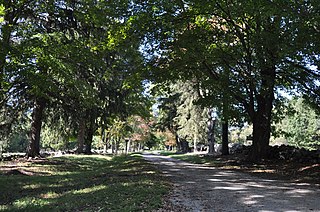
The Hervey Brooks Pottery Shop and Kiln Site is a historic industrial archaeological site in Goshen, Connecticut. It is the site of the 19th-century pottery of Hervey Brooks, a local potter significant for his extensive recordkeeping. Brooks' pottery included a shop and a stone kiln. The shop structure was moved to Old Sturbridge Village in the 20th century, where a reconstruction of his kiln has also been undertaken. The original site is of archaeological significance for identifying the materials Brooks used and how he laid out his work site, and for identifying how those changed over time.
References
- ↑ "The View From: The White Memorial; The Legacy of a Man Before His Time," by Charlotte Libov, New York Times, July 17, 1988
- ↑ "Alain C. White," Chess Life Magazine, April 20 1951, retrieved at https://archive.org/stream/ChessLife1951/Chess%20Life%201951_djvu.txt
- ↑ "Alain and May White Memorial Boulder," by Peter Vermilyea, August 5, 2022, retrieved from https://connecticuthistory.org/alain-and-may-white-memorial-boulder/
- ↑ "Alain and May White Memorial Boulder," by Peter Vermilyea
- ↑ "Dante Prize Winners" at https://dantesociety.org/prizes-and-awards/dante-prize-winners
- ↑ "Mate the Subtle Way," by Vincent Eaton, Chess Life Magazine, April 1951
- ↑ "LHRR Series: The Fourth Mile, into White Memorial" by Peter Vermilyea, from https://hiddeninplainsightblog.com/2016/05/14/lhrr-series-the-fourth-mile-into-white-memorial/ posted May 14, 2016
- ↑ "Alain and May White Memorial Boulder," by Peter Vermilyea
- ↑ "White Memorial Conservation Center: Our History," retrieved from https://whitememorialcc.org/our-history/
- ↑ "The View From: The White Memorial; The Legacy of a Man Before His Time"
- ↑ "LHRR Series: The Fourth Mile, into White Memorial," by Peter Vermilyea, posted on May 14, 2016 at https://hiddeninplainsightblog.com/tag/alain-white/
- ↑ "The View From: The White Memorial; The Legacy of a Man Before His Time"
- ↑ White, Alain C., Memories of My Chess Board , Stroud, 1909. Page 9.
- ↑ White, Alain C., Memories of My Chess Board, page 11
- ↑ "Chess Composers: Whose Birthday Is It Today?" posted March 3, 2012, retrieved from http://chesscomposers.blogspot.com/2012/03/march-3rd.html
- ↑ "Alain C. White," Chess Life Magazine
- ↑ "A White Christmas," by Siegfried Hornecker, Dec. 29, 2018, posted to https://en.chessbase.com/post/study-of-the-month-2018-12
- ↑ "Alain White: A Note by Edgar W. Allen," from Alain White, editors Edgar Allen and Eric Hassberg, Overbrook Press, Stamford Connecticut, 1945, p. 3
- ↑ "Mate the Subtle Way," by Vincent Eaton