
The Lo-100 is an aerobatic glider of classic wood and fabric construction well suited to amateur building methods. The designation Lo was bestowed by the designer Alfred Vogt in memory of his brother Lothar Vogt, with whom he had developed the predecessor model Lo-105 Zwergreiher. The first flight of the prototype took place in 1952 at the Klippeneck. An example is on display at the Gliding Heritage Centre.

The Aer-Pegaso M-100 was a single-seat glider designed and built in Italy from 1957.

The Antonov A-13 was a Soviet aerobatic sailplane flown in the 1950s and 1960s. It was a small, single-seat, all-metal aircraft developed from the A-11 which could optionally be fitted with that aircraft's longer-span wings. It was a mid-wing monoplane with a tadpole-like fuselage and a V-tail.
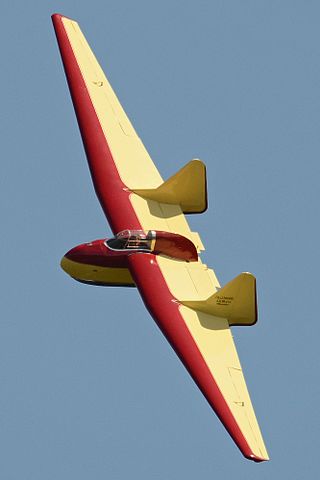
The Fauvel AV.36 was a single-seat tailless glider designed in France in the 1950s by Charles Fauvel. Although the "AV" in AV.36 stands for Aile Volante, it was not a true flying wing: it featured two large fins mounted on stubby tailbooms extending back from the wing's trailing edge, and accommodated the pilot within a stubby fuselage. The aircraft was designed to be quickly disassembled for road transport, with the nose detaching, and the fins able to fold back against the trailing edge of the wing. A refined version with a slightly longer wingspan, the AV.361 was introduced in 1960.
The Schneider ES-59 Arrow is a sailplane designed and manufactured in Adelaide, South Australia in the early 1960s. The Arrow was manufactured with a one-piece wing of 13.23 metres span. It was the first Australian-built sailplane to compete in the World Gliding Championships, 1963 in Argentina. The Arrow has wood/fabric wings and tail and a wood fuselage. It has a fixed main wheel and a nose skid.
The Fauvel AV.45 was an unorthodox motor glider produced in France in the 1960s and 1970s. Like other Charles Fauvel designs, it was a tailless aircraft, in this case inspired by the work that German firms had done on producing motorised versions of his AV.36 design. The prototype of the AV.45 was an extensively modified AV.36 powered by a Nelson H-59 two-stroke engine. AV.45s have been built with a number of other engines, however, including at least one aircraft powered by a small turbojet. Falconar marketed the plans in the 1970s.

The Slingsby T.41 Skylark 2 was a sailplane produced from 1953 by Slingsby Sailplanes at Kirkbymoorside, Yorkshire.
The PIK-3 was a sailplane produced in Finland in the 1950s and 60s. It was designed to be a cheap and easy-to-build aircraft to equip the country's gliding clubs as their standard single-seat machine. It was a conventional design for its day, with a high wing and conventional empennage. Construction was of wood throughout, skinned in plywood.

The PIK-5 was a training glider produced in Finland in the 1940s, and 1950s, equipping the country's gliding clubs with an aircraft greater in performance than primary gliders but less than competition sailplanes.

The Slingsby T.49 Capstan is a British two-seat glider of the 1960s built by Slingsby Sailplanes as a replacement for their earlier Type 42 Eagle.
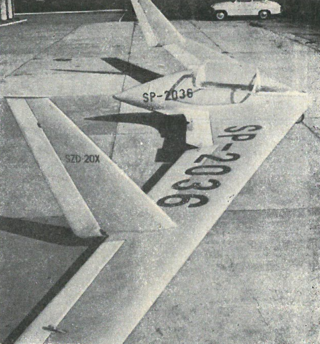
The SZD-20x Wampir II was a single-seat tail-less research glider designed and built in Poland from 1959.

The IS-4 Jastrząb was a single-seat aerobatic glider designed and built in Poland from 1949.
The Schneider ES-52 Kookaburra is an Australian two-seat training sailplane of the 1950s and 1960s. It was designed by Edmund Schneider, the designer of the Grunau Baby, who had emigrated to Adelaide, South Australia following the end of the Second World War.

The Rutan Model 77 Solitaire is an American, single seat, canard, mid-wing motor glider that was developed by Burt Rutan in response to the 1982 Sailplane Homebuilders Association Design Contest for a homebuilt glider. It first flew in 1982. The Solitaire was declared the winner of the contest and its unusual layout attracted a great deal of attention. For a time in the 1980s the aircraft was available as plans and as a kit.
The Applebay Zia is an American, single-seat, high-wing, twin-boom, pusher configuration motor glider that was designed by George Applebay for the 1982 Sailplane Homebuilders Association Homebuilt Sailplane Design Contest. The aircraft was intended to be offered as a factory completed aircraft or as a kit. It first flew in 1982.
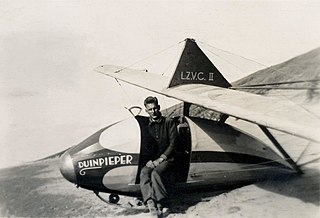
The Zögling is a German high-wing, cable-braced, single seat primary glider that was designed by Alexander Lippisch in 1926 and produced with many variations by a variety of manufacturers.

The Hütter Hü 17, is a German high-wing, strut-braced, single-seat, utility training glider that was designed by brothers Ulrich Hütter and Wolfgang Hütter in the 1930s.
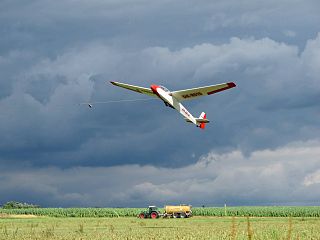
The Schleicher K7 Rhönadler is a West German high-wing, two-seat, glider that was designed by Rudolf Kaiser and produced by Alexander Schleicher GmbH & Co.
The IS-2 was an intermediate training glider designed by Iosif Şilimon and built in Romania in the 1950s at the URMV-3 factory at Brașov.

The Schleicher Ka-2 Rhönschwalbe is a tandem two-seat training glider designed and built in Germany, in 1952.

