
An autogyro, or gyroplane, is a class of rotorcraft that uses an unpowered rotor in free autorotation to develop lift. While similar to a helicopter rotor in appearance, the autogyro's unpowered rotor disc must have air flowing upward across it to make it rotate.
Aer Lingus is the flag carrier of Ireland. Founded by the Irish Government, it was privatised between 2006 and 2015 and it is now a wholly owned subsidiary of International Airlines Group (IAG). The airline's head office is on the grounds of Dublin Airport in Cloghran, County Dublin.
Aer Lualdi & C SpA was an Italian helicopter manufacturer. The company produced several prototypes
The Lualdi-Tassotti ES 53 was an Italian experimental helicopter designed by Carlo Lualdi around a Hiller-designed rotor system and a gyro stabiliser of his own design. It first flew at Campoformido in September 1953.
The Aer Lualdi L.55 was a prototype Italian helicopter, a development of the Lualdi-Tassotti ES 53 featuring a far more powerful 134 kW (180 hp) Lycoming O-360. While the ES 53 had been purely experimental, the L.55 was Lualdi's first step towards a marketable aircraft.
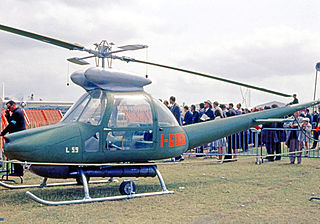
The Aer Lualdi L.59 was an Italian helicopter that failed to reach quantity production.
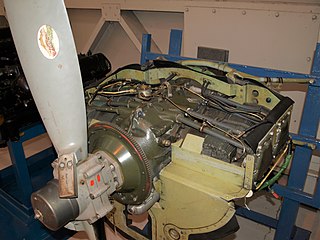
The Lycoming O-360 is a family of four-cylinder, direct-drive, horizontally opposed, air-cooled, piston aircraft engines. Engines in the O-360 series produce between 145 and 225 horsepower, with the basic O-360 producing 180 horsepower.

The Westland Widgeon was a helicopter developed by Westland Aircraft as a private venture improvement on the Westland WS-51 Dragonfly.

A helicopter is a type of rotorcraft in which lift and thrust are supplied by horizontally spinning rotors. This allows the helicopter to take off and land vertically, to hover, and to fly forward, backward and laterally. These attributes allow helicopters to be used in congested or isolated areas where fixed-wing aircraft and many forms of short take-off and landing (STOL) or short take-off and vertical landing (STOVL) aircraft cannot perform without a runway.

The Bell R-12 was an American 1940s military utility helicopter built by the Bell Helicopter company. The design did not go into full production, but over a dozen prototypes were used for various tests and projects.

The Doman LZ-5 was a utility helicopter developed in the United States in the early 1950s by Doman Helicopters Inc. of Danbury, Connecticut. Despite the procurement of international manufacturing agreements, no series production of the aircraft ever occurred, and only three prototypes were built. Two of these were purchased by the United States Army as the YH-31, but eventually becoming VH-31.

The McDonnell XV-1 is an experimental Convertiplane developed by McDonnell Aircraft for a joint research program between the United States Air Force and the United States Army to explore technologies to develop an aircraft that could take off and land like a helicopter but fly at faster airspeeds, similar to a conventional airplane. The XV-1 would reach a speed of 200 mph, faster than any previous rotorcraft, but the program was terminated due to the tip-jet noise and complexity of the technology which gave only a modest gain in performance.

The Bell 47J Ranger is an American single-engine single-rotor light helicopter manufactured by Bell Helicopter. It was an executive variant of the highly successful Bell 47 and was the first helicopter to carry a United States president.

The Italian Air Force Museum is an aircraft museum at Vigna di Valle, on Lake Bracciano (Lazio), in central Italy. It is operated by the Aeronautica Militare. The museum's collection has an emphasis on Italian machines and seaplanes. While maintaining the technical and historical aspects, the museum is also dedicated to the influence aviation has had on Italian art, featuring works by Futurist painters Pietro Annigoni, Giacomo Balla, and Tato; and contemporary art such as Flight: Papiers froissés by Antonio Papasso.
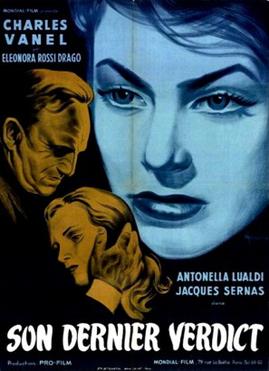
The Last Sentence is a 1951 Italian melodrama-crime film co-written and directed by Mario Bonnard and starring Charles Vanel, Antonella Lualdi and Eleonora Rossi Drago.
The Famà Kiss 209M is an Italian ultralight two-seat helicopter, built from composite materials around a steel frame and with an optional retractable undercarriage. The moniker "Kiss" stands for "keep it stupidly simple", reflecting the philosophy of its designer, Nino Famà.
L55 or variation, may refer to:


