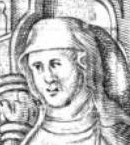
Adelaide of Auxerre (born between 865[1] and 870, died between 928 and 929) was a Duchess consort of Burgundy by marriage to Richard, Duke of Burgundy, and had the title Countess of Auxerre, possibly as ruling Count.
In 888, she married Richard, Duke of Burgundy. Adelaide is called Countess of Auxerre between 888 and 921. Exactly why is not clarified. It has been suggested that this was because she was given the County of Auxerre as her dowry. It is possible that she was ruler of Auxerre.
Ermengarde of Burgundy (born c. 905 and died c. 945)
Notes
↑ Christian Settipani, La Noblesse du Midi Carolingien. Études sur quelques grandes familles d'Aquitaine et du Languedoc, du IXe au XIe siècles. Toulousain, Périgord, Limousin, Poitou, Auvergne, Linacre College, Unit for Prosopographical Research, 2004, p.27 (lire en ligne).
↑ Constance B. Bouchard. The Bosonids or Rising to Power in the Late Carolingian Age.
↑ Constance B. Bourchard, Those of my Blood: Constructing Noble Families in Medieval Francia (University of Pennsylvania Press, 2001)
Related Research Articles
The Free County of Burgundy was a medieval feudal state ruled by a count from 982 to 1678. It was also known as Franche-Comté, from French: franc comte meaning 'free count', and was located in the modern region of Franche-Comté. It bordered the Duchy of Burgundy to the west, which was part of France from 843.
Richard, Duke of Burgundy (858–921), also known as Richard of Autun or Richard the Justiciar, was Count of Autun from 880 and the first Margrave and Duke of Burgundy. He eventually attained suzerainty over all the counties of Burgundy save Mâcon and by 890 he was referred to as dux (duke) and by 900 as marchio (margrave). By 918 he was being called dux Burgundionem or dux Burgundiae, which probably signified less the existence of a unified Burgundian dukedom than feudal suzerainty over a multiplicity of counties in a specific region.
Otto-William was count of Mâcon, Nevers, and Burgundy.
The County of Auxerre was a county in current central France, with its capital in Auxerre. It was commonly associated with the Duchy of Burgundy.
Renauld I was a French nobleman. He was the Count of Nevers and Count of Auxerre from 1028 until his death at the battle of Seignelay against Robert I, Duke of Burgundy.
Rudolph I was King of Upper Burgundy from his election in 888 until his death.
Constance of Arles, also known as Constance of Provence, was Queen of France as the third spouse of King Robert II of France.
Adelaide-Blanche of Anjou(c. 940 –1026) was, by her successive marriages, countess of Gévaudan and Forez, of Toulouse, of Provence, and of Burgundy, and queen of Aquitaine. She was the regent of Gevaudan during the minority of her sons in the 960s, and the regent of Provence during the minority of her son from 994 until 999.
The Bosonids were a dynasty of Carolingian era dukes, counts, bishops and knights descended from Boso the Elder. Eventually they married into the Carolingian dynasty and produced kings and an emperor of the Frankish Empire.
Yolande II or Yolande of Nevers, was ruling Countess of Nevers between 1262 and 1280.
The Robertians are the proposed Frankish family which was ancestral to the Capetian dynasty, and thus to the royal families of France and of many other countries. The Capetians appear first in the records as powerful nobles serving under the Carolingian dynasty of Charlemagne in West Francia, which later became France. As their power increased, they came into conflict with the older royal family and attained the crown several times before the eventual start of the continuous rule of the descendants of Hugh Capet.
William III, Count of Nevers was Count of Nevers, Auxerre and Tonnerre (1148–1161). He was born in Auxerre.
John, called the Old (l'Antique), was a French nobleman, the Count of Auxonne and Chalon-sur-Saône in his own right and regent in right of his son, Hugh III, Count of Burgundy. In contemporary documents, he was sometimes called "Count of Burgundy", as by King William of Germany in 1251.
Adelaide of Auxerre or Adelaide of Burgundy can be used interchangeably and may refer to:
Matilda II, Countess of Nevers (1234/35–1262), also known as Maud of Dampierre or Mathilda II of Bourbon, was a sovereign Countess of Nevers, Countess of Auxerre, Countess of Tonnerre.
Lambert of Chalon was the count of Chalon from 956 to 978, and viscount of Autun.
StephenIII was Count of Auxonne. He was from the House of Ivrea, son of Stephen II, Count of Auxonne and Judith of Lorraine. He was Stephen III in his House and Stephen II as Count of Auxonne.
Matilda I, Countess of Nevers or Mathilde de Courtenay, or Mahaut de Courtenay, (1188–1257), was a ruling countess of Nevers, Auxerre and Tonnerre. She was the only daughter of Peter II of Courtenay and of Agnes of Nevers, born from the Capetian House of Courtenay, she was married to Hervé IV of Donzy and then to Guigues IV of Forez.
Dalmas I of Semur was a Burgundian nobleman.
This page is based on this Wikipedia article Text is available under the CC BY-SA 4.0 license; additional terms may apply. Images, videos and audio are available under their respective licenses.