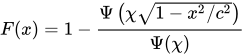
ARGUS distribution Last updated August 01, 2025 Cumulative distribution function The cumulative distribution function (cdf) of the ARGUS distribution is
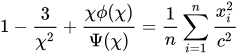
F ( x ) = 1 − Ψ ( χ 1 − x 2 / c 2 ) Ψ ( χ ) {\displaystyle F(x)=1-{\frac {\Psi \left(\chi {\sqrt {1-x^{2}/c^{2}}}\right)}{\Psi (\chi )}}} Parameter estimation Parameter c is assumed to be known (the kinematic limit of the invariant mass distribution), whereas χ can be estimated from the sample X 1 , ..., X n maximum likelihood approach. The estimator is a function of sample second moment, and is given as a solution to the non-linear equation
1 − 3 χ 2 + χ ϕ ( χ ) Ψ ( χ ) = 1 n ∑ i = 1 n x i 2 c 2 {\displaystyle 1-{\frac {3}{\chi ^{2}}}+{\frac {\chi \phi (\chi )}{\Psi (\chi )}}={\frac {1}{n}}\sum _{i=1}^{n}{\frac {x_{i}^{2}}{c^{2}}}} The solution exists and is unique, provided that the right-hand side is greater than 0.4; the resulting estimator χ ^ {\displaystyle \scriptstyle {\hat {\chi }}} consistent and asymptotically normal .
Generalized ARGUS distribution Sometimes a more general form is used to describe a more peaking-like distribution:
f ( x ) = 2 − p χ 2 ( p + 1 ) Γ ( p + 1 ) − Γ ( p + 1 , 1 2 χ 2 ) ⋅ x c 2 ( 1 − x 2 c 2 ) p exp { − 1 2 χ 2 ( 1 − x 2 c 2 ) } , 0 ≤ x ≤ c , c > 0 , χ > 0 , p > − 1 {\displaystyle f(x)={\frac {2^{-p}\chi ^{2(p+1)}}{\Gamma (p+1)-\Gamma (p+1,\,{\tfrac {1}{2}}\chi ^{2})}}\cdot {\frac {x}{c^{2}}}\left(1-{\frac {x^{2}}{c^{2}}}\right)^{p}\exp \left\{-{\frac {1}{2}}\chi ^{2}\left(1-{\frac {x^{2}}{c^{2}}}\right)\right\},\qquad 0\leq x\leq c,\qquad c>0,\,\chi >0,\,p>-1} F ( x ) = Γ ( p + 1 , 1 2 χ 2 ( 1 − x 2 c 2 ) ) − Γ ( p + 1 , 1 2 χ 2 ) Γ ( p + 1 ) − Γ ( p + 1 , 1 2 χ 2 ) , 0 ≤ x ≤ c , c > 0 , χ > 0 , p > − 1 {\displaystyle F(x)={\frac {\Gamma \left(p+1,\,{\tfrac {1}{2}}\chi ^{2}\left(1-{\frac {x^{2}}{c^{2}}}\right)\right)-\Gamma (p+1,\,{\tfrac {1}{2}}\chi ^{2})}{\Gamma (p+1)-\Gamma (p+1,\,{\tfrac {1}{2}}\chi ^{2})}},\qquad 0\leq x\leq c,\qquad c>0,\,\chi >0,\,p>-1} where Γ(·) is the gamma function , and Γ(·,·) is the upper incomplete gamma function .
Here parameters c , χ, p represent the cutoff, curvature, and power respectively.
The mode is:
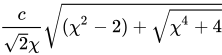
c 2 χ ( χ 2 − 2 p − 1 ) + χ 2 ( χ 2 − 4 p + 2 ) + ( 1 + 2 p ) 2 {\displaystyle {\frac {c}{{\sqrt {2}}\chi }}{\sqrt {(\chi ^{2}-2p-1)+{\sqrt {\chi ^{2}(\chi ^{2}-4p+2)+(1+2p)^{2}}}}}} The mean is:
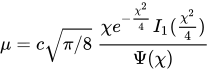
μ = c p π Γ ( p ) Γ ( 5 2 + p ) χ 2 p + 2 2 p + 2 M ( p + 1 , 5 2 + p , − χ 2 2 ) Γ ( p + 1 ) − Γ ( p + 1 , 1 2 χ 2 ) {\displaystyle \mu =c\,p\,{\sqrt {\pi }}{\frac {\Gamma (p)}{\Gamma ({\tfrac {5}{2}}+p)}}{\frac {\chi ^{2p+2}}{2^{p+2}}}{\frac {M\left(p+1,{\tfrac {5}{2}}+p,-{\tfrac {\chi ^{2}}{2}}\right)}{\Gamma (p+1)-\Gamma (p+1,\,{\tfrac {1}{2}}\chi ^{2})}}} where M(·,·,·) is the Kummer's confluent hypergeometric function . [ 2] [ circular reference ]
The variance is:
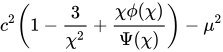
σ 2 = c 2 ( χ 2 ) p + 1 χ p + 3 e − χ 2 2 + ( χ 2 − 2 ( p + 1 ) ) { Γ ( p + 2 ) − Γ ( p + 2 , 1 2 χ 2 ) } χ 2 ( p + 1 ) ( Γ ( p + 1 ) − Γ ( p + 1 , 1 2 χ 2 ) ) − μ 2 {\displaystyle \sigma ^{2}=c^{2}{\frac {\left({\frac {\chi }{2}}\right)^{p+1}\chi ^{p+3}e^{-{\tfrac {\chi ^{2}}{2}}}+\left(\chi ^{2}-2(p+1)\right)\left\{\Gamma (p+2)-\Gamma (p+2,\,{\tfrac {1}{2}}\chi ^{2})\right\}}{\chi ^{2}(p+1)\left(\Gamma (p+1)-\Gamma (p+1,\,{\tfrac {1}{2}}\chi ^{2})\right)}}-\mu ^{2}} p = 0.5 gives a regular ARGUS, listed above.
Further reading Albrecht, H. (1994). "Measurement of the polarization in the decay B → J/ψK*". Physics Letters B . 340 (3): 217– 220. Bibcode :1994PhLB..340..217A . doi :10.1016/0370-2693(94)01302-0 . Pedlar, T.; Cronin-Hennessy, D.; Hietala, J.; Dobbs, S.; Metreveli, Z.; Seth, K.; Tomaradze, A.; Xiao, T.; Martin, L. (2011). "Observation of the hc (1P) Using e+ e− Collisions above the DD Threshold". Physical Review Letters . 107 (4): 041803. arXiv : 1104.2025 . Bibcode :2011PhRvL.107d1803P . doi :10.1103/PhysRevLett.107.041803 . PMID 21866994 . S2CID 33751212 . Lees, J. P.; Poireau, V.; Prencipe, E.; Tisserand, V.; Garra Tico, J.; Grauges, E.; Martinelli, M.; Palano, A.; Pappagallo, M.; Eigen, G.; Stugu, B.; Sun, L.; Battaglia, M.; Brown, D. N.; Hooberman, B.; Kerth, L. T.; Kolomensky, Y. G.; Lynch, G.; Osipenkov, I. L.; Tanabe, T.; Hawkes, C. M.; Soni, N.; Watson, A. T.; Koch, H.; Schroeder, T.; Asgeirsson, D. J.; Hearty, C.; Mattison, T. S.; McKenna, J. A.; et al. (2010). "Search for Charged Lepton Flavor Violation in Narrow Υ Decays". Physical Review Letters . 104 (15): 151802. arXiv : 1001.1883 . Bibcode :2010PhRvL.104o1802L . doi :10.1103/PhysRevLett.104.151802 . PMID 20481982 . S2CID 14992286 .
Discrete
with finite with infinite
Continuous
supported on a supported on a supported with support
Mixed
Multivariate Directional Degenerate singular Families
This page is based on this
Wikipedia article Text is available under the
CC BY-SA 4.0 license; additional terms may apply.
Images, videos and audio are available under their respective licenses.
烟雨镜像程序
量子镜像站群
霸屏SEO镜像站群
MirrorElfR
主动推送镜像站群