Related Research Articles
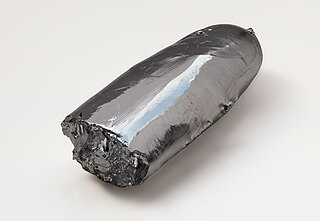
Ruthenium is a chemical element with the symbol Ru and atomic number 44. It is a rare transition metal belonging to the platinum group of the periodic table. Like the other metals of the platinum group, ruthenium is inert to most other chemicals. Russian-born scientist of Baltic-German ancestry Karl Ernst Claus discovered the element in 1844 at Kazan State University and named ruthenium in honor of Russia. Ruthenium is usually found as a minor component of platinum ores; the annual production has risen from about 19 tonnes in 2009 to some 35.5 tonnes in 2017. Most ruthenium produced is used in wear-resistant electrical contacts and thick-film resistors. A minor application for ruthenium is in platinum alloys and as a chemistry catalyst. A new application of ruthenium is as the capping layer for extreme ultraviolet photomasks. Ruthenium is generally found in ores with the other platinum group metals in the Ural Mountains and in North and South America. Small but commercially important quantities are also found in pentlandite extracted from Sudbury, Ontario and in pyroxenite deposits in South Africa.

A noble metal is ordinarily regarded as a metallic chemical element that is generally resistant to corrosion and is usually found in nature in its raw form. Gold, platinum, and the other platinum group metals are most often so classified. Silver, copper and mercury are sometimes included as noble metals, however less often as each of these usually occurs in nature combined with sulfur.

1,10-Phenanthroline (phen) is a heterocyclic organic compound. It is a white solid that is soluble in organic solvents. The 1,10 refer to the location of the nitrogen atoms that replace CH's in the hydrocarbon called phenanthrene.

Metal nitrosyl complexes are complexes that contain nitric oxide, NO, bonded to a transition metal. Many kinds of nitrosyl complexes are known, which vary both in structure and coligand.
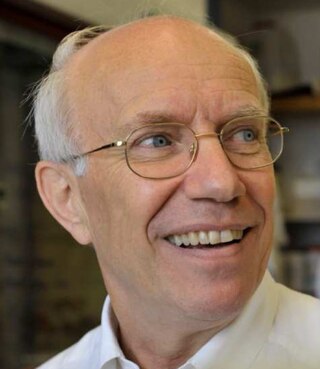
Pierre Braunstein is a French chemist. He was director of the Laboratoire de Chimie de Coordination of Strasbourg (France) and is a member of the French Academy of Science.
A hydrogenase mimic or bio-mimetic is an enzyme mimic of hydrogenases.

Tripodal ligands are tri- and tetradentate ligands. They are popular in research in the areas of coordination chemistry and homogeneous catalysis. Because the ligands are polydentate, they do not readily dissociate from the metal centre. Many tripodal ligands have C3 symmetry.

Organoruthenium chemistry is the chemistry of organometallic compounds containing a carbon to ruthenium chemical bond. Several organoruthenium catalysts are of commercial interest and organoruthenium compounds have been considered for cancer therapy. The chemistry has some stoichiometric similarities with organoiron chemistry, as iron is directly above ruthenium in group 8 of the periodic table. The most important reagents for the introduction of ruthenium are ruthenium(III) chloride and triruthenium dodecacarbonyl.

Ruthenium(III) acetylacetonate is a coordination complex with the formula Ru(O2C5H7)3. O2C5H7− is the ligand called acetylacetonate. This compound exists as a dark violet solid that is soluble in most organic solvents. It is used as a precursor to other compounds of ruthenium.
Anthony F. Hill is a Professor of Chemistry at the Research School of Chemistry of the Australian National University. He specializes in synthetic, organometallic and coordination chemistry. He is the author of a textbook on the subject of the organometallic chemistry of the transition metals and since 1995 has been an editor of the scientific journal/book series Advances in Organometallic Chemistry. He is a fellow of the Royal Society of Chemistry.

The Tolman electronic parameter (TEP) is a measure of the electron donating or withdrawing ability of a ligand. It is determined by measuring the frequency of the A1 C-O vibrational mode (ν(CO)) of a (pseudo)-C3v symmetric complex, [LNi(CO)3] by infrared spectroscopy, where L is the ligand of interest. [LNi(CO)3] was chosen as the model compound because such complexes are readily prepared from tetracarbonylnickel(0). The shift in ν(CO) is used to infer the electronic properties of a ligand, which can aid in understanding its behavior in other complexes. The analysis was introduced by Chadwick A. Tolman.
Ruthenium anti-cancer drugs are coordination complexes of ruthenium complexes that have anticancer properties. They promise to provide alternatives to platinum-based drugs for anticancer therapy. No ruthenium anti-cancer drug has been commercialized.
Lorraine Code is Professor Emerita of Philosophy at York University in Toronto, Ontario, Canada and a Fellow of the Royal Society of Canada. Her principal area of research is feminist epistemology and the politics of knowledge.
Lesley Jane Yellowlees, is a British inorganic chemist conducting research in Spectroelectrochemistry, Electron transfer reactions and Electron paramagnetic resonance (EPR) Spectroscopy. Yellowlees was also elected as the president of the Royal Society of Chemistry 2012–14 and was the first woman to hold that role.

Werner Urland is a German chemist whose name is imprinted in the pioneering implementation of the Angular Overlap Model for the interpretation of optical and magnetic properties of rare-earth coordination compounds. This approach receives a renewed value in the context of the vogue around the lanthanide-based new materials, such as achieving magnets at molecular scale, or designing new phosphor materials.
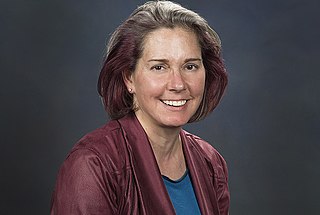
Jaqueline Kiplinger is an American inorganic chemist who specializes in organometallic actinide chemistry. Over the course of her career, she has done extensive work with fluorocarbons and actinides. She is currently a Fellow of the Materials Synthesis and Integrated Devices group in the Materials Physics and Applications Division of Los Alamos National Laboratory (LANL). Her current research interests are focused on the development of chemistry for the United States’ national defense and energy needs.

Alexander Butlerov Chemistry Institute — structural unit of Kazan Federal University, carries out research, development and academic activity in the area of basic and applied chemistry.

Water oxidation catalysis (WOC) is the acceleration (catalysis) of the conversion of water into oxygen and protons:
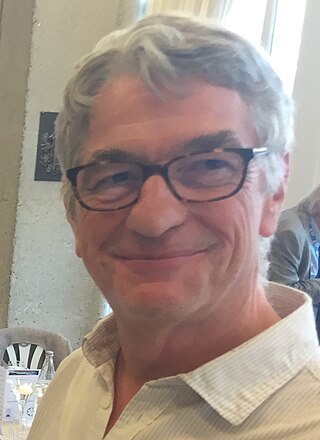
Bruno Chaudret, born on 25 December 1953, is a French chemist and director of research at the CNRS. His research is in organometallic chemistry, particularly the interactions between hydrogen and transition metals.

Transition metal thioether complexes comprise coordination complexes of thioether (R2S) ligands. The inventory is extensive.
References
- ↑ "A. B. P. Lever". yorku.ca. Retrieved February 9, 2017.
- ↑ "A. B. P. Lever". elsevier.com. Retrieved February 9, 2017.
- ↑ "Distinguished Research Professors". yorku.ca. Retrieved February 9, 2017.
- ↑ "Lever, A. B. P." worldcat.org. Retrieved February 9, 2017.
- ↑ "A. B. P." cheminst.ca. Retrieved February 9, 2017.
- ↑ Lever, A. B. P. (March 1990). "Electrochemical parametrization of metal complex redox potentials, using the ruthenium(III)/ruthenium(II) couple to generate a ligand electrochemical series". Inorganic Chemistry. 29 (6): 1271–1285. doi:10.1021/ic00331a030.
| International | |
|---|---|
| National | |
| Academics | |
| Other | |

   | This article about a Canadian scientist is a stub. You can help Wikipedia by expanding it. |