The election also saw JD Vance, a U.S. senator from Ohio, elected vice president with Trump. In addition, Republicans secured control of the Senate, flipping four seats and earning a three-seat majority, while also retaining a House majority, though the party's majority narrowed to three seats after losing two seats.[11]
The president and vice president of the United States are elected through the Electoral College, determined by the number of senators and representatives with an additional three representatives for Washington, D.C. A majority of 270 votes is needed to win the election. Forty-eight states use a winner-take-all system, in which states award all of their electors to the winner of the popular vote. In Maine and Nebraska, two votes are allocated to the winner of the popular vote, while each of the individual congressional districts have one vote. Electoral votes are certified by state electors in December and by Congress on January 6.[12] Presidential candidates are selected in a presidential primary, conducted through primary elections run by state governments or caucuses run by state parties which bind convention delegates to candidates.[13] A brokered convention occurs when a candidate does not receive a majority of votes on the first round of voting,[14] or when a candidate withdraws.[15]
Election Day in the United States is held on the first Tuesday that falls after the first Monday in November.[16] The 2028 presidential election will occur on November 7, 2028.
Eligibility
The United States Constitution limits occupancy of the presidency to individuals who are at least thirty-five, who have been a resident in the United States for at least fourteen years, and who are a natural-born citizen.[17] Section three of the Fourteenth Amendment prevents current and former federal, state, and military officials from holding office—including the presidency—if they have "engaged in insurrection or rebellion" against the United States.[18] A convicted felon may serve as president.[19] Incumbent president Trump, along with former presidents Bill Clinton, George W. Bush, and Barack Obama, are ineligible to be elected to a third term, as the Twenty-second Amendment prohibits any person from being elected president more than twice.[20]
Trump meeting Democratic congressional leaders in September 2025, with Trump 2028 hats displayed
Since beginning his second term in January 2025, Trump has floated the possibility of seeking a third term. On October 27, 2025, when asked about a third term by a reporter on Air Force One, Trump said that he would "love to do it". Trump did rule out a run for vice president, stating that it "wouldn't be right". A hypothetical third term would give Trump an additional four more years of presidency after 2028, which would last through the 2032 United States presidential election which will be held on November 2, 2032;[21][22] however, the possibility of a third term is unconstitutional under the Twenty-second Amendment, barring all former and current presidents from seeking more than two terms in office. If Trump intends to have the amendment repealed, he would have to either require approval from two-thirds of both the House of Representatives and the Senate, or he would need a constitutional convention called by two-thirds of state legislatures, a process viewed by experts as extremely unlikely.[23][24]
This map shows how partisan states are by the Cook Partisan Voting Index. Swing states are the states in lighter colors.
Most U.S. states are usually not highly competitive in presidential elections, often voting consistently for the same party due to longstanding demographic and ideological differences. In the Electoral College, this results in major-party candidates primarily focusing their campaigns on swing states, which can swing between parties from election to election. These states are critical for a presidential candidate's path to victory. For 2028, the expected swing states likely include the Rust Belt states of Pennsylvania, Wisconsin, and Michigan, and the Sun Belt states of Arizona, Georgia, Nevada, and North Carolina, all of which narrowly voted for Trump in 2024.[25][26][27] Other possible swing states include traditional Democratic strongholds that shifted toward Trump and were only narrowly won by Harris in 2024: New Jersey[28][29] and Minnesota;[30] though 2025 polls show a reversal of pro-Trump trends.[31]
States formerly considered swing states, such as Florida, Iowa, and Ohio, voted for Trump in all three of his previous election bids, as well as for Republican candidates in other state and federal elections, with increasing margins in each election and are now seen as solidly red states.[32][33][34] Former red or swing states that, since 2008, have consistently voted Democratic include Colorado, New Hampshire, New Mexico, and Virginia.[35] Due to its recent record of voting Democratic even during Republican national victories, Nebraska's 2nd congressional district has been called "the Blue Dot".[36][37]
Republican Party primaries
Candidates
Expressed interest
Individuals who have expressed an interest in running for the Republican presidential nomination[c]
Rand Paul has served as a U.S. senator from Kentucky since 2011. His father, Ron Paul, is a former U.S. representative from Texas who sought the presidency on three separate occasions; once in 1988 with the Libertarian Party and twice with the Republican Party in 2008 and 2012. Rand Paul ran for president in 2016. A Libertarian Republican, Paul has generally been a supporter of Donald Trump since the latter first became president, but he has been a frequent critic of Trump on different occasions concerning mass deportations,[38]foreign policy,[39]tariffs,[40] and Trump's attitude towards the constitution.[41]
In September 2025, Paul expressed an interest in running for president in 2028 in multiple interviews.[42][43] In December, Paul stated that he would not back Vice President JD Vance for president if he ran for 2028.[44]
Marco Rubio
Marco Rubio is the United States Secretary of State and served as a U.S. senator from Florida from 2011 to 2025. Rubio sought the Republican nomination for president of the United States in 2016, losing to Donald Trump.[45] President Trump later mentioned Rubio as a potential successor in May 2025.[46][47] According to The Wall Street Journal, Rubio has considered running with JD Vance as his vice president,[48] although it was later speculated in November that Vance and Rubio would likely run against each other.[49] Other sources report Rubio acknowledging Vance as the clear front-runner for the nomination, and that he "will do anything he can just to support the vice president in that effort."[50] According to Vanity Fair, Rubio has said that he will not enter the race if JD Vance enters.[51] According to Politico, Rubio is also speculated to be the running mate for Vance's vice president, with President Trump repeatedly naming Vance and Rubio as his two most likely successors.[50]
JD Vance
JD Vance has served as the vice president of the United States since 2025. He previously served as a U.S. senator from Ohio from 2023 to 2025. Trump mentioned Vance as a potential successor in May 2025.[46][47] In an interview with NBC News, Vance said he does not think he is "entitled" to a presidential run in 2028 and said there was no bad blood between him and fellow potential candidate Rubio.[52] According to some commentators, Vance would be the likely successor for Trump's presidency.[49][53] In an interview in November 2025, he acknowledged that he thought about running for president in 2028 and planned to speak with President Trump about it after the midterms, but said he wants to focus on winning the midterms first.[54]
Ted Cruz has served as a United States senator from Texas since 2013 after being appointed as the 3rd Solicitor General of Texas by then Texas Attorney General and fellow potential candidate Greg Abbott, he served this role from 2003 to 2008. Initially reluctant to support Trump, Cruz has become a key Republican figure and a close ally of Trump.[55] Cruz was born in Canada after his father, preacher Rafael Cruz, immigrated there from Cuba, though he is still able fulfill the natural-born citizen requirement due to his mother's American citizenship which he inherited.[56] He now serves as the chair of the Senate Commerce Committee after serving as the ranking member from 2023 to 2025. The runner-up to Donald Trump in the 2016 Republican Party presidential primaries, Cruz has said that he expects to seek the presidency again at some point. He was mentioned as a potential candidate by CNN,[45]Axios,[57][58] and The Hill.[59] In December 2025, The Washington Post reported that Cruz was considering a presidential campaign.[60]
Thomas Massie has served as the U.S. representative for Kentucky's 4th congressional district since 2012. A Republican with libertarian leanings, he is known for fiscal conservatism and often voting against party leadership. In October 2025, former Twitter CEO Jack Dorsey endorsed him for president on X, posting "@RepThomasMassie for president."[63] Massie responded positively but said he had no intention to run. Following a public clash with President Donald Trump in late 2025—particularly over demands to release Jeffrey Epstein files—online speculation surged about a potential 2028 presidential ticket with Marjorie Taylor Greene, dubbed "Massie-Greene 2028" by supporters.[64] Massie has not declared any presidential candidacy and remains in Congress, where he faces a Trump-backed primary challenge in his 2026 reelection bid amid ongoing tensions, including his push for Epstein file releases.[65]
Declined to be candidates
The following individuals have publicly denied interest in being a candidate:
NBC News has reported that multiple DNC members are looking into changing the order of state primaries for the Democratic nomination. Chair of the Nebraska Democratic PartyJane Kleeb stated in November 2024 that "The 2024 calendar will absolutely not be the calendar for 2028."[85] The DNC chose South Carolina to be the first primary in 2024.[86] In December 2024, Ray Buckley, chairman of the New Hampshire Democratic Party, announced his intention to work towards restoring New Hampshire's status as the first-in-the-nation Democratic presidential primary for the 2028 presidential nominating calendar.[87] Democrats in Nevada have started a bid to hold the first-in-the-nation primary in 2028.[88]
In 2023, the Democratic National Committee voted to strip Iowa of its first-in-the-nation presidential caucuses.[89] In November 2024, after the presidential election, Scott Brennan, the only Iowan on the DNC Rules and Bylaws Committee at the time, said he still plans to fight for the return of the first-in-the-nation presidential caucus spot back to Iowa.[90] In June 2025, Iowa's only seat on the DNC's Rules and Bylaws Committee, which determines the order of states in the presidential nominating process, was removed, and New Hampshire was awarded a second seat on the committee.[91]
Ken Martin, the chair of the Democratic National Committee, said in an August 2025 NewsNation interview that the Rules and Bylaws Committee would discuss the 2028 primary calendar in a Minneapolis meeting later in the month.[92]
Martin and other party officials, including Representative Jamie Raskin of Maryland, have discussed the possibility of using ranked-choice voting in the 2028 Democratic presidential primaries. Supporters argue that the system could reduce "wasted votes" and that it would encourage more positive campaigning.[93] Sources such asAlaska Beacon indicated that with plurality voting, which is how most states currently conduct primaries, it is possible to win an election without majority support and that the ranked-choice voting alternative performed much better.[94] After Zohran Mamdani won the 2025 New York City Democratic mayoral primary, progressive voters have proposed that ranked-choice voting could be implemented.[95]
Candidates
Expressed interest
Individuals who have expressed an interest in running for the Democratic presidential nomination[e]
Andy Beshear has served as the governor of Kentucky since 2019. He was previously on the shortlist to be the vice presidential nominee for the 2024 election.[96] In a May 2025 interview with WDRB, Beshear said he "would consider" running for president in 2028.[97] He also mentioned running for president in a July interview with Vanity Fair,[98] in an October interview with NPR,[99] and during a visit to early primary state New Hampshire later that month.[100][101] In a January 2026 profile in Politico, Beshear posited that his status as "a guy who has won three straight statewide elections in a Trump plus-30 state," made him the most electable candidate for Democrats.[102] While announcing his new book in February 2026, Beshear hinted at the possibility of running for president in 2028.[103][104]
Cory Booker
Cory Booker has served as a U.S. senator from New Jersey since 2013 and ran for the Democratic presidential nomination in 2020. He previously served as mayor of Newark, New Jersey from 2006 to 2013. On April 1, 2025, Booker broke the record for the longest Senate floor speech in protest against Donald Trump and Elon Musk, which GOP pollster Frank Luntz remarked positioned him as a party leader in the coming future.[105] He has been considered a presidential candidate by The Birmingham News.[106] In November 2025, during a visit to New Hampshire, Booker told Fox News, "Of course I'm thinking about it, I haven't ruled it out." with respect to a 2028 campaign, while saying he was focused on his re-election campaign in 2026.[107][108]
Pete Buttigieg
Pete Buttigieg served as the United States Secretary of Transportation from 2021 to 2025. Prior to becoming Secretary of Transportation, he served as mayor of South Bend, Indiana, from 2012 to 2020. Buttigieg was thrust into the national spotlight with his 2020 presidential campaign, where he narrowly won the Iowa caucus and finished a close second in the New Hampshire primary, but ultimately dropped out after a poor performance in South Carolina.[109] Buttigieg was also a contender to be Vice President Kamala Harris' running mate after she secured the Democratic nomination for president. If nominated, Buttigieg would be the first openly LGBT individual to receive the nomination of a major party in the United States.[110]
It was later reported that Buttigieg was leading polls in New Hampshire in October 2025.[111][112]
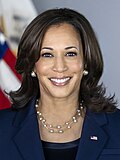
Kamala Harris served as the first female vice president of the United States from 2021 to 2025. She became the party's nominee for president in the 2024 presidential election after President Joe Biden withdrew from the race, losing to Trump.[121] Following the 2024 presidential election, Harris considered running for governor of California in 2026, but in July 2025 she opted not to.[122][123] In a Chicago stop of her 107 Days book tour, Harris expressed uncertainty about running again.[124] She later spoke with Laura Kuenssberg in an October 2025 interview on BBC News about potentially running for president again, stating "I am not done".[125] In February 2026, polls suggested that Harris would win the election in a rematch with President Donald Trump.[126][127] She remarked in a podcast interview with Sharon McMahon that same month that she had not decided on running again for president in 2028.[128]
Mark Kelly
Mark Kelly has served as a U.S. senator from Arizona since 2020. He was previously on the shortlist to be the vice presidential nominee for the 2024 election, and was seen as a potential replacement for President Joe Biden before he withdrew from the race.[129] He has been noted as a potential candidate by Axios[130] and Politico.[131] During a January 2026 interview with Aaron Parnas, Kelly confirmed he was considering a run for president.[132] He reiterated that he was considering a presidential run in an interview with CNN several weeks later,[133] and again in a BBC interview in February.[134]
Gavin Newsom
Gavin Newsom has served as the governor of California since 2019. Newsom has been viewed as a contender for the 2028 presidential election by The New York Times[135] and he was seen as a potential replacement for Biden after his withdrawal from the 2024 election by The New York Times.[136] According to The New York Times, Newsom was considering a bid for the presidency by September 2023.[137] After Newsom's response to the June 2025 Los Angeles protests, it was reported that his chances of being the 2028 Democratic nominee increased significantly.[138][139] Newsom's chances reportedly rose further in August 2025, attributed to the Election Rigging Response Act and him mocking President Donald Trump on social media.[140][141][142] In October 2025, in an interview with CBS News Sunday Morning, Newsom stated that after the 2026 midterm elections, he would give "serious thought" to it, adding, "Yeah, I'd be lying otherwise."[143] When asked about running for president in February 2026, he stated "It's wildly premature."[144]
John Fetterman has served as a U.S. senator from Pennsylvania since 2023, and previously served as Lieutenant Governor of Pennsylvania from 2019 to 2023. Fetterman has frequently been considered one of the Senate Democratic Caucus's most centrist members, most notably for crossing party lines to confirm some of Trump's Cabinet appointees, his consistent support for the state of Israel, and his decision to vote with Senate Republicans to end the shutdown fight. Fetterman has been reported to be "leaving all doors open" for 2028, including a run for re-election to the Senate as well as a presidential bid.[145] When asked about a presidential run, he replied "it's 2025."[146]
Phil Murphy
Phil Murphy served as the governor of New Jersey from 2018 to 2026. He previously served as U.S. ambassador to Germany from 2009 to 2013 under President Barack Obama. In December 2025, Murphy confirmed that while he hadn't ruled out running for president in 2028, he claimed "I wouldn't put a lot of money on that."[147][148]
Alexandria Ocasio-Cortez
Alexandria Ocasio-Cortez has served as the representative of New York's 14th congressional district since 2019. Politico noted that Ocasio-Cortez "has a prominent following from younger, diverse people".[149]Axios noted in April 2025 that Ocasio-Cortez has been "surging in early polling of potential 2028 presidential candidates".[150] Despite this lead, it was later noted that the odds of other candidates such as Gavin Newsom were starting to widen.[142]Vanity Fair has reported that Ocasio-Cortez is reluctant to launch a presidential campaign and also noted that some have called for her to primary Chuck Schumer in the 2028 New York Senate elections.[151] In September 2025, Axios reported that Ocasio-Cortez was positioning to run for president or Senate in 2028.[152]The Hill conducted a poll on December 8, 2025, where Alexandria Ocasio-Cortez led among young voters.[153] According to other polls by The Guardian, Ocasio-Cortez is one of the top contenders beside Harris and Newsom.[154] In December, Ocasio-Cortez responded to a poll that showed she led Vance by tweeting "Bloop!"[155] She has drawn contrasts between herself and Vance on various issues as of January 2026.[156] In 2026, Ocasio-Cortez attended the Munich Security Conference, increased her visibility.[157]
Jon Ossoff
Jon Ossoff has served as a U.S. senator from Georgia since 2021. Following speeches in February 2026 where Ossoff characterized wealthy members of Donald Trump's cabinet as "the Epstein class" and characterized Trump as a "spiritually broken president," he became subject to speculation that if successfully reelected in 2026, he could be a presidential candidate in 2028.[158][159][160]
JB Pritzker
JB Pritzker has served as the governor of Illinois since 2019. Pritzker is one of the wealthiest elected officials in America, with an estimated net worth of $3.7 billion,[161] and has largely bankrolled his own gubernatorial campaigns, as well as national abortion-rights initiatives.[162][163] Pritzker was considered a potential running mate to Kamala Harris in the 2024 presidential election.[164] Pritzker is a potential Democratic contender, according to Capitol News Illinois,[165]The New York Times,[166] and The Hill,[167] and has declined to rule out a run.[168][169] In 2023, Pritzker declined to speak directly with RepresentativeDean Phillips regarding his effort to try to convince him to enter the Democratic Party presidential primary race to oppose Biden.[170][171] Pritzker is also seeking a third term as governor of Illinois in 2026.[172]
Josh Shapiro
Josh Shapiro has served as the governor of Pennsylvania since 2023. Being elected in 2022 by 15 points in a state won by Donald Trump twice, and with him being relatively popular in his home state.[173] Following the announcement of his autobiography and book tour, he has been viewed as a potential Democratic presidential candidate by The Washington Post[174] and The Philadelphia Inquirer.[175]
Jon Stewart
Jon Stewart is an activist, comedian, and commentator. Stewart had been the subject of speculation for years as a potential presidential candidate, including in a Politico opinion piece by Juleanna Glover where Stewart was described as a potentially formidable anti-establishment outsider 2024 Democratic candidate in the event that Biden did not run.[176] Since then, Stewart has been mentioned as a potential 2028 Democratic candidate by USA Today,[177] the Washington Examiner,[178] and Zeteo in late 2025.[179] In a late July 2025 interview with journalist and commentator Mehdi Hasan, Stewart stated that "the Democratic Party is ripe for a takeover... they just need to find the right reality host," and was pressed by Hasan on a potential 2028 Democratic presidential run, to which Hasan recalled that Stewart "didn't deny that was what he was suggesting."[180]Race to the White House includes Stewart at 2% in its national presidential polling average for the Democratic primaries as of February 2026.[181]
Gretchen Whitmer
Gretchen Whitmer has served as the governor of Michigan since 2019. Whitmer has been considered a potential presidential candidate by multiple media sources.[182][183][184] Whitmer has cast doubt on a 2028 presidential bid, but said she would not close the door on it.[182][185]
Declined to be candidates
The following individuals have publicly denied interest in being a candidate:
Joe Manchin served as a U.S. senator from West Virginia from 2010 to 2025, and previously served as the governor of West Virginia from 2005 to 2010. He considered a third-party run in the 2024 presidential election with the centrist political organization No Labels but ultimately decided against it.[206] In September 2025, in an interview with The New York Times, Manchin acknowledged that he is considering running as a third-party candidate in 2028, saying his objective is "for the middle to compete".[207][208]
Andrew Yang
Andrew Yang is a businessman and political activist who sought the Democratic presidential nomination in 2020.[209] He later founded the Forward Party.[210] In early 2026, excerpts from his forthcoming book reported by The Independent and The Times quoted Yang as saying that “the odds of my running again are high,” signaling potential interest in a 2028 presidential bid, likely under the Forward Party banner.[211][212]
Declined to be candidates
The following individuals have publicly denied interest in being a candidate:
↑Individuals listed below have, as of January2026[update], personally expressed an interest in seeking the 2028 Republican Party presidential nomination in at least two reliable media sources in the last six months.
12Individuals listed below have, as of January2026[update], been mentioned as potential 2028 presidential candidates in at least two reliable media sources in the last six months.
↑Individuals listed below have, as of January2026[update], personally expressed an interest in seeking the 2028 Democratic Party presidential nomination in at least two reliable media sources in the last six months.
↑Sanders is an independent, but he caucuses with the Democratic Party.
↑Smith is a registered independent, but he has been polled amongst potential Democratic candidates and had expressed interest in running for president as a Democrat.[197]
↑Individuals listed below have, as of January2026[update], personally expressed an interest in running for president in 2028 in at least two reliable media sources in the last six months.
↑Sinema was a registered Democrat until 2022, at which point she changed her registration to independent, and continued to caucus with the Senate Democrats.
↑Greg Abbott 2%, Rick Scott 2%, S. Huckabee Sanders 2%, Glenn Youngkin 1%, Tulsi Gabbard 1%, Kristi Noem 1%, Tim Scott 1%, Tom Cotton 1%, Elise Stefanik *, Larry Hogan*
↑Tulsi Gabbard 1%, Sarah Huckabee Sanders 1%, Glenn Youngkin 1%, Josh Hawley 1%, Doug Burgum *%, Kristi Noem *%, Tim Scott *%, Steve Bannon *%, Someone else 2%
↑Tom Cotton 2%, S. Huckabee Sanders 2%, Tim Scott 2%, Glenn Youngkin 1%, Tulsi Gabbard 1%, Kristi Noem 1%, Greg Abbott 1%, Rick Scott 0%, Elise Stefanik *, Larry Hogan*
↑Tulsi Gabbard 1%, Tim Scott 1%, Sarah Huckabee Sanders 1%, Steve Bannon 1%, Kristi Noem *%, Josh Hawley *%, Someone else 2%
↑Tim Scott 2%, Elise Stefanik 1%, Kristi Noem 1%, Glenn Youngkin 1%, Scott Bessent 1%, Steve Bannon 1%, None of the mentioned 6%
↑Sarah Huckabee Sanders 6%, Glenn Youngkin 4%, Tim Scott 2%, Brian Kemp 2%, Rand Paul 1%, Another candidate 4%
↑Tulsi Gabbard 2%, S. Huckabee Sanders 2%, Tim Scott 1%, Kristi Noem 1%, Tom Cotton 1%, Rick Scott 0%, Greg Abbott 0%, Glenn Youngkin 0%, Elise Stefanik *, Larry Hogan*
↑Tulsi Gabbard 4%, Glenn Youngkin 2%, Sarah Huckabee Sanders 2%, Tim Scott 1%, Steve Bannon *%, Kristi Noem *%, Doug Burgum *%, Someone else 1%
↑None of the above 7.7%, Tim Scott 1.6%, Brian Kemp 0.3%, Tom Cotton 0.3%, Kristi Noem 0.1%
↑Mike Pence 2%, Tulsi Gabbard 1%, Tim Scott 1%, Someone else 2%
↑Sarah Huckabee Sanders 4%, Tim Scott 4%, Rand Paul 2%, Brian Kemp 2%, Glenn Youngkin 1%, Another candidate 6%
↑S. Huckabee Sanders 2%, Tulsi Gabbard 2%, Glenn Youngkin 2%, Greg Abbott 2%, Tim Scott 1%, Kristi Noem 1%, Tom Cotton 1%, Rick Scott 1%, Elise Stefanik 0%, Larry Hogan *
↑Sarah Huckabee Sanders 2%, Tulsi Gabbard 2%, Josh Hawley 1%, Kristi Noem 1%, Steve Bannon *%, Glenn Youngkin *%, Tim Scott *%, Doug Burgum *%, Someone else 3%
↑None of the above 7.6%, Tim Scott 2.6%, Kristi Noem 1.4%, Greg Abbott 0.9%, Brian Kemp 0.2%, Tom Cotton 0.2%
↑Sarah Huckabee Sanders 3%, Tim Scott 1%, Tulsi Gabbard 1%, Glenn Youngkin 1%, Steve Bannon 1%, Josh Hawley *%, Kristi Noem *%, Doug Burgum -, Someone else 1%
↑Glenn Youngkin 2%, S. Huckabee Sanders 1%, Tim Scott 1%, Greg Abbott 1%, Rick Scott 1%, Tom Cotton 1%, Elise Stefanik 1%, Tulsi Gabbard 1%, Kristi Noem 0%, Larry Hogan*
↑Kristi Noem 2%, Tulsi Gabbard 1%, Glenn Youngkin 1%, Brian Kemp <0.5%, Scott Bessent <0.5%, Someone else 4%
↑Greg Abbott 2%, Tulsi Gabbard 2%, Kristi Noem 1%, Glenn Youngkin 1%, S. Huckabee Sanders 1%, Tim Scott 1%, Tom Cotton 1%, Rick Scott 1%, Elise Stefanik 0%, Larry Hogan *
↑Tim Scott 2.2%, Glenn Youngkin 1.1%, Tom Cotton 0.9%, Greg Abbott 0.8%, Brian Kemp 0.7%, Kristi Noem 0.5%, None of the listed 15.6%
↑Tulsi Gabbard 2%, Rick Scott 1%, Kristi Noem 1%, S. Huckabee Sanders 1%, Tim Scott 1%, Greg Abbott 1%, Elise Stefanik 1%, Glenn Youngkin 1%
↑Tim Scott 2%, Kristi Noem 2%, Glenn Youngkin 1%, Elise Stefanik 1%, Steve Bannon 1%, Scott Bessent 0%, None of the mentioned 3%
↑3% for Glenn Youngkin; 1% for Tulsi Gabbard, Sarah Huckabee Sanders, and Tim Scott; <1% for Steve Bannon, Doug Burgum, Josh Hawley, and Kristi Noem; 1% for "Someone else"
↑2% Sarah Huckabee Sanders, 2% Kristi Noem, 1% Tulsi Gabbard, 1% Glenn Youngkin, 1% Rick Scott, 1% Elise Stefanik, 1% Greg Abbott, 1% Tim Scott
123Polling was conducted under the hypothetical pretext of an amendment to the US constitution removing or changing the presidential two term limit, which had been hinted at by some GOP MAGA politicians as well an idea that has also been promoted by President Trump.[218]
↑Josh Hawley 1%, Sarah Huckabee Sanders 1%, Kristi Noem 1%, Tulsi Gabbard 1%, Tim Scott 1%, someone else 2%
↑2% for Tulsi Gabbard; 1% for Steve Bannon, Josh Hawley, Brian Kemp, Tim Scott, and Glenn Youngkin; 3% for "Other"
↑4% for Tulsi Gabbard, 2% for Josh Hawley, Brian Kemp, and Tim Scott; 1% for Steve Bannon and Marjorie Taylor Greene; <0.5% for Glenn Youngkin; 5% for "Other"
↑Kristi Noem 2%, Sarah Huckabee Sanders 1%, Glenn Youngkin 1%, Josh Hawley 1%, Tim Scott 1%
↑Tulsi Gabbard and Kristi Noem with 2%; Greg Abbott, Tom Cotton, Larry Hogan, Sarah Huckabee Sanders, Rick Scott, and Tim Scott with 1%; Elise Stefanik and Glenn Youngkin with 0%
↑Kristi Noem and Sarah Huckabee Sanders with 2%; Doug Burgum, Josh Hawley, Tim Scott, and Glenn Youngkin with 1%; Katie Britt and Elise Stefanik with <1%; "Someone else" with 2%
↑Tulsi Gabbard with 3%; Gregg Abbott & Glenn Youngkin with 2%; Larry Hogan, Kristi Noem, Sarah Huckabee Sanders & Tim Scott with 1%
↑Tim Scott with 3%; Tulsi Gabbard, Sarah Huckabee Sanders & Glenn Youngkin with 2%; Greg Abbott, Tom Cotton, Kristi Noem & Rick Scott with 1%; Larry Hogan & Elise Stefanik with <1%
↑Greg Abbott, Tucker Carlson, Brian Kemp, Sarah Huckabee Sanders, and Glenn Youngkin with 1%; Someone else with 5%; Would not vote with 4%
↑Tulsi Gabbard and Candace Owens with 1%; Elon Musk, and Glenn Youngkin with <1%; Someone else with 5%
↑Musk is not eligible to serve as president as he is not a natural-born citizen
↑Sarah Huckabee Sanders with 2%; Josh Hawley, Tim Scott, Glenn Youngkin, and Kristi Noem with 1%; Katie Britt, Doug Burgum, and Elise Stefanik with 0%; Someone else with 3%
↑Sarah Huckabee Sanders with 3%; Josh Hawley, and Tim Scott with 2%; Katie Britt, Byron Donalds, and Glenn Youngkin with 1%
↑Tucker Carlson with 6%; Greg Abbott with 3%; Kari Lake and Glenn Youngkin with 2%; Tom Cotton, Byron Donalds, Josh Hawley, Brian Kemp, and Elise Stefanik with 1%; Katie Britt with 0%
↑Mark Kelly 4%, Andy Beshear 2%, Gretchen Whitmer 2%, Chris Murphy 1%, Jon Ossoff 1%, John Fetterman 1%, Raphael Warnock 1%, Wes Moore 1%, Jared Polis 1%, Stephen A. Smith 1%, Rahm Emanuel *%, Ro Khanna *%, Someone else *%
↑Someone else 7%, Mark Kelly 7%, Elizabeth Warren 4%, Andy Beshear 3%, Gretchen Whitmer 2%, Amy Klobuchar 1%, Phil Murphy 1%, Rahm Emanuel 0%
↑Mark Kelly 4%, Someone else 2%, Jon Stewart 2%, Andy Beshear 2%, Gretchen Whitmer 2%, Mark Cuban 1%, Wes Moore 1%, Jon Ossoff 1%, Ro Khanna 1%, Chris Murphy 1%, Ruben Gallego 0%, Stephen A. Smith 0%, Rahm Emanuel 0%
↑Jasmine Crockett 4%, Gretchen Whitmer 2%, Roy Cooper 2%, JB Pritzker 2%, Amy Klobuchar 1%, Wes Moore 1%, Jared Polis 1%, Stephen A. Smith 1%, Phil Murphy 1%, Rahm Emanuel 1%, Deval Patrick *%, Beto O'Rourke *%
↑Mark Kelly 4%, Gretchen Whitmer 3%, Raphael Warnock 2%, Andy Beshear 2%, Someone else 1%, Wes Moore 1%, Rahm Emanuel *%, Chris Murphy *%, Ro Khanna *%, Ruben Gallego *%, John Fetterman *%
↑Someone else 4.1%, Gretchen Whitmer 3.1%, Andy Beshear 2.5%
↑Bernie Sanders 7%, Mark Kelly 7%, Elizabeth Warren 3%, Andy Beshear 2%, Someone else 1%, Gretchen Whitmer 0%, Amy Klobuchar 0%
↑Mark Kelly 4%, Andy Beshear 2%, Wes Moore 2%, Gretchen Whitmer 2%, Jon Ossoff 1%, Amy Klobuchar 1%, Ro Khanna 1%
↑Andy Beshear 5.8%, Gretchen Whitmer 1.8%, Ro Khanna 1.8%, "None of the above" 1.5%, Rahm Emanuel 1.1%, Wes Moore 1.1%, Raphael Warnock 0.2%, Stephen A. Smith 0%
↑Jasmine Crockett 2%, Gretchen Whitmer 2%, Roy Cooper 2%, Amy Klobuchar 1%, Wes Moore 1%, Jared Polis 1%, Stephen A. Smith 1%, Phil Murphy 0%, Rahm Emanuel 0%, Deval Patrick *%, Beto O'Rourke *%
↑Andy Beshear 3%, Mark Kelly 2%, Gretchen Whitmer 2%, Rahm Emanuel 1%, Chris Murphy 1%, Raphael Warnock 1%, Jared Polis *%, Wes Moore *%, John Fetterman *%, Ro Khanna *%, Ruben Gallego 0%, Someone else 1%
↑Jasmine Crockett 5%, Stephen A. Smith 2%, Gretchen Whitmer 2%, Roy Cooper 1%, Wes Moore 1%, Rahm Emanuel 1%, Amy Klobuchar 0%, Phil Murphy 0%, Jared Polis 0%, Deval Patrick*, Beto O'Rourke*
↑Mark Cuban 3%, Andy Beshear 2%, Jasmine Crockett 2%, Jon Stewart 2%, Gretchen Whitmer 1%, Raphael Warnock 1%, Chris Murphy 1%, John Fetterman 1%, Jared Polis 1%, Ruben Gallego *%, Rahm Emanuel *%, Stephen A. Smith *%, Someone else *%
↑Gretchen Whitmer 4%, Wes Moore 3%, Stephen A. Smith 1%
↑Jasmine Crockett 3%, Stephen A. Smith 3%, Amy Klobuchar 2%, Gretchen Whitmer 1%, Wes Moore 1%, Roy Cooper 1%, Phil Murphy 1%, Rahm Emanuel 1%, Jared Polis 0%, Deval Patrick*, Beto O'Rourke*
↑Jasmine Crockett 3%, Jon Stewart 2%, Gretchen Whitmer 2%, Andy Beshear 2%, Raphael Warnock 1%, Mark Cuban 1%, Stephen A. Smith 1%, John Fetterman 1%, Wes Moore 1%, Rahm Emanuel *%, Ruben Gallego *%, Jared Polis *%, Someone else *%
↑Gretchen Whitmer 3%, Someone else 2%, Wes Moore 1%
↑Jasmine Crockett 5%, Amy Klobuchar 2%, Gretchen Whitmer 1%, Roy Cooper 1%, Wes Moore 1%, Jared Polis 1%, Stephen A. Smith 1%, Phil Murphy 1%, Rahm Emanuel 0%, Deval Patrick*, Beto O'Rourke*
↑Jasmine Crockett 3%, Mark Cuban 3%, Gretchen Whitmer 2%, Jon Stewart 2%, John Fetterman 1%, Andy Beshear 1%, Chris Murphy 1%, Rahm Emanuel 1%, Raphael Warnock 1%, Ro Khanna 1%, Someone else 1%, Wes Moore *%, Stephen A. Smith *%, Jared Polis *%
↑Andy Beshear 2.7%, Raphael Warnock 0.6%, Wes Moore 0.6%, Gretchen Whitmer 0.3%, Stephen A. Smith 0.2%, None of the above 6%
↑Bernie Sanders 5%, Elizabeth Warren 3%, Mark Kelly 2%, Gretchen Whitmer 2%, Amy Klobuchar 1%, Someone else 4%
↑Jasmine Crockett 3%, Gretchen Whitmer 2%, Roy Cooper 1%, Wes Moore 1%, Phill Murphy 1%, Amy Klobuchar 1%, Jared Polis 1%, Stephen A. Smith 1%, Rahm Emanuel 1%, Deval Patrick *, Beto O'Rourke *
↑Andy Beshear 2%, Gretchen Whitmer 2%, Wes Moore 1%
↑Jasmine Crockett 3%, Gretchen Whitmer 3%, Mark Cuban 2%, Andy Beshear 2%, Wes Moore 1%, Jon Stewart 1%, Stephen A. Smith 1%, Ruben Gallego *%, Chris Murphy *%, Raphael Warnock *%, Jared Polis *%, John Fetterman -, Rahm Emanuel -, Someone else 1%
↑Mamdani is not eligible to serve as president as he is not a natural-born citizen.
↑Zohran Mamdani 4%,[ef] None of the above 2.3%, Gretchen Whitmer 1.4%, Raphael Warnock 0.5%, Rahm Emanuel 0.3%
↑Mark Cuban 3%, Gretchen Whitmer 3%, Andy Beshear 2%, Chris Murphy 2%, John Fetterman 2%, Wes Moore 1%, Jasmine Crockett 1%, Jon Stewart 1%, Stephen A. Smith 1%, Raphael Warnock 1%, Rahm Emanuel *%, Jared Polis *%, Ruben Gallego *%, Someone else 2%
↑Mark Cuban 4%, Gretchen Whitmer 3%, John Fetterman 2%, Wes Moore 2%, Andy Beshear 2%, Jasmine Crockett 2%, Chris Murphy 2%, Jon Stewart 2%, Raphael Warnock 1%, Stephen A. Smith 1%, Rahm Emanuel 1%, Jared Polis *%, Ruben Gallego *%, Someone else 3%
↑Gretchen Whitmer 4%, Amy Klobuchar 3%, Roy Cooper 2%, Stephen A. Smith 2%, Jasmine Crockett 2%, Wes Moore 1%, Phil Murphy 1%, Rahm Emanuel 1%, Jared Polis 1%, Deval Patrick*, Beto O'Rourke*
↑Gretchen Whitmer 3%, Jasmine Crockett 2%, Rahm Emanuel 2%, Amy Klobuchar 2%, Roy Cooper 1%, Wes Moore 1%, Stephen A. Smith 1%, Phil Murphy 1%, Jared Polis 0%, Deval Patrick *, Beto O'Rourke *
↑Mark Cuban 4%, Gretchen Whitmer 2%, Amy Klobuchar 2%, Andy Beshear 1%, Jared Polis 1%, Ruben Gallego 1%, John Fetterman 1%, Jon Ossoff 0%, Raphael Warnock 0%, Chris Murphy 0%, Wes Moore 0%
↑Gretchen Whitmer 3.7%, Raphael Warnock 1.4%, Chris Murphy 0.4%, Ro Khanna 0.3%, Stephen A. Smith 0.3%, Andy Beshear 0.2%, Rahm Emanuel 0.2%, None of the candidates listed 3.6%
↑Gretchen Whitmer 3%, Amy Klobuchar 3%, Jasmine Crockett 2%, Stephen A. Smith 1%, Roy Cooper 1%, Jared Polis 1%, Phil Murphy 1%
↑Jasmine Crockett at 3%; Mark Cuban and Gretchen Whitmer at 2%; Andy Beshear, John Fetterman, Wes Moore, Chris Murphy, Jared Polis, Jon Stewart and Raphael Warnock at 1%; Ruben Gallego and Stephen A. Smith at <1%; "Someone else" at 1%
↑2% Jasmine Crockett, 2% Roy Cooper, 2% Amy Klobuchar, 1% Gretchen Whitmer, 1% Phil Murphy, 1% Wes Moore, 1% Stephen A. Smith
↑Elizabeth Warren 4%, Wes Moore 1%, Gretchen Whitmer 1%, Andy Beshear 1%, Rahm Emanuel 1%, Mark Kelly 1%, Someone else 2%
↑9% for Gretchen Whitmer; 2% for Andy Beshear, Raphael Warnock, and Chris Murphy
↑Gretchen Whitmer; 3% for Amy Klobuchar and Jon Stewart; 2% for Andy Beshear and Mark Cuban; 1% for Chris Murphy
↑4% for Gretchen Whitmer; 2% for Andy Beshear, Mark Cuban, Amy Klobuchar, and Jon Stewart; 1% for Chris Murphy and Wes Moore; <0.5% for Jasmine Crockett, Shawn Fain, Stephen A. Smith, and Raphael Warnock
↑Jasmine Crockett 3%, Jon Stewart 3%, and Gretchen Whitmer 3%, Wes Moore 2%, Andy Beshear 1%, Stephen A. Smith 1%, Jared Polis 1%, John Fetterman 1%, Raphael Warnock 1%, Chris Murphy 1%, Someone Else 2%
↑4% for Mark Kelly; 3% for Andy Beshear, Mark Cuban and Gretchen Whitmer; 1% for Roy Cooper, John Fetterman, Ruben Gallego, Wes Moore, and Stephen A. Smith; <0.5% for Jared Polis, 6% for "Other"
↑Bernie Sanders 8%, Mark Kelly 4%, Elizabeth Warren 2%, Gretchen Whitmer 2%, someone else 3%
↑Mark Cuban 4%, Gretchen Whitmer 2%, Andy Beshear 2%, Amy Klobuchar 2%, Chris Murphy 1%, Jared Polis 1%, John Fetterman 1%, Wes Moore 1%, Rahm Emanuel 1%, Raphael Warnock 1%, Ruben Gallego <1%, Someone else 2%
↑Jasmine Crockett 3%, Mark Cuban 3%, Gretchen Whitmer 2%, Andy Beshear 2%, Jared Polis 1%, John Fetterman 1%, Raphael Warnock 1%, Chris Murphy 1%, Jon Stewart 1%, Stephen A Smith <1%, Wes Moore <1%
↑Someone else with 11%; Mark Cuban with 7%; Gretchen Whitmer with 4%; Andy Beshear with 3%; Wes Moore with 2%; Phil Murphy with 1%
↑Gretchen Whitmer with 4%; Amy Klobuchar with 3%; Roy Cooper, Beto O'Rourke with 2%; Wes Moore, Phil Murphy, Deval Patrick, and Stephen A. Smith with 1%; Jared Polis with 0%
↑Gretchen Whitmer with 4%; Mark Cuban with 3%; Jasmine Crockett, John Fetterman and Raphael Warnock with 2%; Andy Beshear, Ruben Gallego, and Jared Polis with 1%; Wes Moore and Stephen A. Smith with <1%; "Someone else" with 1%
↑Amy Klobuchar & Gretchen Whitmer with 3%; Wes Moore, & Stephen A. Smith with 2%; Phil Murphy, Jared Polis & Beto O'Rourke with 1%, Deval Patrick with <1%
↑Gretchen Whitmer & Beto O'Rourke with 3%; Amy Klobuchar, Wes Moore, Phil Murphy & Deval Patrick with 1%; Jared Polis with <1%
↑Gretchen Whitmer with 3%; Michelle Obama and Bernie Sanders with 2%; Hakeem Jeffries, Wes Moore, Jon Stewart, and Rashida Tlaib with 1%; Andy Beshear and Mark Kelly with <1%; Someone else with 4%
↑Gretchen Whitmer with 3%; Andy Beshear with 2%; Jared Polis and Wes Moore with 1%; Someone else with 1%
↑Gretchen Whitmer with 3%; Amy Klobuchar, Elizabeth Warren, and Andy Beshear with 2%; Wes Moore and John Fetterman with 1%; "Someone else" with 3%; "Would not vote" with 6%
↑Mark Kelly and Gretchen Whitmer with 4%; "Someone else" with 7%
↑Gretchen Whitmer with 3%; John Fetterman, and Raphael Warnock with 2%; Andy Beshear and Wes Moore with 1%
↑Tim Walz 4%, Ro Khanna 3%, Andy Beshear 3%, Mark Kelly 2%, JB Pritzker 1%, Ruben Gallego 1%, Gina Raimondo 1%, Chris Murphy 1%, Wes Moore 1%, Rahm Emanuel 1%, Raphael Warnock 1%, Jared Polis 1%, Other 2%
↑Hasan, Mehdi (August 12, 2025). "Should Jon Stewart Run for President in 2028?". Zeteo. Retrieved January 5, 2026. Stewart and I discussed corporate media, the Gaza genocide, and Donald Trump, and Stewart wondered aloud whether 'the Democratic Party is ripe for a takeover' and 'they just need to find the right reality host.' My response? 'Please, please, no reality hosts, I beg of you. Unless Jon, you're thinking of throwing your hat in the ring, which I know many people want.. If that's what you're suggesting, we can talk about that.' Stewart laughed. He didn't deny that was what he was suggesting. He didn't rule out throwing his 'hat in the ring.' He didn't recite some version of: 'Don't be crazy, Mehdi, I have no intention of doing that.' There was a glint in his eye as he simply leaned his head back and… chuckled.
↑Kelly, Erin. "Kentucky Gov. Andy Beshear making stops in South Carolina". Spectrum News. Retrieved February 18, 2026. On the podcast Beshear started this year, he got an early endorsement from former University of Louisville quarterback and current New Orleans Saint Tyler Shough, during a conversation with recurring guest Jon Rabinowitz.
This page is based on this Wikipedia article Text is available under the CC BY-SA 4.0 license; additional terms may apply. Images, videos and audio are available under their respective licenses.


 (will not run if Vance runs)


 2028 U.S. presidential election