| ||||||||||||||||||||||||||||||||||||||||||||
12 April 2026 | ||||||||||||||||||||||||||||||||||||||||||||
All 199 seats in the National Assembly 100 seats needed for a majority | ||||||||||||||||||||||||||||||||||||||||||||
|---|---|---|---|---|---|---|---|---|---|---|---|---|---|---|---|---|---|---|---|---|---|---|---|---|---|---|---|---|---|---|---|---|---|---|---|---|---|---|---|---|---|---|---|---|
| Opinion polls | ||||||||||||||||||||||||||||||||||||||||||||
| ||||||||||||||||||||||||||||||||||||||||||||
 | ||||||||||||||||||||||||||||||||||||||||||||


Parliamentary elections are to be held in Hungary on 12 April 2026. [1] This parliamentary election will be the 10th since 1990.
| ||||||||||||||||||||||||||||||||||||||||||||
12 April 2026 | ||||||||||||||||||||||||||||||||||||||||||||
All 199 seats in the National Assembly 100 seats needed for a majority | ||||||||||||||||||||||||||||||||||||||||||||
|---|---|---|---|---|---|---|---|---|---|---|---|---|---|---|---|---|---|---|---|---|---|---|---|---|---|---|---|---|---|---|---|---|---|---|---|---|---|---|---|---|---|---|---|---|
| Opinion polls | ||||||||||||||||||||||||||||||||||||||||||||
| ||||||||||||||||||||||||||||||||||||||||||||
| | ||||||||||||||||||||||||||||||||||||||||||||
| ||||||||||||||||||||||||||||||||||||||||||||
Parliamentary elections are to be held in Hungary on 12 April 2026. [1] This parliamentary election will be the 10th since 1990.
On 3 April 2022, with 54.13% of the popular vote, Fidesz–KDNP received the highest vote share by any party or alliance since 1990. It won two-thirds of the seats for the fourth time. The United for Hungary alliance suffered a massive defeat and was shortly after dissolved; its members sat in separate political groups in the National Assembly. From other minor parties, only Our Homeland Movement reached the threshold for entry; the satirical Hungarian Two-Tailed Dog Party did not. [2] Following the election, only the Democratic Coalition managed to achieve sustained double-digit poll results alongside Fidesz, but still lagged far behind the ruling parties. [3] [4]
The European Parliament views Hungary as a "hybrid regime of electoral autocracy" since 2022 and considers Hungary according to Article 7.1 of the Treaty on European Union in clear risk of a serious breach of the Treaty on European Union. [5] [6] In January 2024, a majority of MEPs voted for a resolution demanding that the Council of the European Union considers that Hungary be stripped of its EU voting rights under Article 7 of the Treaty. [7]


On 2 February 2024, it was revealed that President Katalin Novák had granted a pardon in April 2023 to a criminal involved in a pedophilia case. [8] The scandal resulted in Novák's resignation, and that of former justice minister Judit Varga, who had countersigned the pardon. [9] Not long after, Varga's ex-husband Péter Magyar posted on Facebook that he would resign from all of his government-related positions, stating that the past few years had made him realize that the idea of a "national, sovereign, bourgeois Hungary" stated as the goal of Viktor Orbán's rule was in fact a "political product" serving to obscure massive corruption and transfers of wealth to those with the right connections. [10]
On 15 March 2024, Magyar, despite initially refusing his participation in politics, held a rally attended by tens of thousands in Budapest at which he announced the formation of a new political party. [11] According to polling conducted that month, around 15% of voters claimed they were "certain or highly likely" to vote for Magyar if he ran for office. [12]
On 10 April 2024, Magyar announced his bid to run in both the European and Budapest Assembly elections with the then unknown Tisza Party (Respect and Freedom Party), which finished in second place with nearly 30% of votes, the highest number and percentage of votes by any non-Fidesz party since 2006, eventuating collapse for other opposition parties with it and a new situation in Hungarian politics. Following the midterm elections, the strengthening of the Tisza Party continued and according to the independent/opposition-aligned polls, by the end of the year it had become the most popular political party in Hungary, or at least a close competitor to Fidesz, thus overturning the continuous dominance of ruling parties that had lasted since the Őszöd speech came to light. [13] [14]
The Tisza party selected 103 of its 106 future candidates for the election in a two-round primary late 2025 (following a call for candidates in 2024). The party put forward 3 nominees in each district (except the district of Magyar and 2 seats) and in the first round all Tisza Sziget members above the age of 16 could vote. Voting took place via a modified Borda count. In the second round, voting was opened also to all resident citizens above 18 who could vote for either of the two advancing candidates. Winners were announced on 28 November 2025.
Prior to the presidential pardon scandal, left-wing Democratic Coalition (DK) was considered as the strongest opposition party; its leading member Klára Dobrev even formed a one-party shadow cabinet in September 2022, which clearly indicated the role of the main challenger against the other opposition parties. [15] Public opinion polls, however, in the two years after the 2022 parliamentary election measured DK's support at a maximum of 15–20%. Except for the Momentum Movement and Hungarian Two-Tailed Dog Party, [16] the opposition parties – Hungarian Socialist Party (MSZP), Jobbik, Dialogue – The Greens' Party and LMP – Hungary's Green Party – usually did not reach the threshold according to public opinion polls. In contrast, the far-right Our Homeland Movement, which many consider a quasi-ally of Fidesz, has consistently been above the electoral threshold. [17] The two years after the 2022 election were characterized by frozen party relations and political apathy, similar to much of the Orbán era, which consisted of a dominant ruling Fidesz–KDNP and far behind, medium and small opposition parties competing each other for a non-growing bloc of opposition voters. [18] Moreover, the governance by decree introduced due to the permanent "state of emergency" due to the Covid and then the Russo-Ukrainian war has significantly eroded the political significance of parliament. [19]
The appearance and rapid advance of the Tisza party completely rearranged the political party structure. [17]
Several opposition parties, such as Everybody's Hungary People's Party and Momentum Movement, decided not to run in the next election in the interest of government change. [20] [21] In January 2026, three opposition parties – Solution Movement, Second Reform Era Party and the parliamentary force LMP – Hungary's Green Party – announced within a week that they will not run in the parliamentary election. The LMP party congress declared that "we do not wish to hinder the change of government, so we are not setting up a list or nominating candidates". [22] On 7 February 2026, another parliamentary force, Dialogue – The Greens' Party, announced their withdrawal from participation. [23] On 20 February, the Hungarian Socialist Party withdrew from the election, saying that an electoral system that amounted to "legalised cheating" could only be overcome by uniting behind "the strongest opposition candidate" regardless of party. [24]
On 17 December 2024, the National Assembly voted on changes to the constituencies. As a result, the number of electoral districts in Budapest decreased from 18 to 16, while in Pest County the number of districts increased from 12 to 14. Border changes in some parts of Csongrád-Csanád County and Fejér County also happened. The ruling Fidesz–KDNP made the decision citing changes in the results of latest census (2022), but according to the opposition, the real goal was to weaken their position in those, mainly capital districts, where they were previously elected directly. [25] The changes have been accused of amounting to gerrymandering, with the opposition Tisza Party needing to win by around 3–5 points in the national vote in order to get a majority in the Assembly. [26]
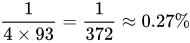
The 199 members of the National Assembly will be elected by mixed-member majoritarian representation with two methods; 106 elected in single-member constituencies by first-past-the-post voting, while the other 93 elected from a single nationwide constituency, by modified proportional representation. The electoral threshold is set at 5% for single party lists, 10% for joint lists of two parties and 15% for joint lists of three or more parties. Since 2014, each of the Armenian, Bulgarian, Croatian, German, Greek, Polish, Romani, Romanian, Rusyn, Serbian, Slovak, Slovenian, and Ukrainian ethnic minorities can win one of the 93 party lists seats if they register as a specific list and reach a lowered quota of of the total of party list votes. Each minority is able to send a minority spokesman – without the rights of an MP – to the National Assembly, if the list does not reach this lowered quota. [27] Fractional votes, calculated as all the votes of individual candidates not elected (but associated with a party list over the threshold), as well as surplus votes cast for successful candidates (margin of victory minus 1 vote), are added to the direct lists votes of the respective parties or alliances. Seats are then allocated using the D'Hondt method. [28]
The following graph presents the average of all polls.

The following two graphs present only the polls that are government-aligned, or independent/opposition-aligned, respectively.


When it comes to migration, Hungary has set a very good example of how to build a barrier. A good neighbor is much better than an enemy, and Hungary is such a neighbor. (...) The fact that you want to cooperate with us is part of mutual trust (...). I believe that the Hungarian people will make the right decision in the elections, which means ensuring cultural identity and economic growth. Let's keep Europe for Europeans.
| Parliamentary elections |
|
|---|---|
| European elections | |
| Local elections | |
| Referendums | |
See also: List of Hungarian by-elections | |