| | ||||||||||||||||||||||||||
November 8–9, 1804 | ||||||||||||||||||||||||||
| ||||||||||||||||||||||||||
County results
| ||||||||||||||||||||||||||
| ||||||||||||||||||||||||||
| Elections in North Carolina |
|---|
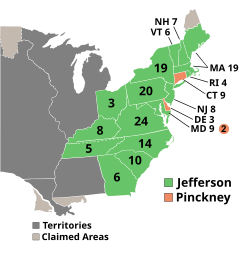
A presidential election was held in North Carolina on November 9, 1804, as part of the 1804 United States presidential election. [1] [2] The Democratic-Republican Party's ticket of the incumbent president, Thomas Jefferson, and the former New York governor, George Clinton, defeated the Federalist Party's ticket in the state's 14 electoral districts. [3]
Jefferson won the national election in a landslide over the de facto Federalist candidate, Charles Cotesworth Pinckney. [4] Although a clandestine gathering of Federalist members of Congress had nominated Pinckney in February, the Federalist electors were formally unpledged. [5] In two districts, Federalists won the popular vote on Election Day, but the exclusion of votes from Martin and Montgomery counties gave both districts to Jefferson. [6] The narrow margin in the former Federalist stronghold of Fayetteville, North Carolina, indicated the party's decline in the state. [7]
North Carolina chose 14 electors from as many single-member districts. Complete returns are available for the 8th and 10th electoral districts; returns from the remaining districts are either incomplete or missing. [3] Nineteenth-century election laws required voters to elect the members of the Electoral College individually, rather than as a block. This sometimes resulted in small differences in the number of votes cast for electors pledged to the same presidential nominee, if some voters did not vote for all the electors nominated by a party. [8] The following table calculates the sum of all votes for Democratic-Republican and Federalist candidates in each district to give an approximate sense of the statewide popular vote.
| Party | Candidate | Votes | % | |
|---|---|---|---|---|
| Democratic-Republican | Thomas Jefferson George Clinton | 2,886 | 71.42 | |
| Federalist | Unpledged electors | 1,155 | 28.58 | |
| Total votes | 4,041 | 100.00 | ||
| State or district | E.V. | Thomas Jefferson Democratic-Republican | Unpledged electors Federalist | Margin | Total | |||||
|---|---|---|---|---|---|---|---|---|---|---|
| Votes | % | E.V. | Votes | % | E.V. | Votes | % | |||
| North Carolina–1 | 1 | ** | 1 | ** | — | ** | ** | |||
| North Carolina–2 | 1 | ** | 1 | ** | — | ** | ** | |||
| North Carolina–3 [a] | 1 | 789 | 100.00 | 1 | — | — | 789 | 100.00 | 789 | |
| North Carolina–4 | 1 | ** | 1 | ** | — | ** | ** | |||
| North Carolina–5 | 1 | ** | 1 | ** | — | ** | ** | |||
| North Carolina–6 | 1 | ** | 1 | ** | — | ** | ** | |||
| North Carolina–7 | 1 | ** | 1 | ** | — | ** | ** | |||
| North Carolina–8 [b] | 1 | 1,511 [c] | 70.94 | 1 | 619 | 29.06 | — | 892 | 41.88 | 2,130 |
| North Carolina–9 | 1 | ** | 1 | ** | — | ** | ** | |||
| North Carolina–10 [d] | 1 | 489 | 47.75 | 1 | 535 | 52.24 | — | -46 | -4.49 | 1,024 |
| North Carolina–11 | 1 | ** | 1 | ** | — | ** | ** | |||
| North Carolina–12 | 1 | ** | 1 | ** | — | ** | ** | |||
| North Carolina–13 | 1 | ** | 1 | ** | — | ** | ** | |||
| North Carolina–14 [a] | 1 | 97 | 98.98 | 1 | 1 | 1.02 | — | 96 | 97.96 | 98 |
| TOTAL | 12 | 2,886 | 71.42 | 12 | 1,155 | 28.58 | 0 | 1,731 | 42.84 | 4,041 |
Returns from this district appear to be lost. Felix Walker, a Democratic-Republican, was elected. [9]
Returns from this district appear to be lost. Peter Forney, a Democratic-Republican, was elected. [10]
Returns from Stokes and Surry counties appear to be lost. Joseph Williams, a Democratic-Republican, was elected. [11]
| Party | Candidate | Votes | % | |
|---|---|---|---|---|
| Democratic-Republican | Joseph Williams | 198 | 22.78 | |
| Democratic-Republican | John Brown | 671 | 77.22 | |
| Total votes | 869 | 100.00 | ||
Returns from this district appear to be lost. Montfort Stokes, a Democratic-Republican, was elected. [12]
Returns from this district appear to be lost. Solomon Graves, a Democratic-Republican, was elected. [13]
Returns from this district appear to be lost. Joseph Taylor, a Democratic-Republican, was elected. [14]
Returns from this district appear to be lost. Joseph J. Alston, a Democratic-Republican, was elected. [15]
Two Democratic-Republicans, one Federalist pledged to Jefferson, and one unpledged Federalist ran in this single-member district. The Federalist unpledged elector, John Culpepper, received the most votes on Election Day based on votes from Montgomery County. [16]
| Party | Candidate | Votes | % | |
|---|---|---|---|---|
| Federalist | John Culpepper [e] | 619 | 29.06 | |
| Democratic-Republican | Isaac Lanier | 535 | 25.12 | |
| Democratic-Republican | Robert Cochran | 504 | 23.66 | |
| Federalist | Allen Gilchrist [f] | 472 | 22.16 | |
| Total votes | 2,130 | 100.00 | ||
The votes from Montgomery County were excluded from the official returns, flipping the district. Robert Cochran, a Democratic-Republican, was elected. [16]
| Party | Candidate | Votes | % | |
|---|---|---|---|---|
| Democratic-Republican | Robert Cochran | 492 | 27.59 | |
| Federalist | John Culpepper [e] | 461 | 25.86 | |
| Federalist | Allen Gilchrist [f] | 450 | 25.24 | |
| Democratic-Republican | Isaac Lanier | 380 | 21.31 | |
| Total votes | 1,783 | 100.00 | ||