External links
 | This article related to telecommunications is a stub. You can help Wikipedia by expanding it. |
X.32 is an old ITU-T standard published in 1984 for connecting to an X.25 network by dial-up. It defines how the network identifies the terminal for billing and security purposes.
| | This article related to telecommunications is a stub. You can help Wikipedia by expanding it. |

Dual-tone multi-frequency signaling (DTMF) is a telecommunication signaling system using the voice-frequency band over telephone lines between telephone equipment and other communications devices and switching centers. DTMF was first developed in the Bell System in the United States, and became known under the trademark Touch-Tone for use in push-button telephones supplied to telephone customers, starting in 1963. DTMF is standardized as ITU-T Recommendation Q.23. It is also known in the UK as MF4.
H.263 is a video compression standard originally designed as a low-bit-rate compressed format for videoconferencing. It was standardized by the ITU-T Video Coding Experts Group (VCEG) in a project ending in 1995/1996. It is a member of the H.26x family of video coding standards in the domain of the ITU-T.

The ITU Telecommunication Standardization Sector (ITU-T) coordinates standards for telecommunications and Information Communication Technology such as X.509 for cybersecurity, Y.3172 for machine learning, and H.264/MPEG-4 AVC for video compression, between its Member States, Private Sector Members, and Academia Members. ITU-T is one of the three Sectors of the International Telecommunication Union (ITU).
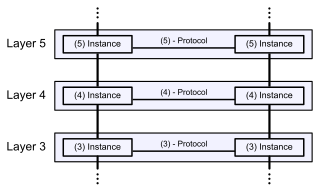
The Open Systems Interconnection model is a conceptual model that characterises and standardises the communication functions of a telecommunication or computing system without regard to its underlying internal structure and technology. Its goal is the interoperability of diverse communication systems with standard communication protocols.
Digital subscriber line is a family of technologies that are used to transmit digital data over telephone lines. In telecommunications marketing, the term DSL is widely understood to mean asymmetric digital subscriber line (ADSL), the most commonly installed DSL technology, for Internet access.

X.25 is an ITU-T standard protocol suite for packet-switched data communication in wide area networks (WAN). It was originally defined by the International Telegraph and Telephone Consultative Committee in a series of drafts and finalized in a publication known as The Orange Book in 1976.
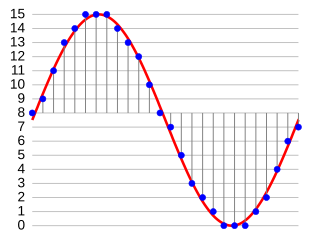
G.711 is a narrowband audio codec originally designed for use in telephony that provides toll-quality audio at 64 kbit/s. G.711 passes audio signals in the range of 300–3400 Hz and samples them at the rate of 8,000 samples per second, with the tolerance on that rate of 50 parts per million (ppm). Non-uniform (logarithmic) quantization with 8 bits is used to represent each sample, resulting in a 64 kbit/s bit rate. There are two slightly different versions: μ-law, which is used primarily in North America and Japan, and A-law, which is in use in most other countries outside North America.
Advanced Video Coding (AVC), also referred to as H.264 or MPEG-4 Part 10, Advanced Video Coding, is a video compression standard based on block-oriented, motion-compensated integer-DCT coding. It is by far the most commonly used format for the recording, compression, and distribution of video content, used by 91% of video industry developers as of September 2019. It supports resolutions up to and including 8K UHD.
3G is the third generation of wireless mobile telecommunications technology. It is the upgrade for 2.5G GPRS and 2.75G EDGE networks, for faster data transfer. This is based on a set of standards used for mobile devices and mobile telecommunications use services and networks that comply with the International Mobile Telecommunications-2000 (IMT-2000) specifications by the International Telecommunication Union. 3G finds application in wireless voice telephony, mobile Internet access, fixed wireless Internet access, video calls and mobile TV.
H.261 is an ITU-T video compression standard, first ratified in November 1988. It is the first member of the H.26x family of video coding standards in the domain of the ITU-T Study Group 16 Video Coding Experts Group, and was developed with a number of companies, including Hitachi, PictureTel, NTT, BT and Toshiba. It was the first video coding standard that was useful in practical terms.
X.400 is a suite of ITU-T Recommendations that defines the ITU-T Message Handling System (MHS).
G.726 is an ITU-T ADPCM speech codec standard covering the transmission of voice at rates of 16, 24, 32, and 40 kbit/s. It was introduced to supersede both G.721, which covered ADPCM at 32 kbit/s, and G.723, which described ADPCM for 24 and 40 kbit/s. G.726 also introduced a new 16 kbit/s rate. The four bit rates associated with G.726 are often referred to by the bit size of a sample, which are 2, 3, 4, and 5-bits respectively. The corresponding wide-band codec based on the same technology is G.722.
X.75 is an International Telecommunication Union (ITU) standard specifying the interface for interconnecting two X.25 networks. X.75 is almost identical to X.25. The significant difference is that while X.25 specifies the interface between a subscriber and the network, X.75 specifies the interface between two networks, and refers to these two STE as STE-X and STE-Y. This gives rise to some subtle differences in the protocol compared with X.25. For example, X.25 only allows network-generated reset and clearing causes to be passed from the network (DCE) to the subscriber (DTE), and not the other way around since the subscriber is not a network. However, at the interconnection of two X.25 networks, either network might reset or clear an X.25 call, so X.75 allows network-generated reset and clearing causes to be passed in either direction.
The Video Coding Experts Group or Visual Coding Experts Group is a working group of the ITU Telecommunication Standardization Sector (ITU-T) concerned with video coding standards. It is responsible for standardization of the "H.26x" line of video coding standards, the "T.8xx" line of image coding standards, and related technologies.
H.323 is a Recommendation from the ITU Telecommunication Standardization Sector (ITU-T) that defines the protocols to provide audio-visual communication sessions on any packet network. The H.323 standard addresses call signaling and control, multimedia transport and control, and bandwidth control for point-to-point and multi-point conferences.
The ITU-T Recommendation E.212 defines mobile country codes (MCC) as well as mobile network codes (MNC).
High Efficiency Video Coding (HEVC), also known as H.265 and MPEG-H Part 2, is a video compression standard designed as part of the MPEG-H project as a successor to the widely used Advanced Video Coding. In comparison to AVC, HEVC offers from 25% to 50% better data compression at the same level of video quality, or substantially improved video quality at the same bit rate. It supports resolutions up to 8192×4320, including 8K UHD, and unlike the primarily 8-bit AVC, HEVC's higher fidelity Main10 profile has been incorporated into nearly all supporting hardware.
A video coding format is a content representation format for storage or transmission of digital video content. It typically uses a standardized video compression algorithm, most commonly based on discrete cosine transform (DCT) coding and motion compensation. Examples of video coding formats include H.262, MPEG-4 Part 2, H.264, HEVC (H.265), Theora, RealVideo RV40, VP9, and AV1. A specific software or hardware implementation capable of compression or decompression to/from a specific video coding format is called a video codec; an example of a video codec is Xvid, which is one of several different codecs which implements encoding and decoding videos in the MPEG-4 Part 2 video coding format in software.
Coding tree unit (CTU) is the basic processing unit of the High Efficiency Video Coding (HEVC) video standard and conceptually corresponds in structure to macroblock units that were used in several previous video standards. CTU is also referred to as largest coding unit (LCU).