This article has multiple issues. Please help improve it or discuss these issues on the talk page . (Learn how and when to remove these template messages) (Learn how and when to remove this template message)
|
| St. Paul's Co-educational (Kennedy Road) Primary School 聖保羅男女中學附屬(堅尼地道)小學 | |
|---|---|
| Location | |
Hong Kong | |
| Information | |
| Motto | Faith, Hope, Love |
| Religious affiliation(s) | Anglican |
St. Paul's Co-educational (Kennedy Road) Primary School was one of the two former affiliated primary schools campus of St. Paul's Co-educational College, Hong Kong, with the campus at 26 Kennedy Road. It is a full day Anglicanism school primary school. It is an Anglican school associated with Sheng Kung Hui.The school motto is Faith, Hope and Love. The school fee is $48,000 Hong Kong Dollar(which is approximately $6000 USD)per year since the school has been changed to a Direct Subsidy Scheme school since the year 2001. [1]
St. Paul's Co-educational College, is an Anglican secondary school located at 33 MacDonnell Road, Mid-levels, Hong Kong, founded in 1915. It follows the HKDSE and IBDP curriculum, and is the first Round Square school in Greater China. It was the first school in Hong Kong to require a school uniform. Until after World War II, it was a girls-only college. Since 2001, it has been under the Direct Subsidy Scheme. It is also known for the students' academic excellency and held outstanding results in public exams. It has an affiliated primary school, making it a school of the "through-train" system.
Hong Kong, officially the Hong Kong Special Administrative Region of the People's Republic of China, is a special administrative region on the eastern side of the Pearl River estuary in southern China. With over 7.4 million people of various nationalities in a 1,104-square-kilometre (426 sq mi) territory, Hong Kong is the world's fourth most densely populated region.
Kennedy Road is a road in the Mid-levels on Hong Kong Island, Hong Kong. It is named after Arthur Kennedy, the seventh governor of Hong Kong.
It was founded in 1915 at Glenealy as St. Paul's Co-educational Primary School. The school was changed from full-day into AM and PM modes. The original premises consisted of two old colonial style buildings dating from around 1918. The exact date is not known as the information is missing from the Lands Office records. The main building at No. 26 Kennedy Road was erected as a Japanese school for 80 students.he campus on Kennedy Road was built in 1935. [2] It was donated by the Japanese companies in Hong Kong and was the original Kennedy Road and the 12th Hong Kong Japanese School. The staff lived in flats on the top floor. A camphor wood tree grew in the courtyard on the Ground Floor level, which can still be seen on the multipurpose sports field today. In 1999 both primary schools reverted to full-day education. St. Paul's Co-educational PM Primary School moved to the site at Kennedy Road, and changed to St. Paul's Co-educational (Kennedy Road) Primary School. There was an altar off the main play area guarded by the two stone temple dogs which were used to guard the entrance of our present site until donated to a local Japanese school, and the Japanese logo of the Rising Sun was on the gable. The building became Government property following the Second World War. The AM school remains at Macdonnell Road and was renamed St.Paul's Co-educational (Macdonnell Road) Primary School. In 2006, the two primary school merged and renamed St. Paul's Co-educational College Primary School. The school moved into Wong Chuk Hang Nam Fung Path in 2008 (see detail in section Present). The campus was rented by the St.Paul's co-educational college for the usage of junior forms of secondary school and also the A level classes . The school will be returned to the Hong Kong government after the completion of the construction project of on the MacDonnell Road new wing building. [3] The school building had a main hall, six classrooms and four teachers dorm room. During the Japanese occupation of Hong Kong, the premises has been assigned as many schools:
Glenealy is one of the few roads or streets without a suffix in Hong Kong. Located in the Mid-levels on the Hong Kong Island, Hong Kong, it starts from Ice House Street and goes uphill to Hong Kong Zoological and Botanical Gardens, across Robinson Road and ends at Hornsey Road and Conduit Road.
MacDonnell Road, is an affluent road in the Mid-Levels district in Hong Kong Island, Hong Kong. It is one of the most expensive roads in Central Mid-levels, together with Old Peak Road, Magazine Gap Road, Tregunter Path, Bowen Road, Borett Road and May Road. MacDonnell Road is named after former Hong Kong Governor Richard Graves MacDonnell. Starting from Garden Road, the road runs westward in the Mid-Levels and ends in Kennedy Road.

Queen's College, initially named The Government Central School in 1862, later renamed as Victoria College (皇后書院) in 1889, is a selective sixth form college for boys with a secondary school attached. It was the first public secondary school founded in Hong Kong by the British colonial government. Queen's College obtained its present name in 1894 and is now located at Causeway Bay, Hong Kong.
Clementi Secondary School is pre-tertiary institution in Fortress Hill, North Point Hong Kong. Founded by the 17th British Governor of Hong Kong and the 20th Governor of the Straits Settlements Sir Cecil Clementi, the school has the longest history in using Chinese as medium of instruction in Hong Kong. Besides the strong emphasis on classical Chinese, the school was also instructed, since its founding, to provide a well-rounded English education to its pupils due to its strong ties with the British colonial government. British national anthem was sung and the Union Jack was displayed continuously until the handover of Hong Kong to China. Students and Alumni of the school are commonly known as "Clementian".
The Kennedy School, originally the John D. Kennedy Elementary School, is a former elementary school that has been converted to a hotel, movie theater and dining establishment in northeast Portland, Oregon. The facility is operated by the McMenamins chain. The hotel has 35 guestrooms, a brewery, four bars, and a restaurant.
Since then the school premises is used as the St. Paul's Co-educational College Primary School and St. Paul's Co-educational College. The school campus has been listed as a historic building by the Antiquities and Monuments Office (AMO, 古物古蹟辦事處) [4]
The Antiquities and Monuments Office (AMO) was established in 1976 under the Antiquities and Monuments Ordinance to protect and preserve Hong Kong's historic monuments. Housed in the Former Kowloon British School, the AMO is responsible for identifying, recording and researching buildings and items of historical interest, as well as organizing and coordinating surveys and excavations in areas of archaeological significance. The Leisure and Cultural Services Department of the Hong Kong government currently manages the Office.
There are 12 class rooms, 1 main hall, 1 computer lab, 1 library, 1 meeting hall, 1 swimming pool at Glenealy, 1 media room, and 2 playground that one of them consists of a multipurpose sports field. [5]
A computer lab is a space which provides computer services to a defined community. Computer labs are typically provided by libraries to the public, by academic institutions to students who attend the institution, or by other institutions to the public or to people affiliated with that institution. Users typically must follow a certain user policy to retain access to the computers. This generally consists of the user not engaging in illegal activities or attempting to circumvent any security or content-control software while using the computers. In public settings, computer lab users are often subject to time limits, in order to allow more people a chance to use the lab, whereas in other institutions, computer access typically requires valid personal login credentials, which may also allow the institution to track the user's activities. Computers in computer labs are typically equipped with internet access, while scanners and printers may augment the lab setup. Computers in computer labs are typically arranged either in rows, so that every workstation has a similar view of one end of the room to facilitate lecturing or presentations, or in clusters, to facilitate small group work. In some cases, generally in academic institutions, student laptops or laptop carts take the place of dedicated computer labs, although computer labs still have a place in applications requiring special software or hardware not practically implementable in personal computers.
A library is a collection of sources of information and similar resources, made accessible to a defined community for reference or borrowing. It provides physical or digital access to material, and may be a physical building or room, or a virtual space, or both. A library's collection can include books, periodicals, newspapers, manuscripts, films, maps, prints, documents, microform, CDs, cassettes, videotapes, DVDs, Blu-ray Discs, e-books, audiobooks, databases, and other formats. Libraries range in size from a few shelves of books to several million items. In Latin and Greek, the idea of a bookcase is represented by Bibliotheca and Bibliothēkē : derivatives of these mean library in many modern languages, e.g. French bibliothèque.
A swimming pool, swimming bath, wading pool, or paddling pool is a structure designed to hold water to enable swimming or other leisure activities. Pools can be built into the ground or built above ground, and are also a common feature aboard ocean-liners and cruise ships. In-ground pools are most commonly constructed from materials such as concrete, natural stone, metal, plastic or fiberglass, and can be of a custom size and shape or built to a standardized size, the largest of which is the Olympic-size swimming pool.
The primary school focuses Chinese, English, Mandarin, Mathematics and Science. [6] The classes begins at 8:10am and finishes at 2:45pm in weekdays. The courses that were taught are Physical Education, Chinese, Visual Arts, English, Music, Mathematics, Mandarin, General Studies, Computer Literacy, Religious Studies and Library studies. Most of the curriculum of primary school is taught in Cantonese or English, with some lessons being taught by native English teachers. In Primary 6, English, Mathematics, General Studies (including Science), Religious Studies, etc. are taught in English; and Chinese is mainly taught in Mandarin. [7]
Chinese is a group of related, but in many cases not mutually intelligible, language varieties, forming the Sinitic branch of the Sino-Tibetan language family. Chinese is spoken by the Han majority and many minority ethnic groups in China. About 1.2 billion people speak some form of Chinese as their first language.
English is a West Germanic language that was first spoken in early medieval England and eventually became a global lingua franca. Named after the Angles, one of the Germanic tribes that migrated to the area of Great Britain that would later take their name, England, both names ultimately deriving from the Anglia peninsula in the Baltic Sea. It is closely related to Frisian and Low Saxon, and its vocabulary has been significantly influenced by other Germanic languages, particularly Norse, and to a greater extent Latin and French.
Music is an art form and cultural activity whose medium is sound organized in time. General definitions of music include common elements such as pitch, rhythm, dynamics, and the sonic qualities of timbre and texture. Different styles or types of music may emphasize, de-emphasize or omit some of these elements. Music is performed with a vast range of instruments and vocal techniques ranging from singing to rapping; there are solely instrumental pieces, solely vocal pieces and pieces that combine singing and instruments. The word derives from Greek μουσική . See glossary of musical terminology.
The school has relocated to Nam Fung Path near the Ocean Park in Wong Chuk Hang 2008 to meet the needs of the space required after the combination of the MacDonnell Road campus and the Kennedy Road campus. The campus has turned into a campus for the Form 1 in St. Paul's Co-educational College.
Ying Wa College is a direct subsidised boys' secondary school in Kowloon, Hong Kong. It was established in Malacca in 1818 by the first Protestant missionary to China, Rev. Robert Morrison. In 1843, the college was moved to Hong Kong.
St. Paul's College is an Anglican day school for boys in Hong Kong. Established in 1851, it is the oldest continuously-operated school in Hong Kong. The college opened in 1851 with one tutor and nine pupils.Today, it has 1,200 pupils in the secondary section and nearly 600 pupils in the primary section.
The University of Hong Kong (HKU) is a public research university in Hong Kong. Founded in 1911, its origins trace back to the Hong Kong College of Medicine for Chinese, which was founded in 1887. It is the oldest tertiary institution in Hong Kong.
Wah Yan College, Kowloon is a Roman Catholic secondary school for boys run by the Chinese Province of the Society of Jesus. Located at 56 Waterloo Road, Yau Ma Tei, Kowloon, it is a grant-in-aid secondary school using English as the primary medium of instruction.
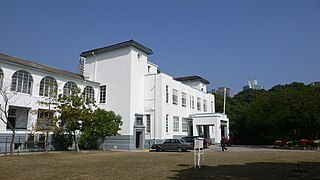
The Diocesan Boys' School (DBS) is a boys' school in Hong Kong, located at 131 Argyle Street, Mong Kok, Kowloon. Founded in 1869, it is one of the oldest secondary schools in the city. The school's mission is "to provide a liberal education based on Christian principles". Having run as a grant-aided school since it was founded, the school commenced operation in the Direct Subsidy Scheme in September 2003. It uses English as the medium of instruction.
St Stephen's College is a Christian Direct Subsidy Scheme co-educational secondary school in Stanley, Hong Kong. With an area of about 150,000 m², the college is the largest secondary school in Hong Kong, and is one of the very few boarding schools in the territory. Many buildings in the campus are listed in the list of historic Buildings and Declared Monuments by the Antiquities Advisory Board. When the college was founded in 1903, there were only six boarders and one day student; in the academic year 2011-2012, there were approximately 1200 students studying in the college. The current principal is Ms. Carol C. Yang, commencing duty since 2011. St Stephen's College uses English as a medium of instruction, and Chinese language for Chinese, Chinese History, Chinese Language and Culture, Putonghua, Visual Arts and Physical Education. St Stephen's College is the first school in the territory having its own Heritage Trail in the school campus. The college’s oldest building, the School House, was declared a monument in 2011, being one of the few schools in Hong Kong to own a Declared Monument in its campus.
The Chinese International School is a private international school in Hong Kong, China. It is one of the most expensive schools in Hong Kong and widely recognised as the best academically focused schools in Hong Kong.
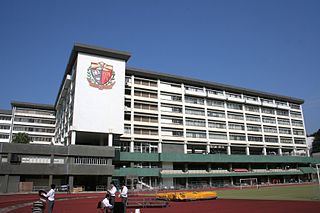
La Salle College is a boys' secondary school in Hong Kong. It was established by the Institute of the Brothers of the Christian Schools, a Roman Catholic religious teaching order founded by St. John Baptist de La Salle.
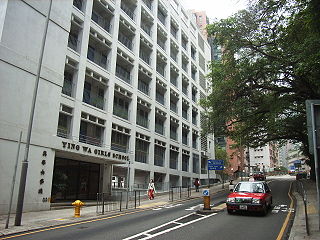
Ying Wa Girls' School is an HKCCCC secondary day school for girls in Central, Hong Kong. It is located at 76 Robinson Road, Mid-levels. The campus at Robinson Road is under redevelopment. It will be completed in late 2018. The decanting site is located at 101 Castle Peak Road, Sham Shui Po. Total enrolment currently stands at slightly under 1,000. YWGS is notable for its excellent results in public examinations, and is one of the most prestigious girls' schools in Hong Kong.
Sacred Heart Canossian College is a Catholic, all-girls' school established at Robinson and Caine Roads, Mid-Levels, Hong Kong. Founded in 1860, the school currently serves under 2,000 students and has been identified as one of the most prestigious schools in Hong Kong. It is now ranked 23rd on the best secondary school charts in Hong Kong.
Marymount Secondary School is a Band 1 all-girls EMI Roman Catholic Secondary School located in Happy Valley, Hong Kong Island, Hong Kong. The Primary School is Marymount Primary School. Marymount is also well known for its school choir which receives a lot of prizes in the Hong Kong Schools Music Festival as well as International Competitions.
Bonham Road is a main road in West Mid-Levels, Hong Kong Island in Hong Kong, running mainly East-West. The road connects Pokfulam Road in the west, near the University of Hong Kong, and Caine Road in the east, at the junction with Hospital Road and Seymour Road. It was named after Sir George Bonham, the third Governor of Hong Kong. It was renamed Nishi-Taisho Dori (西大正通) during Japanese occupation of Hong Kong.
Kowloon True Light School is a Protestant girls' secondary school situated in Kowloon Tong, Kowloon, Hong Kong, China. It is supervised by The Hong Kong Council of the Church of Christ in China. Ths school is conveniently located near Kowloon Tong Station.
The Chung Chi College is one of the constituent colleges of The Chinese University of Hong Kong (CUHK), and one of the three original colleges that joined to form the CUHK in 1963. Founded in 1951 by representatives of Protestant churches in Hong Kong, it was formally incorporated under the Chung Chi College Incorporation Ordinance in 1955.

St. Francis' Canossian College was founded on 7 May 1869 as the second school established by the Italian Canossian Daughters of Charity in Hong Kong. The wall painting of four Guardian Angels playing instruments is the school's mascot.
The Central and Western District located on northern part of Hong Kong Island is one of the 18 administrative districts of Hong Kong. It had a population of 243 266 in 2016. The district has the most educated residents with the second highest income and the third lowest population due to its relatively small size.
Tang Shiu Kin Victoria Government Secondary School (鄧肇堅維多利亞官立中學)was founded by the Hong Kong Government in 1933. Named The Junior Technical School (初級工業學校) initially, and then renamed as Victoria Technical School (維多利亞工業學校) since the 1950s. This is the first Government-founded Technical College in Hong Kong. The school is now at 5 Oi Kwan Road, Wan Chai, Victoria, Hong Kong. Currently, the principal is Mr.Yan-kei CHAN.
Diocesan Native Female Training School was a school under the Anglican Church of Hong Kong in the 19th century, founded in 1860 and closed down in 1868. Its premises now belong to today's Bonham Road Government Primary School(般咸道官立小學). In 1869, another institution called Diocesan Home and Orphanage was founded in the same place. Due to the obvious differences in founding groups, vision of education, personnel arrangement and students’ background, DNFTS has been regarded only as a forerunner, and called ‘the First Foundation’ by DHO and later DBS. Using 1869 as its founding year, DBS calls itself ‘the Second Foundation’. As for Diocesan Girls' School, founded in Rose Villas near DSO in 1899, it claims to be the successor of DNFTS and traces the founding year back to 1860.