英文互译镜像站

Sherwood, Mills & Smith

Last updated
Sherwood, Mills & Smith
SMS Partnership
SMS Architects
Hudson River Museum 5BBC jeh.jpg
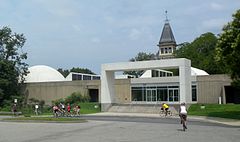
The Hudson River Museum in Yonkers, New York, designed chiefly by Willis N. Mills and Willis N. Mills Jr. of Sherwood, Mills & Smith and completed in 1969.
Practice information
FoundersThorne Sherwood FAIA ; Willis N. Mills FAIA ; Lester W. Smith FAIA
Founded1946
Dissolved2000
Location Stamford, Connecticut
Thorne Sherwood
Born(1910-12-03)December 3, 1910
DiedDecember 27, 1994(1994-12-27) (aged 84)
NationalityUnited States
OccupationArchitect
Willis N. Mills
Born(1907-01-05)January 5, 1907
DiedSeptember 25, 1995(1995-09-25) (aged 88)
NationalityUnited States
OccupationArchitect
Lester W. Smith
Born(1909-05-21)May 21, 1909
DiedJuly 24, 1993(1993-07-24) (aged 84)
NationalityUnited States
OccupationArchitect
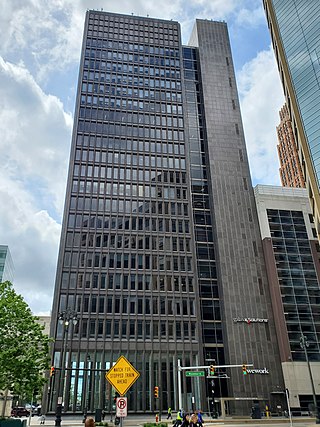
The former Mutual Insurance Company of Hartford offices, completed in 1959, featuring a cast concrete mural by Costantino Nivola. St. Francis Hospital, 95 Woodland Street in Hartford, Connecticut, 2009-09-02.jpg
The former Mutual Insurance Company of Hartford offices, completed in 1959, featuring a cast concrete mural by Costantino Nivola.
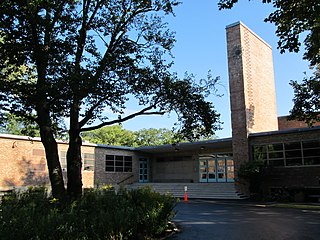
The Mount Vernon High School, designed by Sherwood, Mills & Smith and completed in 1961. Mount Vernon High School 2021 jeh.jpg
The Mount Vernon High School, designed by Sherwood, Mills & Smith and completed in 1961.
St. Mark's Episcopal Church in New Canaan, completed in 1961. NewCanaanCT StMarksEpiscopalChurch3.jpg
St. Mark's Episcopal Church in New Canaan, completed in 1961.
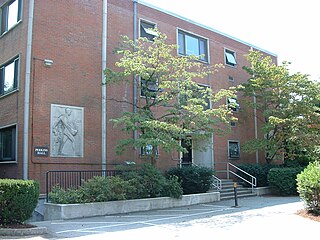
Towers Hall of Wagner College, completed in 1964. Parker Towers Dormitory at Wagner College.jpg
Towers Hall of Wagner College, completed in 1964.
The Barus and Holley Building of Brown University, completed in 1965. Barus and Holley Building, Brown University.jpg
The Barus and Holley Building of Brown University, completed in 1965.
Olmsted Hall of Vassar College, completed in 1973. Olmsted Hall, April 2015.jpg
Olmsted Hall of Vassar College, completed in 1973.
The F. N. Manross Memorial Library in Bristol, completed in 1975. BristolManrossLib.jpg
The F. N. Manross Memorial Library in Bristol, completed in 1975.
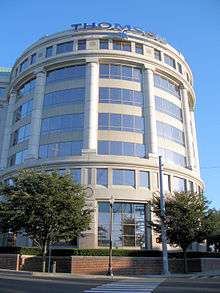
Metro Center in Stamford, completed in 1988. Thomson Corporation headquarters.jpg
Metro Center in Stamford, completed in 1988.

Sherwood, Mills & Smith, known after 1968 as the SMS Partnership and as SMS Architects, was an American architecture firm active in Stamford and New Canaan, Connecticut from 1946 to 2000. Initially the partnership of architects Thorne Sherwood FAIA , Willis N. Mills FAIA and Lester W. Smith FAIA , the firm grew into one of the most influential in the region.

Contents

History

Sherwood, Mills & Smith was founded in 1946 in Stamford as the partnership of three architects, Thorne Sherwood (1910–1994), Willis N. Mills (1907–1995) and Lester W. Smith (1909–1993).

Thorne Sherwood was born December 3, 1910, in Montclair, New Jersey. He was educated at Williams College and Columbia University, graduating from the latter in 1936 with a BArch. He worked for Schultze & Weaver, van der Gracht & Kilham, Harrison & Fouilhoux and Raymond Loewy before 1942. During World War II he served in the naval reserve and was discharged in 1946. [1]

Willis Nathaniel Mills was born January 5, 1907, in Menominee, Michigan. He was educated at the Kent School, the University of Pennsylvania and Columbia University, graduating from the latter in 1934. He worked for Shreve, Lamb & Harmon and William Lescaze before opening his own office in 1937. He served in the marine corps reserve during World War II and was discharged in 1946. [2]

Lester Wickham Smith was born May 21, 1909, in Brooklyn. He was educated at Princeton University, earning an AB in 1930 and an MFA in 1933. He worked for van der Gracht & Kilham, Wallace K. Harrison and Voorhees, Walker, Foley & Smith before 1940. During World War II he served in the army air force and was discharged in 1946. [3]

The partners chose to locate in Stamford, forty miles from New York City, because it offered many of the advantages and resources of the city without its drawbacks, including competition from other architects. This choice proved advantageous, and the firm expanded quickly over the next ten years. [4]

In 1959, to manage this expansion, Sherwood, Mills & Smith added four new partners, Thomas A. Norton (1922–2016), Carrell S. McNulty Jr. (born 1924), Gray Taylor (1916–1985) and A. Raymond von Brock (1922–2006). [5]

Thomas Akin Norton was born August 4, 1922, in Great Neck, New York. He served in the air force during World War II and was educated at Columbia University, earning a BA in 1946 and a BArch in 1949. He worked for O'Connor & Kilham and Skidmore, Owings & Merrill before joining Sherwood, Mills & Smith in 1953. [6]

Carrell Stewart McNulty Jr. was born December 4, 1924, in Newark, New Jersey. He was educated at Emory University, the University of North Carolina and Columbia University, graduating from the latter in 1950 with a BArch. He joined Sherwood, Mills & Smith immediately after leaving school. [7]

Gray Taylor was born April 15, 1916, in New York City. He attended Harvard College and Columbia University, graduating from the latter in 1947 with a BArch. His education was interrupted by World War II, and he served in the corps of engineers from 1941 to 1945. He worked for Ketchum, Giná & Sharp and William F. Schorn before joining Sherwood, Mills & Smith in 1954. [8] [9]

A. Raymond von Brock was born March 18, 1922, in Greenwich, Connecticut. He was educated at the Pratt Institute, graduating in 1946 with a BArch. He worked for Ryder, Struppmann & Neumann before joining Sherwood, Mills & Smith in 1952. [10]

The firm's leadership was again changed in 1963 when Norton left to enter private practice, [11] and in 1967 Mills' son, Willis N. Mills Jr. (1933–2020), joined as partner.

Willis Nathaniel Mills Jr. was born September 25, 1933, in New York City. He was educated at Princeton University, earning an AB in 1955 and an MFA in 1958. He worked for Pedersen & Tilney and Earl P. Carlin in New Haven before joining his father's firm in 1963. [12] In 1962 he was also the architect of a house in Van Hornesville, New York for James H. Case, a relative of his wife, and his then wife, Laura Rockefeller Chasin. This house, completed in 1963, is now NRHP-listed.

In 1968 the firm was renamed the SMS Partnership. [13] The economic decline of the late 1960s led the firm to downsize. Thorne Sherwood retired in 1969, [14] and in 1970 the firm was incorporated as SMS Architects. Mills and Smith retired in 1970 and 1971, respectively, and in 1972 the firm moved from downtown Stamford to suburban New Canaan. [15] McNulty and von Brock retired in 1973 and 1982, followed shortly thereafter by Taylor. [16] [17] Willis N. Mills Jr. led the firm in the 1980s and 1990s in association with several new principals, including Ellen Glenn Golden, Andrew J. Santella, Robert C. Steinmetz, Leonard M. Sussman and Lee A. Wright. [18] [19] In 1998 the firm was acquired by Perkins Eastman of New York City and moved its offices back to Stamford. [20] In 2000 SMS Architects was fully merged with Perkins Eastman, which still maintains a Stamford office.
Legacy

Sherwood, Mills & Smith developed the largest architectural practice in the suburban regions of the New York metropolitan area and was the undisputed architectural leader in Stamford and Fairfield County. Their works were built throughout the New York area and the Mid-Atlantic states. They were known for the high quality of design of their works, and by the 1970s had won more design awards than any other architecture firm in Connecticut. [21] [18]

The partners of Sherwood, Mills & Smith and SMS were widely respected by their peers. Both of the Mills, McNulty, Sherwood, Smith, Taylor and von Brock were all elected Fellows of the American Institute of Architects (AIA), and they and other principals served in leadership roles in the Connecticut chapter and on national AIA committees. [22]

In recent years several of their works, particularly in New Canaan, have been listed on the United States National Register of Historic Places.

Architectural works

Notes

  1. Designed in association with O'Connor & Kilham of New York City.
  2. Designed in association with Harrison & Abramovitz of New York City. Wallace K. Harrison was chiefly responsible for the sanctuary while Sherwood, Mills & Smith were responsible for the other parish buildings and general supervision.
  3. Featuring a cast concrete mural by Costantino Nivola.
  4. Designed in association with Skidmore, Owings & Merrill of New York City.

Related Research Articles

<span class="mw-page-title-main">Hewitt & Emerson</span> American architectural firm

Hewitt & Emerson was an architectural firm based in Peoria, Illinois. It was founded in 1909 as the partnership of architects Herbert E. Hewitt and Frank N. Emerson. After 1927 it was known successively as Hewitt, Emerson & Gregg; Emerson, Gregg & Briggs and Gregg & Briggs. It was active until at least the 1960s.

<span class="mw-page-title-main">Lloyd W. Kent</span> American architect

Lloyd Willington Kent (1907-1991) was an American architect from Providence, Rhode Island. With work based in modernist theory, Kent and his firms designed many Rhode Island civic buildings during the mid-twentieth century.

<span class="mw-page-title-main">C. Wellington Walker</span> American architect

C. Wellington Walker (1889–1967) was an American architect in practice in Bridgeport, Connecticut from 1910 until 1967.

Larch Campbell Renshaw Smith (1906–2002) was an American architect who practiced primarily in Connecticut and Florida, designing residences in the 1930s through the 1970s and writing for architectural publications.

Shirley Jane Vernon was an American architect and architectural educator in Pennsylvania. She was named a Fellow of the American Institute of Architects in 1976.

<span class="mw-page-title-main">Oliver W. Fontaine</span> American architect

Oliver W. Fontaine was an American architect from Woonsocket, Rhode Island.

<span class="mw-page-title-main">Hassel T. Hicks</span> American architect

Hassel T. Hicks (1896–1952) was an American architect from Welch, West Virginia.

<span class="mw-page-title-main">Mills, Rhines, Bellman & Nordhoff</span> American architectural firm

Mills, Rhines, Bellman & Nordhoff was an architectural firm founded in Toledo, Ohio in 1912. Renamed Bellman, Gillett & Richards in 1944, Richards, Bauer & Moorhead in 1962 and Bauer, Stark & Lashbrook in 1979, it closed in 1999.

<span class="mw-page-title-main">George Bain Cummings</span> American architect (1890–1974)

George Bain Cummings (1890–1974) was an American architect in practice in Binghamton, New York, from 1920 until 1961. From 1955 to 1956 he was president of the American Institute of Architects.

<span class="mw-page-title-main">Raymond J. Ashton</span> American architect (1887–1973)

Raymond J. Ashton (1887–1973) was an American architect in practice in Salt Lake City from 1919 until 1970. From 1943 to 1945 he was president of the American Institute of Architects.

<span class="mw-page-title-main">Clair W. Ditchy</span> American architect (1891–1967)

Clair W. Ditchy (1891–1967) was an American architect in practice in Detroit from 1922 until 1967. From 1953 to 1955 he was president of the American Institute of Architects.

<span class="mw-page-title-main">Leon Chatelain Jr.</span> American architect (1902–1979)

Leon Chatelain Jr. (1902–1979) was an American architect in practice in Washington, D.C., from 1932 to 1974. From 1956 to 1958 he was president of the American Institute of Architects.

<span class="mw-page-title-main">Waldron Faulkner</span> American architect

Waldron Faulkner (1898–1979) was an American architect in practice in New York City and Washington, D.C. from 1927 to 1968.

<span class="mw-page-title-main">Philip Will Jr.</span> American architect

Philip Will Jr. (1906–1985) was an American architect in practice in Chicago from 1935 to 1980. He was cofounder of the global architectural firm Perkins & Will in 1935 and was president of the American Institute of Architects from 1960 to 1962.

<span class="mw-page-title-main">Robert L. Durham</span> American architect (1912–1998)

Robert L. Durham (1912–1998) was an American architect in practice in Seattle from 1941 to 1977. He was president of the American Institute of Architects for the year 1967–68.

<span class="mw-page-title-main">Robert F. Hastings</span> American architect (1914–1973)

Robert F. Hastings (1914–1973) was an American architect in practice in Detroit. He spent his entire career with Smith, Hinchman & Grylls, now SmithGroup, and was its president from 1960 to 1971 and chair from 1971 to 1973. He was president of the American Institute of Architects for the year 1971.

<span class="mw-page-title-main">Rex Whitaker Allen</span> American architect (1914–2008)

Rex Whitaker Allen (1914–2008) was an American healthcare architect in practice in San Francisco from 1953 to 1987. He was president of the American Institute of Architects for the year 1969–70.

<span class="mw-page-title-main">John A. Carter (architect)</span> American architect

John A. Carter (1924–2017) was an American architect in practice in Nashua, New Hampshire from 1953 to 1995.

<span class="mw-page-title-main">Robert M. Lawrence</span> American architect (1930–2011)

Robert M. Lawrence was an American architect in practice in Oklahoma City. He was president of the American Institute of Architects for the year 1982.

<span class="mw-page-title-main">E. William Martin</span> American architect (1891–1977)

E. William Martin was a Scottish-born American architect in practice in Wilmington, Delaware from 1926 to 1965. In part through personal and political connections to members of the wealthy du Pont family Martin was architect of many important public works in Delaware, including public schools, the Zwaanendael Museum and the Delaware Legislative Hall.

References

  1. 1 2 3 4 5 "Sherwood, Thorne" in American Architects Directory (New York: R. R. Bowker Company, 1956): 503.
  2. 1 2 3 4 5 "Mills, Willis Nathaniel" in American Architects Directory (New York: R. R. Bowker Company, 1956): 383.
  3. 1 2 3 4 "Smith, Lester Wickham" in American Architects Directory (New York: R. R. Bowker Company, 1956): 518.
  4. "The Architect and His Community: Sherwood, Mills & Smith: Stamford, Connecticut" in Progressive Architecture 38, no. 3 (March, 1957): 107–123.
  5. "new partners, associates" in Progressive Architecture 40, no. 3 (March, 1959): 54.
  6. 1 2 3 "Norton, Thomas Akin" in American Architects Directory (New York: R. R. Bowker Company, 1962): 518.
  7. 1 2 3 "McNulty, Carrell Stewart Jr." in American Architects Directory (New York: R. R. Bowker Company, 1962): 454.
  8. 1 2 3 4 "Taylor, Gray" in American Architects Directory (New York: R. R. Bowker Company, 1962): 694–695.
  9. "Taylor, Gray" in American Architects Directory (New York: R. R. Bowker Company, 1970): 905.
  10. 1 2 3 "von Brock, A. Raymond" in American Architects Directory (New York: R. R. Bowker Company, 1962): 729.
  11. "Norton, Thomas Akin" in American Architects Directory (New York: R. R. Bowker Company, 1970): 672.
  12. "Mills, Willis Nathaniel Jr." in American Architects Directory (New York: R. R. Bowker Company, 1970): 627.
  13. "Real Estate Notes" in New York Times, August 1, 1968, 50.
  14. "Sherwood, Thorne" in American Architects Directory (New York: R. R. Bowker Company, 1970): 832.
  15. Bess Balchen, "A Firm That Gained Strength Through Transition" in AIA Journal 58, no. 5 (November, 1972): 27–34
  16. "McNulty, Carrell Stewart Jr." in Who's Who in America 2010 (New Providence: Marquis Who's Who): 3143.
  17. "Von Brock, A. Raymond" in Who Was Who in America (New Providence: Marquis Who's Who, 2007): 249.
  18. 1 2 Estelle F. Feinstein and Joyce S. Pendery, "SMS Architects" in Stamford: An Illustrated History (Stamford: Stamford Historical Society, 1984)
  19. 1 2 3 "SMS Architects PC" in ProFile: The Sourcebook of U. S. Architectural Design Firms (Atlanta: Construction Market Data, 1996): 365.
  20. "Perkins Eastman extends its reach" in Contemporary Long Term Care 21, no. 4 (April, 1998): 107.
  21. 1 2 3 Michael Knight, "Influence is a Many-Splintered Thing," New York times, March 20, 1977, CN1 and CN6-7.
  22. The American Institute of Architects College of Fellows History & Directory (Washington: American Institute of Architects, 2019)
  23. 1 2 3 4 5 "Sherwood, Thorne" in American Architects Directory (New York: R. R. Bowker Company, 1962): 639.
  24. 1 2 "Mills, Willis Nathaniel" in American Architects Directory (New York: R. R. Bowker Company, 1970): 627.
  25. 1 2 3 4 5 6 "Smith, Lester Wickham" in American Architects Directory (New York: R. R. Bowker Company, 1962): 655.
  26. 1 2 3 4 "Mills, Willis Nathaniel" in American Architects Directory (New York: R. R. Bowker Company, 1962): 486.
  27. 1 2 3 4 "McNulty, Carrell Stewart Jr." in American Architects Directory (New York: R. R. Bowker Company, 1962): 583.
  28. "Smith, Lester Wickham" in American Architects Directory (New York: R. R. Bowker Company, 1970): 853.
  29. "Precast Vaults Support a Pour" in Progressive Architecture 45, no. 9 (September, 1964): 163–165.
  30. 1 2 Norval White, Elliot Willensky and Fran Leadon, AIA Guide to New York City (New York: Oxford University Press, 2010): 925.
  31. "University of Connecticut: An enclave for graduate students" in College Management 4, no. 4 (April, 1969): 60–61.
  32. Miriam F. Stimpson, A Field Guide to Landmarks of Modern Architecture in the United States (Englewood Cliffs: Prentice–Hall, 1985)
  33. Karen Van Lengen and Lisa Reilly, Vassar College (New York: Princeton Architectural Press, 2004)
  34. Nolan Lushington and James M. Kusack, The Design and Evaluation of Public Library Buildings (Hamden: Library Professional Publications, 1991)
  35. "The 1985 New England Regional Council/AIA Architectural Design Awards" in BSA Chapterletter 71, no. 10 (November, 1985): 5.
泛目录+镜像 镜像站群霸屏 泛镜像站群 镜像站群 网页镜像工具