
Alexander Sergeyevich Pushkin was a Russian poet, playwright, and novelist of the Romantic era. He is considered by many to be the greatest Russian poet, and the founder of modern Russian literature.

Eugene Onegin is a novel in verse written by Alexander Pushkin. Onegin is considered a classic of Russian literature, and its eponymous protagonist has served as the model for a number of Russian literary heroes. It was published in serial form between 1825 and 1832. The first complete edition was published in 1833, and the currently accepted version is based on the 1837 publication.

Mikhail Ivanovich Glinka was the first Russian composer to gain wide recognition within his own country, and is often regarded as the fountainhead of Russian classical music. Glinka's compositions were an important influence on future Russian composers, notably the members of The Five, who took Glinka's lead and produced a distinctive Russian style of music.

Ruslan and Lyudmila is an opera in five acts composed by Mikhail Glinka between 1837 and 1842. The opera is based on the 1820 poem of the same name by Alexander Pushkin. The Russian libretto was written by Valerian Shirkov, Nestor Kukolnik and N. A. Markevich, among others. Pushkin's death in the famous duel prevented him from writing the libretto himself as planned.

A bogatyr or vityaz is a stock character in medieval East Slavic legends, akin to a Western European knight-errant. Bogatyrs appear mainly in Rus' epic poems—bylinas. Historically, they came into existence during the reign of Vladimir the Great as part of his elite warriors (druzhina), akin to Knights of the Round Table. Tradition describes bogatyrs as warriors of immense strength, courage and bravery, rarely using magic while fighting enemies in order to maintain the "loosely based on historical fact" aspect of bylinas. They are characterized as having resounding voices, with patriotic and religious pursuits, defending Rus' from foreign enemies and their religion. In modern Russian, the word bogatyr labels a courageous hero, an athlete or a physically strong man.

Charles-Louis Didelot was a French dancer, the creator of the ballet shoes and choreographer. The son of Charles Didelot, the dance master of the King of Sweden, he studied dance with his father, who was an instructor in dance at the Swedish Opera, and debuted as dancer in the theatre of Bollhuset in Stockholm 1786.
Ludmila or Ludmilla is a Slavic female given name that may particularly refer to:

Ruslan and Ludmila is a poem by Alexander Pushkin, published in 1820. It is written as an epic fairy tale consisting of a dedication (посвящение), six "cantos" (песни), and an epilogue (эпилог). It tells the story of the abduction of Ludmila, the daughter of Prince Vladimir of the Kievan Rus', by an evil wizard and the attempt by the brave knight Ruslan to find and rescue her.

Ruslan and Ludmila is a 1972 film directed by Aleksandr Ptushko. It is based on the poem of the same name written by Alexander Pushkin in 1820.
Onegin most often refers to Alexander Pushkin's 1833 verse novel Eugene Onegin. Works based on Pushkin's poem titled "Onegin" include:
"The Gypsies" is a narrative poem in 569 lines by Alexander Pushkin, originally written in Russian in 1824 and first published in 1827. The last of Pushkin's four 'Southern Poems' written during his exile in the south of the Russian Empire, The Gypsies is also considered to be the most mature of these Southern poems, and has been praised for originality and its engagement with psychological and moral issues. The poem has inspired at least eighteen operas and several ballets.
Prisoner of the Caucasus may refer to:
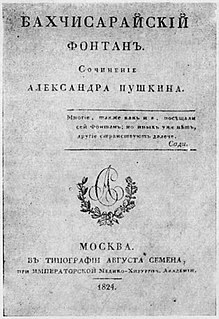
The Fountain of Bakhchisaray is a poem by Alexander Pushkin, written during the years 1821 to 1823.
Ruslan is a Russian-Slavic masculine given name used mainly in Slavic culture and all over CIS states. It is also a masculine given name in Indonesia. The name is a Russian variant from the Turkic word arslan/aslan, which is translated as lion. The name Eruslan is another, earlier variant of the form Ruslan; a hero from Russian folk tales is known by that name.

Commemorative Cantata for the Centenary of the Birth of Pushkin, Op. 65, is a cantata by Alexander Glazunov, composed in 1899 in memory of author Alexander Pushkin. It is also known as Memorial Cantata and Cantata in Memory of Pushkin's 100th Birthday. The work in five movements on lyrics by Konstantin Romanov is scored for solo voices, choir and piano.
The Tale of Tsar Saltan is a poem by Aleksandr Pushkin. It may also refer to:
Naina is a given name in India and Russia.
Valeri Yevseevich Kozinets is a Soviet Russian stage and film actor and screenwriter.
Aleko is the trade name of a Russian mid-size car sold between 1986 and 1997.
This page is based on this
Wikipedia article Text is available under the
CC BY-SA 4.0 license; additional terms may apply.
Images, videos and audio are available under their respective licenses.
