
Thomas Jonathan "Stonewall" Jackson was a general officer in the Confederate States Army during the American Civil War. He played a prominent role in nearly all military engagements in the Eastern theater of the war until his death. Military historians regard him as one of the most gifted tactical commanders in U.S. history.

The Second Battle of Bull Run or Battle of Second Manassas was fought August 28–30, 1862, in Prince William County, Virginia, as part of the American Civil War. It was the culmination of the Northern Virginia Campaign waged by Confederate Gen. Robert E. Lee's Army of Northern Virginia against Union Maj. Gen. John Pope's Army of Virginia, and a battle of much larger scale and numbers than the First Battle of Bull Run fought on July 21, 1861, on the same ground.

The Army of Northern Virginia, was the primary military force of the Confederate States of America in the Eastern Theater of the American Civil War. It was also the primary command structure of the Department of Northern Virginia. It was most often arrayed against the Union Army of the Potomac.

Ambrose Powell Hill Jr. was a Confederate general who was killed in the American Civil War. He is usually referred to as A. P. Hill to differentiate him from Confederate general Daniel Harvey Hill, who was unrelated.

The First Battle of Bull Run, called the Battle of First Manassas by Confederate forces, was the first major battle of the American Civil War. The battle was fought on July 21, 1861, in Prince William County, Virginia, just north of the city of Manassas and about thirty miles west-southwest of Washington, D.C. The Union Army was slow in positioning themselves, allowing Confederate reinforcements time to arrive by rail. Each side had about 18,000 poorly trained and poorly led troops. The battle was a Confederate victory and was followed by a disorganized post-battle retreat of the Union forces.

The Peninsula campaign of the American Civil War was a major Union operation launched in southeastern Virginia from March to July 1862, the first large-scale offensive in the Eastern Theater. The operation, commanded by Major General George B. McClellan, was an amphibious turning movement against the Confederate States Army in Northern Virginia, intended to capture the Confederate capital of Richmond. McClellan was initially successful against the equally cautious General Joseph E. Johnston, but the emergence of the more aggressive General Robert E. Lee turned the subsequent Seven Days Battles into a humiliating Union defeat.

Richard Stoddert Ewell was a career United States Army officer and a Confederate general during the American Civil War. He achieved fame as a senior commander under Stonewall Jackson and Robert E. Lee and fought effectively through much of the war. Still, his legacy was clouded by controversies over his actions at the Battle of Gettysburg and the Battle of Spotsylvania Court House.

The Seven Days Battles were a series of seven battles over seven days from June 25 to July 1, 1862, near Richmond, Virginia, during the American Civil War. Confederate General Robert E. Lee drove the invading Union Army of the Potomac, commanded by Maj. Gen. George B. McClellan, away from Richmond and into a retreat down the Virginia Peninsula. The series of battles is sometimes known erroneously as the Seven Days Campaign, but it was actually the culmination of the Peninsula Campaign, not a separate campaign in its own right.

CSS Jamestown, originally a side-wheel, passenger steamer, was built at New York City in 1853, and seized at Richmond, Virginia in 1861 for the Virginia Navy during the early days of the American Civil War. She was commissioned by the Confederate States Navy (CSN) the following July, and renamed CSS Thomas Jefferson but was generally referred to as Jamestown, after Jamestown, Virginia.
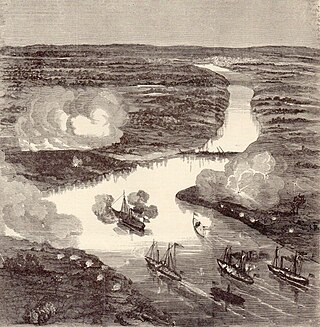
The Battle of Drewry's Bluff, also known as the Battle of Fort Darling, or Fort Drewry, took place on May 15, 1862, in Chesterfield County, Virginia, as part of the Peninsula Campaign of the American Civil War. Four Union Navy warships, including the ironclads USS Monitor and Galena, and the United States Revenue Cutter Service's ironclad USRC Naugatuck steamed up the James River to test the defenses of Richmond, Virginia, the Confederate capital. They encountered submerged obstacles, and deadly accurate fire from the batteries of Fort Darling at Drewry's Bluff, which inflicted severe damage on Galena, forcing them to turn back.

The Battle of Seven Pines, also known as the Battle of Fair Oaks or Fair Oaks Station, took place on May 31 and June 1, 1862, in Henrico County, Virginia, nearby Sandston, as part of the Peninsula Campaign of the American Civil War. It was the culmination of an offensive up the Virginia Peninsula by Union Maj. Gen. George B. McClellan, in which the Army of the Potomac reached the outskirts of Richmond.

The Battle of Glendale, also known as the Battle of Frayser's Farm, Frazier's Farm, Nelson's Farm, Charles City Crossroads, New Market Road, or Riddell's Shop, took place on June 30, 1862, in Henrico County, Virginia, on the sixth day of the Seven Days Battles of the American Civil War.

The Manassas Station Operations included the operations known as Bristoe Station, Kettle Run, Bull Run Bridge, or Union Mills. It took place August 25–27, 1862, in Prince William County, Virginia, as part of the Northern Virginia Campaign of the American Civil War.
The Battle of Thoroughfare Gap, also known as Chapman's Mill, took place on August 28, 1862, in Fauquier County and Prince William County, Virginia, as part of the Northern Virginia Campaign of the American Civil War. Confederate forces under Maj. Gen. James Longstreet successfully drove back Union forces under Brig. Gen. James B. Ricketts and Col. Percy Wyndham, allowing his corps to unite with that of Thomas J. "Stonewall" Jackson prior to the Second Battle of Bull Run.

Drewry's Bluff is located in northeastern Chesterfield County, Virginia, in the United States. It was the site of Confederate Fort Darling during the American Civil War. It was named for a local landowner, Confederate Captain Augustus H. Drewry, who owned the property.

The Northern Virginia Campaign, also known as the Second Bull Run Campaign or Second Manassas Campaign, was a series of battles fought in Virginia during August and September 1862 in the Eastern Theater of the American Civil War. Confederate General Robert E. Lee followed up his successes of the Seven Days Battles in the Peninsula campaign by moving north toward Washington, D.C., and defeating Maj. Gen. John Pope and his Army of Virginia.

Manassas National Battlefield Park is a unit of the National Park Service located in Prince William County, Virginia, north of Manassas that preserves the site of two major American Civil War battles: the First Battle of Bull Run, also called the Battle of First Manassas, and the Second Battle of Bull Run or Battle of Second Manassas. It was also where Confederate General Thomas J. Jackson acquired his nickname "Stonewall". The park was established in 1936 and listed on the National Register of Historic Places on October 15, 1966.
The 33rd Virginia Infantry Regiment was an infantry regiment raised in the Commonwealth of Virginia for service in the Confederate States Army during the American Civil War. It was a part of the famed "Stonewall Brigade," named for General Stonewall Jackson.

The eastern theater of the American Civil War consisted of the major military and naval operations in the states of Virginia, West Virginia, Maryland, and Pennsylvania, the District of Columbia, and the coastal fortifications and seaports of North Carolina.
The 19th Virginia Infantry Regiment was an infantry regiment raised in Virginia for service in the Confederate States Army during the American Civil War. It fought mostly with the Army of Northern Virginia.
