Nest algebras are examples of reflexive operator algebras. In finite dimensions, these are simply algebras of all matrices of a given size whose nonzero entries lie in an upper-triangular pattern.
In fact if we fix any pattern of entries in an n by n matrix containing the diagonal, then the set of all n by n matrices whose nonzero entries lie in this pattern forms a reflexive algebra.
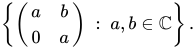
An example of an algebra which is not reflexive is the set of 2 × 2 matrices
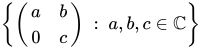
This algebra is smaller than the Nest algebra
but has the same invariant subspaces, so it is not reflexive.
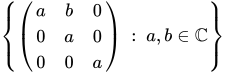
If T is a fixed n by n matrix then the set of all polynomials in T and the identity operator forms a unital operator algebra. A theorem of Deddens and Fillmore states that this algebra is reflexive if and only if the largest two blocks in the Jordan normal form of T differ in size by at most one. For example, the algebra
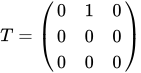
which is equal to the set of all polynomials in
and the identity is reflexive.
Hyper-reflexivity
Let be a weak*-closed operator algebra contained in B(H), the set of all bounded operators on a Hilbert spaceH and for T any operator in B(H), let
Observe that P is a projection involved in this supremum precisely if the range of P is an invariant subspace of .
The algebra is reflexive if and only if for every T in B(H):
We note that for any T in B(H) the following inequality is satisfied:
Here is the distance of T from the algebra, namely the smallest norm of an operator T-A where A runs over the algebra. We call hyperreflexive if there is a constant K such that for every operator T in B(H),
The smallest such K is called the distance constant for . A hyper-reflexive operator algebra is automatically reflexive.
In the case of a reflexive algebra of matrices with nonzero entries specified by a given pattern, the problem of finding the distance constant can be rephrased as a matrix-filling problem: if we fill the entries in the complement of the pattern with arbitrary entries, what choice of entries in the pattern gives the smallest operator norm?
Examples
Every finite-dimensional reflexive algebra is hyper-reflexive. However, there are examples of infinite-dimensional reflexive operator algebras which are not hyper-reflexive.
The distance constant for a one-dimensional algebra is 1.
Nest algebras are hyper-reflexive with distance constant 1.
Many von Neumann algebras are hyper-reflexive, but it is not known if they all are.
This page is based on this Wikipedia article Text is available under the CC BY-SA 4.0 license; additional terms may apply. Images, videos and audio are available under their respective licenses.