
Mao Zedong was a Chinese politician, Marxist theorist, military strategist, poet, and revolutionary who was the founder of the People's Republic of China (PRC). He led the country from its establishment in 1949 until his death in 1976, while also serving as the chairman of the Chinese Communist Party during that time. His theories, military strategies and policies are known as Maoism.

"Mainland China", also referred to as "the Chinese mainland", is a geopolitical term defined as the territory under direct administration of the Chinese Communist government of the People's Republic of China (PRC) in the aftermath of the Chinese Civil War. In addition to the geographical mainland, the geopolitical sense of the term includes islands such as Hainan, Chongming, and Zhoushan. By convention, territories outside of mainland China include:
The time period in China from the founding of the People's Republic in 1949 until Mao's death in 1976 is commonly known as Maoist China and Red China. The history of the People's Republic of China is often divided distinctly by historians into the Mao era and the post-Mao era. The country's Mao era lasted from the founding of the People's republic on 1 October 1949 to Deng Xiaoping's consolidation of power and policy reversal at the Third Plenum of the 11th Party Congress on 22 December 1978. The Mao era focuses on Mao Zedong's social movements from the early 1950s on, including land reform, the Great Leap Forward and the Cultural Revolution. The Great Chinese Famine, one of the worst famines in human history, occurred during this era.
Mao Zedong (1893–1976) was the leader of the People's Republic of China between 1949 and 1976.

Rosamond Soong Ch'ing-ling was a Chinese political figure. As the third wife of Sun Yat-sen, then Premier of the Kuomintang and President of the Republic of China, she was often referred to as Madame Sun Yat-sen. She was a member of the Soong family and, together with her siblings, played a prominent role in China's politics prior to and after 1949.

Zhu De was a Chinese general, military strategist, politician and revolutionary in the Chinese Communist Party.
Communist China may refer to:
The term "Free China" may mean:
China, officially the People's Republic of China, is a country in East Asia.

Chen Boda, was a Chinese Communist journalist, professor and political theorist who rose to power as the chief interpreter of Maoism in the first 20 years of the People's Republic of China. Chen became a close associate of Mao Zedong in Yan'an, during the late 1930s, drafting speeches and theoretical essays and directing propaganda.
The Stinking Old Ninth is a Chinese dysphemism for intellectuals used at two major points, the Yuan dynasty (1271–1368) and the Cultural Revolution (1966–1976).
The Red Terror was a campaign of mass arrests and executions conducted by the Bolshevik government of Soviet Russia in 1918–1922.
White Terror may refer to:
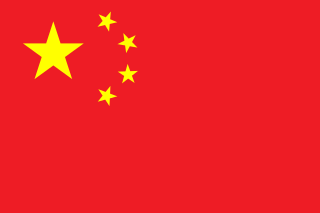
The national flag of the People's Republic of China, also known as the Five-star Red Flag, is a Chinese red field with five golden stars charged at the canton. The design features one large star, with four smaller stars in an arc set off towards the fly. It has been the national flag of China since the foundation of the People's Republic of China on 1 October 1949. The flag was designed by Zeng Liansong.
The Chinese Revolution can refer to:

The Republic of China (ROC), or simply China, was a sovereign state based on mainland China from 1912 to 1949 prior to the government's relocation to Taiwan, where it continues to be based today. The ROC was established on 1 January 1912 during the Xinhai Revolution against the Qing dynasty, ending the imperial history of China. The Republican government was ruled by the Kuomintang (KMT) as a one-party state based in Nanjing from 1927, until its flight to Taipei on 7 December 1949 following the KMT's de facto defeat by the Chinese Communist Party (CCP) in the Chinese Civil War. The CCP proclaimed the People's Republic of China on 1 October 1949, while the ROC retains control over the "Free Area", with the political status of Taiwan remaining in dispute to this day.
The Republic of China in the present-day refers to Taiwan, a country in East Asia, It may also refer to:

The Chinese Communist Revolution was a social and political revolution that culminated in the establishment of the People's Republic of China (PRC) in 1949. For the preceding century, China had faced escalating social, economic, and political problems as a result of Western imperialism, Japanese imperialism, and the decline of the Qing dynasty. Cyclical famines and an oppressive landlord system kept the large mass of rural peasantry poor and politically disenfranchised. The Chinese Communist Party (CCP) was formed in 1921 by young urban intellectuals inspired by European socialist ideas and the success of the October Revolution in Russia. The CCP originally allied itself with the nationalist Kuomintang (KMT) party against the warlords and foreign imperialist forces, but the 1927 massacre of Communists in Shanghai ordered by Kuomintang leader Chiang Kai-shek forced them into the Chinese Civil War, which would last more than two decades.
Lingxiu is a town of Shishi City, in the south of Fujian province, China.
People's Leader is a Chinese honorific title. It may refer to:
This page is based on this
Wikipedia article Text is available under the
CC BY-SA 4.0 license; additional terms may apply.
Images, videos and audio are available under their respective licenses.

