
The Pacific Plate is an oceanic tectonic plate that lies beneath the Pacific Ocean. At 103 million km2 (40 million sq mi), it is the largest tectonic plate.

The Australian Plate is a major tectonic plate in the eastern and, largely, southern hemispheres. Originally a part of the ancient continent of Gondwana, Australia remained connected to India and Antarctica until approximately 100 million years ago when India broke away and began moving north. Australia and Antarctica began rifting 85 million years ago and completely separated roughly 45 million years ago. The Australian plate later fused with the adjacent Indian Plate beneath the Indian Ocean to form a single Indo-Australian Plate. However, recent studies suggest that the two plates have once again split apart and have been separate plates for at least 3 million years and likely longer. The Australian Plate includes the continent of Australia, including Tasmania, as well portions of New Guinea, New Zealand, and the Indian Ocean basin.

Puysegur Point is located in the far southwest of the South Island of New Zealand. It lies within Fiordland National Park on the southern head of Preservation Inlet. It lies 145 kilometres (90 mi) west-northwest of Invercargill. It is the site of a lighthouse station now automated but for many years the home of three married permanent lighthouse keepers. The original wooden lighthouse was burnt down in 1943 by a man who had recently left a psychiatric hospital and made his way down to Coal Island across the fjord from the lighthouse. He decided the light was a deliberate plot to keep him awake at night by shining in his window so took matters into his own hands. He held all the keepers hostage with a rifle, smashed the radio telephone and set fire to the lighthouse. The concrete lighthouse which replaced it has now in turn been replaced by two automated beacons.

The arrondissement of Condom is an arrondissement of France in the Gers department in the Occitanie region. It has 162 communes. Its population is 67,137 (2016), and its area is 2,462.2 km2 (950.7 sq mi).

Although Amand-Marie-Jacques de Chastenet, Marquis de PuységurFrench: [amɑ̃maʁiʒak də ʃastənɛ maʁkidpɥizegyʁ] (1751–1825) was a French magnetizer aristocrat from one of the most illustrious families of the French nobility, he is now remembered as one of the pre-scientific founders of hypnotism.
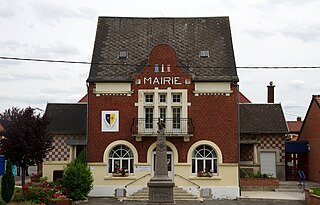
Roclincourt is a commune in the Pas-de-Calais department in northern France.

The former French Catholic diocese of Saint-Omer existed from 1559 until the French Revolution. Its see at Saint-Omer, in the modern department of Pas-de-Calais, was created as a reaction to the destruction of the see of Thérouanne, by military action in the wars of the Emperor Charles V. It then became a suffragan of the Archdiocese of Cambrai in 1559.
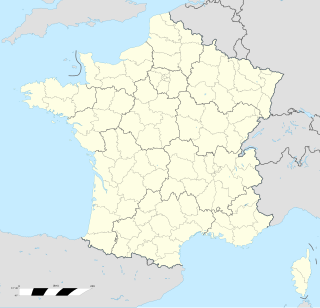
Puységur is a commune in the Gers department in southwestern France.
Louis Pierre de Chastenet, comte de Puységur was a French soldier under the Ancien Régime. A lieutenant général from 1781, he became minister of war in the ministry of Jacques Necker, from 30 November 1788 to 12 July 1789. Replaced by Victor-François, 2nd duc de Broglie, he received marks of esteem from the Assembly. Remaining faithful to the king, he commanded a small troop of gentlemen and defended the Tuileries against the Revolutionaries on 10 August 1792, and emigrated soon afterwards. He returned on Napoleon's seizure of power on 18 Brumaire and institution of the First French Empire, and died in his home town.

Jean Auguste de Chastenet de Puységur was a French bishop.
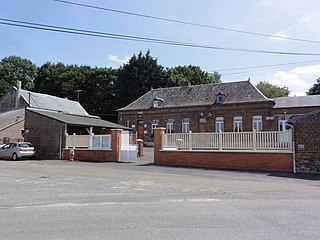
Aisonville-et-Bernoville is a commune in the department of Aisne in the Hauts-de-France region of northern France.
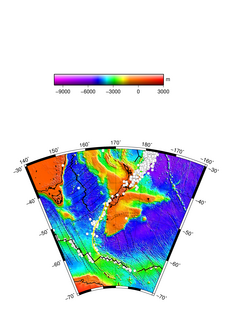
The Macquarie Fault Zone is a major right lateral-moving transform fault along the seafloor of the south Pacific Ocean which runs from New Zealand southwestward to the Macquarie Triple Junction. It is also the tectonic plate boundary between the Indo-Australian Plate to the northwest and the Pacific Plate to the southeast.

The Battle of La Marfée, also known as the Battle of Sedan, took place on 6 July, 1641, during the 1635 to 1659 Franco-Spanish War, a connected conflict of the Thirty Years War.
Events from the year 1807 in France.
Events from the year 1815 in France.

The 6,300-metre (20,700 ft) deep Puysegur Trench is a deep cleft in the floor of the south Tasman Sea formed by the subduction of the Indo-Australian Plate under the Pacific Plate to the south of New Zealand. Immediately to its east lies a ridge, a northern extension of the Macquarie Ridge, which separates the Puysegur Trench from the Solander Trough. To the west is the expanse of the Tasman Basin, which stretches most of the distance to Australia. To the north of the trench lies the Fiordland Basin, which can be considered an extension of the trench. The Puysegur Trench mirrors the Kermadec Trench and Tonga Trench north of New Zealand.

An unofficial referendum on whether to support the Free French or the Vichy regime was held in the French Oceanian islands of Mo'orea and Tahiti on 24 August 1940. The referendum was held following a call from Charles de Gaulle to oppose the Vichy government on 18 June, and was organised by the underground Free France Committee.
Events from the year 1751 in France.
The canton of Fleurance-Lomagne is an administrative division of the Gers department, southwestern France. It was created at the French canton reorganisation which came into effect in March 2015. Its seat is in Fleurance.
Guillaume Besaucèle was an ecclesiastic who was constitutional bishop of Aude from 1791 to 1801.
This page is based on this
Wikipedia article Text is available under the
CC BY-SA 4.0 license; additional terms may apply.
Images, videos and audio are available under their respective licenses.
