
In biochemistry, a kinase is an enzyme that catalyzes the transfer of phosphate groups from high-energy, phosphate-donating molecules to specific substrates. This process is known as phosphorylation, where the substrate gains a phosphate group and the high-energy ATP molecule donates a phosphate group. This transesterification produces a phosphorylated substrate and ADP. Conversely, it is referred to as dephosphorylation when the phosphorylated substrate donates a phosphate group and ADP gains a phosphate group. These two processes, phosphorylation and dephosphorylation, occur four times during glycolysis. Kinases are part of the larger family of phosphotransferases. Kinases should not be confused with phosphorylases, which catalyze the addition of inorganic phosphate groups to an acceptor, nor with phosphatases, which remove phosphate groups. The phosphorylation state of a molecule, whether it be a protein, lipid, or carbohydrate, can affect its activity, reactivity, and its ability to bind other molecules. Therefore, kinases are critical in metabolism, cell signalling, protein regulation, cellular transport, secretory processes, and many other cellular pathways, which makes them very important to human physiology.
Pip, PIP, Pips, PIPS, Pipp may refer to:

Phosphoinositide phospholipase C (PLC) is a family of eukaryotic intracellular enzymes that play an important role in signal transduction processes. These enzymes belong to a larger superfamily of Phospholipase C. Other families of phospholipase C enzymes have been identified in bacteria and trypanosomes. Phospholipases C are phosphodiesterases.

Phosphatidylinositol (3,4,5)-trisphosphate (PtdIns(3,4,5)P3), abbreviated PIP3, is the product of the class I phosphoinositide 3-kinases (PI 3-kinases) phosphorylation of phosphatidylinositol (4,5)-bisphosphate (PIP2). It is a phospholipid that resides on the plasma membrane.

Phosphoinositide 3-kinases (PI3Ks), also called phosphatidylinositol 3-kinases, are a family of enzymes involved in cellular functions such as cell growth, proliferation, differentiation, motility, survival and intracellular trafficking, which in turn are involved in cancer.

Phosphatidylinositol 4,5-bisphosphate or PtdIns(4,5)P2, also known simply as PIP2 or PI(4,5)P2, is a minor phospholipid component of cell membranes. PtdIns(4,5)P2 is enriched at the plasma membrane where it is a substrate for a number of important signaling proteins.
Phosphatidylinositol 3,5-bisphosphate is one of the seven phosphoinositides found in eukaryotic cell membranes.
In quiescent cells, the PtdIns(3,5)P2 levels, typically quantified by HPLC, are the lowest amongst the constitutively present phosphoinositides. They are approximately 3 to 5-fold lower as compared to PtdIns3P and PtdIns5P levels, and more than 100-fold lower than the abundant PtdIns4P and PtdIns(4,5)P2.
PtdIns(3,5)P2 was first reported to occur in mouse fibroblasts and budding yeast S. cerevisiae in 1997.
In S. cerevisiae PtdIns(3,5)P2 levels increase dramatically during hyperosmotic shock.
The response to hyperosmotic challenge is not conserved in most tested mammalian cells except for differentiated 3T3L1 adipocytes.
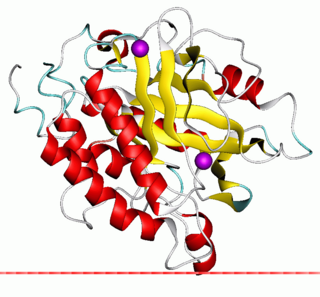
In enzymology, a phosphatidylinositol diacylglycerol-lyase is an enzyme that catalyzes the chemical reaction
In enzymology, a phosphatidylinositol-3,4,5-trisphosphate 3-phosphatase (EC 3.1.3.67) is an enzyme that catalyzes the chemical reaction
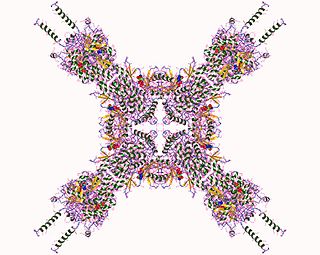
In enzymology, a 1-phosphatidylinositol 4-kinase is an enzyme that catalyzes the chemical reaction

Phosphatidylinositol 4-kinase beta is an enzyme that in humans is encoded by the PI4KB gene.

Phosphatidylinositol 4-kinase alpha is an enzyme that in humans is encoded by the PI4KA gene.

Phosphatidylinositol 4-kinase 2-alpha is an enzyme that in humans is encoded by the PI4K2A gene.
PIP2, or phosphatidylinositol biphosphate, is the products obtained by cleavage of PIP3, or by phosphorylation of PI(3)P, PI(4)P or PI(5)P.

Phosphatidylinositol 4-Phosphate-5 kinase (PI4P5K) or PIP5K or PI5K family regulates diverse cellular processes such as G protein-coupled receptor(GPCR) signaling, vesicle trafficking, chemotaxis and cellular movement. There are at least two types of PIP5K found which includes Type I and Type II. Other types are also suspected in the nervous system but have not been well reported. These enzyme synthesize diverse Phosphatidyl Inositol 4,5 bisphosphate by phosphorylating the D- 5 position of the inositol ring of Phosphatidylinositol 4-phosphate]. PIP5KI is the most extensively studied and is synthesizing for most of the PI(4,5)P2 pool the cell.

Gasdermin D (GSDMD) is a protein that in humans is encoded by the GSDMD gene on chromosome 8.
It belongs to the gasdermin family which is conserved among all vertebrates and comprises six members, GSDMA, GSDMB, GSDMC, GSDMD, DFNA5 and DFNB59. Members of the gasdermin family are mainly expressed in epithelial tissues and appear to play a role in regulation of epithelial proliferation and differentiation. GSDMA, GSDMC, GSDMD and DFNA5 have been suggested to act as tumour suppressors.
The PI(4,5)P2 cycle or simply PIP2 cycle (also known as PI cycle in past) is one of the important signalling cascades underlying many cellular functions including GPCR signaling, cytokinesis, endocytosis, and apoptosis.

