
Penalty, The Penalty, Penalization, Penalisation, Penalize or Penalise may refer to:
Penalty, The Penalty, Penalization, Penalisation, Penalize or Penalise may refer to:


Canadian football, or simply football, is a sport in Canada in which two teams of 12 players each compete on a field 110 yards (101 m) long and 65 yards (59 m) wide, attempting to advance a pointed oval-shaped ball into the opposing team's end zone.

Association football, more commonly known as football or soccer, is a team sport played between two teams of 11 players each, who primarily use their feet to propel a ball around a rectangular field called a pitch. The objective of the game is to score more goals than the opposing team by moving the ball beyond the goal line into a rectangular-framed goal defended by the opposing team. Traditionally, the game has been played over two 45-minute halves, for a total match time of 90 minutes. With an estimated 250 million players active in over 200 countries and territories, it is the world's most popular sport.
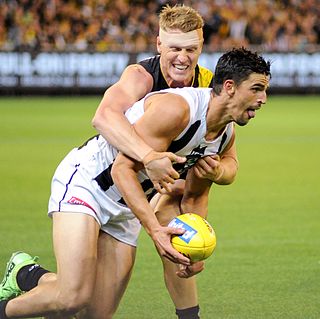
Most forms of football have a move known as a tackle. The primary purposes of tackling are to dispossess an opponent of the ball, to stop the player from gaining ground towards goal or to stop them from carrying out what they intend.
Pickup, pick-up or pick up may refer to:
Crusader or Crusaders may refer to:
A goal is an objective that a person or a system plans or intends to achieve.
Offside, off-side or off side may refer to:
"Power play" is a sporting term used to describe a period of play where one team has a numerical advantage in players, usually due to a rule violation by the opposing team.
An outlaw is a person living outside the law.
Hawkeye may refer to:

The penalty box or sin bin is the area in ice hockey, rugby union, rugby league, roller derby and some other sports where a player sits to serve the time of a given penalty, for an offence not severe enough to merit outright expulsion from the contest. Teams are generally not allowed to replace players who have been sent to the penalty box.
A scorpion is a predatory arthropod animal.
In rugby football, the penalty is the main disciplinary sanction available to the referee to penalise players who commit deliberate infringements. The team who did not commit the infringement are given possession of the ball and may either kick it towards touch, attempt a place kick at goal, or tap the ball with their foot and run it. It is also sometimes used as shorthand for penalty goal.
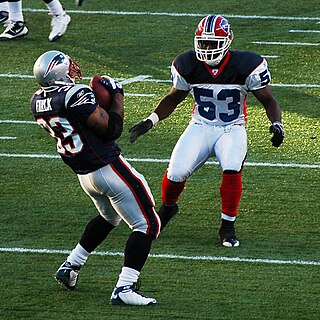
A fair catch is a feature of American football and several other codes of football, in which a player attempting to catch a ball kicked by the opposing team – either on a kickoff or punt – is entitled to catch the ball without interference from any member of the kicking team. A player, usually a return specialist, wishing to make a fair catch signals his intent by extending one arm above his head and waving it while the kicked ball is in flight. A ball caught in this manner becomes dead once caught, i.e., the player catching the ball is not entitled to advance the ball, and the receiving team begins its drive at the spot where the ball was caught.
A warrior is a person engaged or experienced in warfare, or a figurative term for a person who shows or has shown great vigor, courage, or aggressiveness, as in politics or athletics.

In sports, an ejection is the removal of a participant from a contest due to a violation of the sport's rules. The exact violations that lead to an ejection vary depending upon the sport, but common causes for ejection include unsportsmanlike conduct, violent acts against another participant that are beyond the sport's generally accepted standards for such acts, abuse against officials, violations of the sport's rules that the contest official deems to be egregious, or the use of an illegal substance to better a player's game. Most sports have provisions that allow players to be ejected, and many allow for the ejection of coaches, managers, or other non-playing personnel. In sports that use penalty cards, a red card is often used to signal dismissals. In some sports, another player is permitted to enter the game in place of the player who has been ejected, but in others the team is required to continue the game with a reduced number of players.

Penalty cards are used in many sports as a means of warning, reprimanding or penalising a player, coach or team official. Penalty cards are most commonly used by referees or umpires to indicate that a player has committed an offence. The official will hold the card above their head while looking or pointing toward the player who has committed the offence. This action makes the decision clear to all players, as well as spectators and other officials in a manner that is language-neutral. The colour or shape of the card used by the official indicates the type or seriousness of the offence and the level of punishment that is to be applied. Yellow and red cards are the most common, typically indicating, respectively, cautions and dismissals.

Unsportsmanlike conduct is a foul or offense in many sports that violates the sport's generally accepted rules of sportsmanship and participant conduct. Examples include verbal abuse, taunting of an opponent or a game official, an excessive celebration following a significant play, or feigning injury. The official rules of many sports include a general provision whereby participants or an entire team may be penalized or otherwise sanctioned for unsportsmanlike conduct.
A lioness is a female lion.

The 1995 Rugby World Cup Final was the final match of the 1995 Rugby World Cup, played in South Africa. The match was played at Ellis Park Stadium, Johannesburg on 24 June 1995 between the host nation, South Africa, and New Zealand.