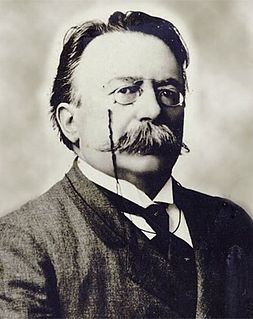
Andrea Costa was an Italian Master Mason and socialist activist, born in Imola. Initiated in September 25 1883 to the Masonic Lodge "Rienzi" in Rome, he progressively become 32nd degree Mason and adjunctive Great Master of the Grande Oriente d'Italia. He co-founded the Partito dei Lavoratori Italiani in 1892 after renouncing his anarchist principles in 1879. It is probable that this happened due to his marriage to Russian Socialist Anna Kulischov. In his later years Costa was an active politician; he served as mayor of Imola and as a representative in the Italian Parliament. He died in Imola in 1910. His close friend and masonic brother Giovanni Pascoli wrote the funeral inscription dedicated to him, whom he knew together with Alceste Faggioli when he was a university student.

Giovanni Placido Agostino Pascoli was an Italian poet, classical scholar and an emblematic figure of Italian literature in the late nineteenth century. He was, together with Gabriele D'Annunzio, the greatest Italian decadent poet.

The University of Messina, known colloquially as UniME, is a state university located in Messina, Sicily, Italy. Founded in 1548 by Pope Paul III, it was the world's first Jesuit college and today it is considered one of the oldest universities in Italy.

Riccardo Zandonai was an Italian composer.
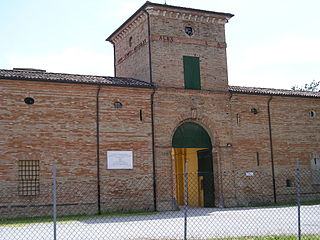
San Mauro Pascoli is a comune (municipality) in the Province of Forlì-Cesena in the Italian region Emilia-Romagna, located about 100 kilometres (62 mi) southeast of Bologna and about 35 kilometres (22 mi) southeast of Forlì. It is at some 7.5 kilometres (4.7 mi) from the sea, the frazione of San Mauro Mare facing it.

Luigi Garzi was an Italian painter of the Baroque period, whose work displayed heavy influences of the Bolognese painter, Guido Reni.

Giovanni Battista Benaschi, or Beinaschi, (1636–1688) was an Italian painter and engraver active in the Mannerist and Baroque style.

Piadina[pjaˈdiːna] or Piada[ˈpjaːda] is a thin Italian flatbread, typically prepared in the Romagna historical region. It is usually made with white flour, lard or olive oil, salt and water. The dough was traditionally cooked on a terracotta dish, although nowadays flat pans or electric griddles are commonly used.

Dante Alighieri, is a public artwork by Italian artist Ettore Ximenes, located at Meridian Hill Park in Washington, D.C., United States. Dante Alighieri was originally surveyed as part of the Smithsonian Institution's Save Outdoor Sculpture! survey in 1994. The monument is a tribute to Italian poet Dante Alighieri.

Giuseppe Zanotti is an Italian luxury footwear and fashion designer known for his sculptural, jeweled heels, luxury sneakers, handbags, jewelry, and leather ready-to-wear.
Lione Pascoli was an Italian abbot, art historian, collector, and economist.
Lione is both an Italian surname and a given name. Notable people with the name include:

Luigi Mercatelli was an Italian politician, attorney and diplomatic.
Taije Silverman is an American poet, translator, and professor. She currently teaches at the Department of English at the University of Pennsylvania.

Cavallina storna is a 1953 Italian historical melodrama film directed by Giulio Morelli and starring Gino Cervi. It is loosely based on some autobiographical poems by Giovanni Pascoli. It grossed about 145 million lire at the Italian box office.

Mariù Pascoli is the pseudonym of the Italian writer and poet Maria Pascoli. She is the sister of the poet Giovanni Pascoli, whom she assisted until his death and whose archives she kept in the house that bears his name.

Castelvecchio di Barga, officially Castelvecchio Pascoli, is a village in Tuscany in central Italy. Administratively, it is a frazione of the comune of Barga, in the province of Lucca, in the Serchio Valley, where poet Giovanni Pascoli bought the house "Cardosi-Carrara".
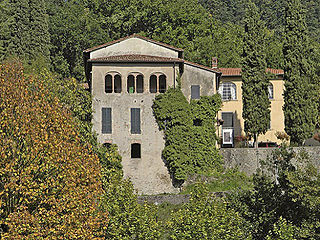
The Pascoli House Museum opened in Castelvecchio Pascoli, Tuscany, Italy in 1960 and is devoted to the exhibition of the Italian writer Giovanni Pascoli's personal poetry.
The Braschi family is an Italian noble family established in Cesena in the 12th century. The family achieved great notoriety with the election of one of its members, Giannangelo Braschi as Pope of the Catholic Church
This page is based on this
Wikipedia article Text is available under the
CC BY-SA 4.0 license; additional terms may apply.
Images, videos and audio are available under their respective licenses.

