A kit lens is a "starter" lens which can be sold with an interchangeable-lens camera such as a mirrorless camera or DSLR. It is generally an inexpensive lens priced at the lowest end of the manufacturer's range so as to not add much to a camera kit's price. The kit consists of the camera body, the lens, and various accessories usually necessary to get started. A kit lens can be sold by itself outside of a kit, particularly the ones that are moderately expensive; for instance a kit lens included in a prosumer camera kit is often marketed as an upgrade lens for a consumer camera. In addition, retailers often have promotions of standalone low-end camera bodies without the lens, or a package that bundles a body with one or two more expensive lenses.

The Nikon F-mount is a type of interchangeable lens mount developed by Nikon for its 35mm format single-lens reflex cameras. The F-mount was first introduced on the Nikon F camera in 1959, and features a three-lug bayonet mount with a 44 mm throat and a flange to focal plane distance of 46.5 mm. The company continues, with the 2020 D6 model, to use variations of the same lens mount specification for its film and digital SLR cameras.

The Nikon DX format is an alternative name used by Nikon corporation for APS-C image sensor format being approximately 24x16 mm. Its dimensions are about 2⁄3 those of the 35mm format. The format was created by Nikon for its digital SLR cameras, many of which are equipped with DX-sized sensors. DX format is very similar in size to sensors from Pentax, Sony and other camera manufacturers. All are referred to as APS-C, including the Canon cameras with a slightly smaller sensor.

The Nikon D40 is a 6.1-megapixel DX format DSLR Nikon F-mount camera announced by Nikon on November 16, 2006. It replaces the D50 as Nikon's entry level DSLR. It features a 2.5-inch 230,000-dot resolution LCD monitor, CCD sensor with ISO 200-1600 and 3D Color Matrix Metering.
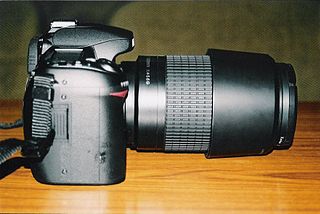
The 70-300mm lens is a telephoto zoom lens made by Nikon. The lens has an F-mount to work with all the SLRs line of cameras, although the more recent AF-P lenses will not focus on film SLRs or older DSLRs.

The Nikon D60 is a 10.2-megapixel Nikon F-mount digital single-lens reflex camera announced in January 2008. The D60 succeeds the entry-level Nikon D40x. It features the Nikon EXPEED image processor introduced in the higher-end Nikon D3 and D300.
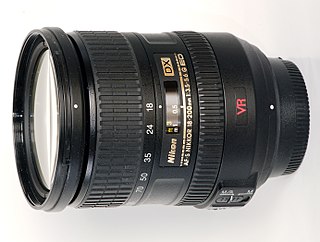
The Nikon AF-S DX VR Zoom-Nikkor 18-200mm f/3.5-5.6G IF-ED is an image stabilised superzoom lens manufactured by Nikon for use on Nikon DX format digital SLR cameras. It provides a single-lens "walk-around" solution for wide-angle through to telephoto shots, as well as close-up photography.

The 55-200mm AF-S lens is a medium telephoto zoom lens manufactured by Nikon for use on Nikon DX format digital SLR cameras. It comes in three variants:

The Nikon AF-S DX Zoom-Nikkor 16-85mm f/3.5-5.6G IF-ED VR is a wide to medium telephoto zoom lens produced by Nikon Corporation for its Nikon DX format digital SLR cameras.

The AF-S DX Nikkor 18-105mm f/3.5-5.6G ED VR is a superzoom lens manufactured by Nikon, introduced in August 2008 for use on Nikon DX format digital SLR cameras. This lens is sold as a kit lens for the Nikon D90, Nikon D7000, Nikon D5100, Nikon D5200 and Nikon D3200 cameras, but it also can be purchased separately from the camera body.

The Nikon 1 series is a discontinued camera line from Nikon, originally announced on 21 September 2011. The cameras utilized Nikon 1-mount lenses, and featured 1" CX format sensors.

The Nikon AF-S 17-55mm f/2.8 G IF-ED DX was announced in 2004. It is a F-mount professional zoom lens with a constant fast aperture of f/2.8 designed for Nikon DX digital SLR cameras. Nikon have incorporated their Silent Wave Motor for silent auto focusing. The lens is made mostly of metal and the rubber sealed rear mount makes the lens partially dust and water resistant. Dimensions of the lens are 85.5 x 110.5mm. The filter size is 77mm and the lens weighs 755g.
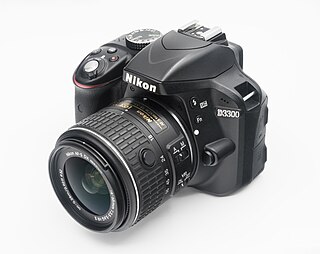
Nikon D3300 is a 24.2-megapixel DX format DSLR Nikon F-mount camera officially launched by Nikon on 7 January 2014. It was marketed as an entry-level DSLR camera for beginners and experienced DSLR hobbyist who were ready for more advanced specs and performance. It replaced the D3200 as Nikon's entry level DSLR. The D3300 usually came with an 18-55mm VR II kit lens, which is the upgraded model of older VR lens. The new kit lens has the ability to retract its barrel, shortening it for easy storage.

The AF-S DX Nikkor 18-140mm f/3.5-5.6G ED VR is a superzoom lens manufactured by Nikon, introduced in August 2013 for use on Nikon DX format digital SLR cameras.
The 18-300mm f/3.5-6.3G lens is a telephoto superzoom lens manufactured by Nikon for its line of DX DSLR cameras.
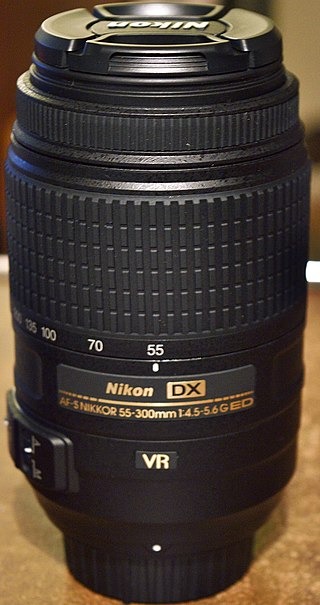
The 55-300mm f/4.5-5.6G AF-S lens is a telephoto superzoom lens manufactured by Nikon for its line of DX DSLR cameras.
The 18-300mm f/3.5-5.6G ED VR is a telephoto superzoom lens manufactured by Nikon for its line of DX DSLR cameras.
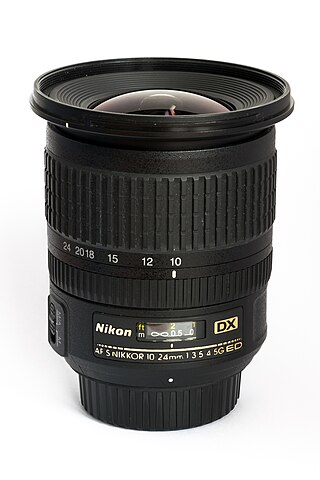
The AF-S DX Zoom-Nikkor 10-24mm f/3.5-4.5G ED is a lens manufactured by Nikon for use on Nikon DX format digital SLR cameras. It provides an angle of view on a DX format camera similar to that of a 15-35mm lens on a 135 film format camera.

Nikon Z-mount is an interchangeable lens mount developed by Nikon for its mirrorless digital cameras. In late 2018, Nikon released two cameras that use this mount, the full-frame Nikon Z7 and Nikon Z6. In late 2019 Nikon announced their first Z-mount camera with an APS-C sensor, the Nikon Z50. In July 2020 the entry-level full-frame Z5 was introduced. In October 2020, Nikon announced the Nikon Z6II and Nikon Z7II, which succeed the Z6 and Z7, respectively. The APS-C lineup was expanded in July 2021, with the introduction of the retro styled Nikon Zfc, and in October 2021, Nikon unveiled the Nikon Z9, which effectively succeeds the brand's flagship D6 DSLR. The APS-C lineup was further expanded with the Nikon Z30, announced at the end of June 2022. The Nikon Z6III was announced in June 2024. In November 2024, Nikon announced the Z50II, the first APS-C camera to use the Expeed 7 processor introduced with the Z9.



![Uncropped and Edited image of a British Roasted Pork Dish. Image Size: L (6016 x 4000), Date Shot: 8/4/2015 18:29:54.40, Time Zone and Date: UTC+5:30, Device: Nikon D3200, Lens: Nikon AF-S DX Zoom-Nikkor 18-55mm f/3.5-5.6G VR, Focal Length: 36mm, Focus Mode: AF-A, AF-Area Mode: Auto, VR: ON, Aperture: f/5, Shutter Speed: 1/60s, Exposure Mode: Aperture Priority, Exposure Comp.: 0EV, ISO Sensitivity: ISO 400, Flash Device: Built-in Flash, Flash Sync Mode: Front Curtain, Color Space: sRGB, High ISO NR: ON (Normal), Picture Control: [SD] STANDARD, Base: [SD] STANDARD, Edited Using: Nikon ViewNX 2, Photographer and Editor: Viraj Brian Wijesuriya. Roasted Pork Dish.JPG](http://upload.wikimedia.org/wikipedia/commons/thumb/0/07/Roasted_Pork_Dish.JPG/260px-Roasted_Pork_Dish.JPG)


