
Konica Minolta, Inc. is a Japanese multinational technology company headquartered in Marunouchi, Chiyoda, Tokyo, with offices in 49 countries worldwide. The company manufactures business and industrial imaging products, including copiers, laser printers, multi-functional peripherals (MFPs) and digital print systems for the production printing market. Konica Minolta's Managed Print Service (MPS) is called Optimised Print Services. The company also makes optical devices, including lenses and LCD film; medical and graphic imaging products, such as X-ray image processing systems, colour proofing systems, and X-ray film; photometers, 3-D digitizers, and other sensing products; and textile printers. It once had camera and photo operations inherited from Konica and Minolta but they were sold in 2006 to Sony, with Sony's Alpha series being the successor SLR division brand.

Minolta Co., Ltd. was a Japanese manufacturer of cameras, camera accessories, photocopiers, fax machines, and laser printers. Minolta Co., Ltd., which is also known simply as Minolta, was founded in Osaka, Japan, in 1928 as Nichi-Doku Shashinki Shōten. It made the first integrated autofocus 35 mm SLR camera system. In 1931, the company adopted its final name, an acronym for "Mechanism, Instruments, Optics, and Lenses by Tashima".

The Minolta MAXXUM 7000 35 mm SLR camera was introduced in February 1985. It was the first camera to feature both integrated autofocus (AF) and motorised film advance, the standard configuration for later amateur and professional single lens reflex cameras.

Sigma Corporation is a Japanese company, manufacturing cameras, lenses, flashes and other photographic accessories. All Sigma products are produced in the company's own Aizu factory in Bandai, Fukushima, Japan. Although Sigma produces several camera models, the company is best known for producing high-quality lenses and other accessories that are compatible with the cameras produced by other companies.

Sony α is a brand of digital camera. This line has been active since 2006, building upon the Konica Minolta camera technologies, whose assets were acquired by Sony.

The Maxxum 7D, labelled Dynax 7D in Europe/Hong Kong and α-7 Digital in Japan and officially named "DG-7D", is a 6.1 megapixel digital single-lens reflex camera, or DSLR, produced by Konica Minolta. It was the top model of their DSLR range; the Maxxum/Dynax 5D consumer-grade model was the other.

The Minolta AF Zoom 70–210mm f/4 lens is an autofocusing telephoto photographic lens compatible with cameras using the Minolta AF lens mount.

Originally produced by Minolta, and currently produced by Sony, the AF 75-300mm F4.5-5.6, is a telephoto zoom photographic lens compatible with cameras using the Minolta AF and Sony α lens mounts.

The Minolta A-mount camera system was a line of photographic equipment from Minolta introduced in 1985 with the world's first integrated autofocus system in the camera body with interchangeable lenses. The system used a lens mount called A-mount, with a flange focal distance 44.50 mm, one millimeter longer, 43.5 mm, than the previous SR mount from 1958. The new mount was wider, 49.7 mm vs. 44.97 mm, than the older SR-mount and due to the longer flange focal distance, old manual lenses were incompatible with the new system. Minolta bought the autofocus technology of Leica Correfot camera which was partly used on the a-mount autofocus technology. The mount is now used by Sony, who bought the SLR camera division from Konica Minolta, Konica and Minolta having merged a few years before.
Originally produced by Minolta starting in 1985, then produced by Sony from 2006 until 2022, the AF Apo Tele 300mm f/2.8 is a professional telephoto prime photographic lens compatible with cameras using the Minolta A-mount and Sony A-mount lens mounts. The name indicates it has an apochromatic design and is part of the G series, Minolta's designation for high-performance lenses. Later versions included "High Speed" gearing; starting in 2003, the lens was recomputed with a new optical design and equipped with a focusing distance encoder for the Advance Distance Integration (ADI) flash system.

Originally produced by Minolta, and later produced by Sony, the AF Macro 50mm f/2.8 is a macro prime photographic lens compatible with cameras using the Minolta A-mount and Sony A-mount lens mounts.

The Pentax ME F was an amateur level, interchangeable lens, 35 mm film, single-lens reflex (SLR) camera. It was manufactured by Asahi Optical Co., Ltd. of Japan from November 1981 to 1984. The ME F was a heavily modified version of the Pentax ME-Super, and a member of the Pentax M-series family of SLRs. It was the first mass-produced SLR camera to come with an autofocus system.

The Konica Minolta DiMAGE A2 is a digital bridge camera which was manufactured by Konica Minolta, announced at the Photo Marketing Association exposition on February 12, 2004 as the flagship of Konica Minolta's fixed-lens DiMAGE digital camera line. It was similar to and succeeded the Minolta DiMAGE A1 (2003) and was supplemented by the DiMAGE A200 (2004) prior to Konica Minolta selling off its camera division to Sony in 2006.

The Minolta AF Macro 100 mm f/2.8 lens is a discontinued macro lens produced by Minolta that was renowned for its sharpness all the while garnering raving reviews also. This lens achieves a true 1:1 magnification of the subject matter of interest to the photographer. While still having an aperture of f/2.8 coupled with its focal length of 100 mm, it is considered a double duty lens for macro photography and portraiture/portrait photography.

This article details lensesfor single-lens reflex and digital single-lens reflex cameras. The emphasis is on modern lenses for 35 mm film SLRs and for "full-frame" DSLRs with sensor sizes less than or equal to 35 mm.

The Konica Hexar is a 35 mm fixed-lens, fixed focal length autofocus camera which was produced through the 1990s. It was introduced to the market in 1993. While styled like a rangefinder camera, and intended for a similar style of photography, in specification it is more like a larger "point and shoot" camera.

Sony α100 (DSLR-A100) is the first digital single-lens reflex camera (DSLR) marketed by Sony in 2006. It is the successor to the previous Konica Minolta DSLR models through Sony's purchase of the Konica Minolta camera division. The α100 retains a similar body design and claimed improvements on Konica Minolta's Anti-Shake sensor-shifting image stabilization feature, renamed Super SteadyShot. It uses a 10.2 megapixel APS-C sized CCD sensor. Another notable feature inherited from Konica Minolta is Eyestart, which provides for automatic autofocus activation by detecting the presence of the photographer's eye on the viewfinder, thus quickening the camera's response.

The E-mount is a lens mount designed by Sony for their NEX and ILCE series of camcorders and mirrorless cameras. The E-mount supplements Sony's α mount, allowing the company to develop more compact imaging devices while maintaining compatibility with 35mm sensors. E-mount achieves this by:
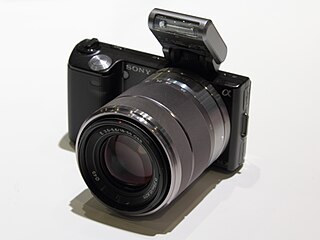
The Sony α NEX-5 is a digital camera launched on 11 May 2010. It is a mirrorless interchangeable lens camera with the body size of a larger model fairly compact point-and-shoot camera with a larger sensor size (APS-C) comparable to that of some digital single-lens reflex cameras. Its major competitors in the market are the cameras based on the micro 4/3 standard created by Panasonic and Olympus, and a few low end Canon, Nikon, and even Sony α DSLRs. The NEX-5 shoots 14.2 megapixel stills and has a 7 frame/s continuous shotmode. It has the capability to shoot 1920×1080i at 60 frame/s in AVCHD or 1440×1080p at 30 frame/s in MPEG4. The NEX-5 was replaced by the 16 megapixel NEX-5N in August 2011.

 No
No

