Related Research Articles
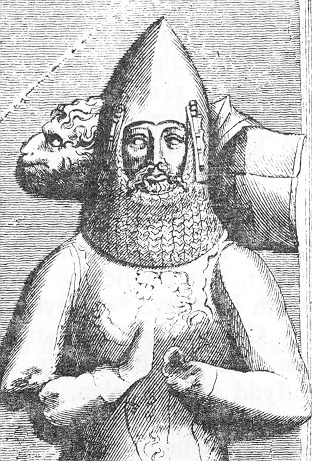
Rhys ap Gruffydd, commonly known as The Lord Rhys, in Welsh Yr Arglwydd Rhys was the ruler of the Welsh kingdom of Deheubarth in south Wales from 1155 to 1197 and native Prince of Wales.
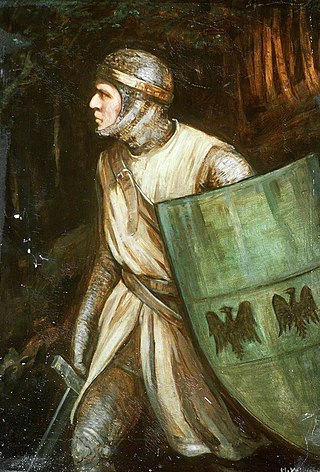
Owain ap Gruffudd was King of Gwynedd, North Wales, from 1137 until his death in 1170, succeeding his father Gruffudd ap Cynan. He was called Owain the Great and the first to be styled "Prince of Wales", and the "Prince of the Welsh". He is considered to be the most successful of all the North Welsh princes prior to his grandson, Llywelyn the Great. He became known as Owain Gwynedd to distinguish him from the contemporary king of Powys Wenwynwyn, Owain ap Gruffydd ap Maredudd, who became known as Owain Cyfeiliog.

The Kingdom of Powys was a Welsh successor state, petty kingdom and principality that emerged during the Middle Ages following the end of Roman rule in Britain. It very roughly covered the northern two-thirds of the modern county of Powys and part of today's English West Midlands. More precisely, and based on the Romano-British tribal lands of the Ordovices in the west and the Cornovii in the east, its boundaries originally extended from the Cambrian Mountains in the west to include the modern West Midlands region of England in the east. The fertile river valleys of the Severn and Tern are found here, and this region is referred to in later Welsh literature as "the Paradise of Powys".
Maelgwn ap Rhys was prince of part of the kingdom of Deheubarth in south west Wales.

Madog ap Llywelyn was the leader of the Welsh revolt of 1294–95 against English rule in Wales and proclaimed "Prince of Wales". The revolt was surpassed in longevity only by the revolt of Owain Glyndŵr in the 15th century. Madog belonged to a junior branch of the House of Aberffraw and was a distant relation of Llywelyn ap Gruffudd, the last recognised native Prince of Wales.
Gruffydd ap Rhys II was a prince of Deheubarth in south-west Wales.
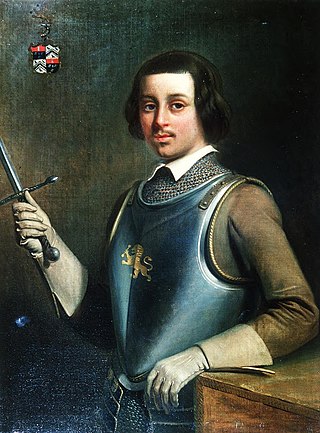
Rhys Gryg, real name Rhys ap Rhys, also known as Rhys Fychan, was a Welsh prince who ruled part of the Kingdom of Deheubarth.

Maelienydd, sometimes spelt Maeliennydd, was a cantref and lordship in east central Wales covering the area from the River Teme to Radnor Forest and the area around Llandrindod Wells. The area, which is mainly upland, is now in Powys. During the Middle Ages it was part of the region known as Rhwng Gwy a Hafren and its administrative centre was at Cefnllys Castle.
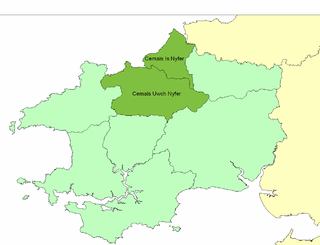
Cemais was an ancient cantref of the Kingdom of Dyfed, from the 11th century a Norman Marcher Lordship, from the 16th century a Hundred, and is now part of Pembrokeshire, Wales. It occupied the coastal area between the Teifi estuary and Fishguard, and the northern and southern slopes of the Preseli Hills, covering an area of approximately 140 square miles (360 km2). The Afon Nyfer divided it into two commotes: Cemais Is Nyfer to the north and Cemais Uwch Nyfer to the south.
This article is about the particular significance of the century 1201–1300 to Wales and its people.
This article is about the particular significance of the century 1101–1200 to Wales and its people.

Wales in the High Middle Ages covers the 11th to 13th centuries in Welsh history. Beginning shortly before the Norman invasion of the 1060s and ending with the Conquest of Wales by Edward I between 1278 and 1283, it was a period of significant political, cultural and social change for the country.

Elfael was one of a number of Welsh cantrefi occupying the region between the River Wye and river Severn, known as Rhwng Gwy a Hafren, in the early Middle Ages. It was divided into two commotes, Is Mynydd and Uwch Mynydd, separated by the chain of hills above Aberedw. In the late medieval period, it was a marcher lordship. However, after the Laws in Wales Act of 1535, it was one of the territorial units which went to make up the county of Radnorshire in 1536.

The history of Gwynedd in the High Middle Ages is a period in the History of Wales spanning the 11th through the 13th centuries. Gwynedd, located in the north of Wales, eventually became the most dominant of Welsh polities during this period. Contact with continental courts allowed for Gwynedd to transition from a petty kingdom into an increasingly sophisticated principality of seasoned courtiers capable of high level deplomacy and representation; not only with the Angevine kings, but also the king of France and the Papal See. Distinctive achievements in Gwynedd include further development of Medieval Welsh literature, particularly poets known as the Beirdd y Tywysogion associated with the court of Gwynedd; the reformation of bardic schools; and the continued development of Cyfraith Hywel. All three of these further contributed to the development of a Welsh national identity in the face of Anglo-Norman encroachment of Wales.
Cynan ap Maredudd was a Welsh nobleman who assumed leadership of the Welsh revolt of Madog ap Llywelyn in the mid-Wales area in 1294 and 1295.

Sir Rhys ap Thomas (1449–1525) was a Welsh soldier and landholder who rose to prominence during the Wars of the Roses, and was instrumental in the victory of Henry Tudor at the Battle of Bosworth. He remained a faithful supporter of Henry and was rewarded with lands and offices in South Wales. Some sources claim that he personally delivered the death blow to King Richard III at Bosworth with his poleaxe.
Sir Gruffydd Llywd, or Gruffydd ap Rhyd ap Gruffydd ap Ednyfed was a Welsh nobleman notable for his involvement in quashing Roger Mortimer’s 1322 revolt against King Edward II. Throughout his life until his death in 1335, Llwyd held high-ranking positions in Welsh society, with Lordships in Tregarnedd and Dinorwig and serving as Sheriff of Caernarfonshire, Anglesey and Merionethshire. Son of loyalist Rhys ap Gruffyd, Gruffyd Llwyd was a supporter of King Edward I and King Edward II, helping to enforce conformity to English rule along the Welsh Marches. Historical folklore has often mistakenly portrayed Llwyd as a ‘Welsh Rebel’ who challenged King Edward II, though this has been strongly disputed by historians.

A series of Welsh rebellions broke out in the century following the conquest of Wales by Edward I in 1283, which had brought the whole of Wales under the control of the Kingdom of England for the first time. In 1400, Welsh discontent with English rule in Wales culminated in the Welsh Revolt, a major uprising led by Owain Glyndŵr, who achieved de facto control over much of the country in the following years. The rebellion petered out after 1409, and after complete English control was restored in 1415 no further major rebellions occurred.
References
- J. E. Morris, The Welsh Wars of Edward I a contribution to mediaeval military history, based on original documents, Oxford, 1901
- Bridgeman, History of the Princes of South Wales, 1876
- https://biography.wales/article/s-MAEL-APR-1295