Related Research Articles
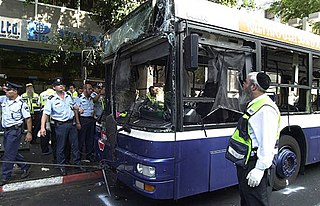
The Second Intifada, also known as the Al-Aqsa Intifada, was a major Palestinian uprising against Israel. The general triggers for the unrest are speculated to have been centred around the failure of the 2000 Camp David Summit, which was expected to reach a final agreement on the Israeli–Palestinian peace process in July 2000. Outbreaks of violence began in September 2000, after Israeli prime minister Ariel Sharon made a provocative visit to the Temple Mount in Jerusalem; the visit itself was peaceful, but, as anticipated, sparked protests and riots that were put down by Israeli police with rubber bullets and tear gas.
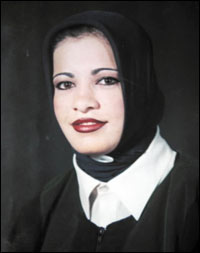
Hanadi Tayseer Abdul Malek Jaradat, a Palestinian militant from Jenin, blew herself up on Saturday, October 4, 2003 in a suicide attack on Maxim restaurant in the northern Israeli city of Haifa. Twenty-one people were killed and 51 injured. Among the dead were four Israeli children, including an infant, and three Arabs. She was the sixth female suicide bomber of the Al-Aqsa Intifada and the second woman recruited by Islamic Jihad.

The Maxim restaurant suicide bombing was a suicide bombing which occurred on October 4, 2003 in the beachfront "Maxim" restaurant in Haifa, Israel. Twenty-one people were killed in the attack and 60 were injured. Among the victims were two families and four children, including a two-month-old baby.
As part of the Arab–Israeli conflict, especially during the Second Intifada from 2000 to 2005, Palestinian militant groups used children for suicide bombings. Minors were recruited to attack Israeli targets, both military and civilian. This deliberate involvement of children in armed conflict was condemned by international human rights organizations.

The Murder of the Hatuel family was a shooting attack on May 2, 2004, in which Palestinian militants killed Tali Hatuel, a Jewish settler, who was eight months pregnant, and her four daughters, aged two to eleven. The attack took place near the Kissufim Crossing near their home in Gush Katif bloc of Israeli settlements in the Gaza Strip during the Second Intifada. After shooting at the vehicle in which Hatuel was driving with her daughters, witnesses said the militants approached the vehicle and shot the occupants repeatedly at close range.
Zakaria Muhammad 'Abdelrahman Zubeidi is the former Jenin chief of the Al-Aqsa Martyrs' Brigades.
The Sbarro restaurant suicide bombing, also called the Sbarro massacre, was a Palestinian terrorist attack on a pizzeria in downtown Jerusalem, on 9 August 2001, in which 15 civilians were killed, including 7 children and a pregnant woman, and 130 wounded.

Wafa Idris was the first female suicide bomber in the Israeli–Palestinian conflict. At the time of her death, Idris was a 28-year-old, divorced Red Crescent Volunteer. She lived in the Am'ari Refugee Camp in Ramallah.

The murder of Shalhevet Pass was a shooting attack carried out in Hebron, West Bank, on 26 March 2001, in which a Palestinian sniper killed 10-month-old Israeli infant Shalhevet Pass. The event shocked the Israeli public, partly because an investigation ruled that the sniper had deliberately aimed for the baby. According to Deborah Sontag of the New York Times, the murder became a "potent Israeli symbol as an innocent victim of the raging violence."
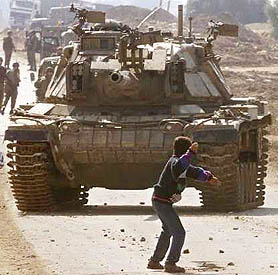
Faris Odeh was a Palestinian boy shot dead by the Israel Defense Forces near the Karni crossing in the Gaza Strip while throwing stones in the second month of the Al-Aqsa Intifada.

The Land of the Settlers is a five-part documentary series created by Chaim Yavin, who was described by the Arab News as "the Israeli version of America’s Walter Cronkite". With a handheld camera, Yavin traveled throughout his homeland of Israel and interviewed a range of Palestinians and Israelis in order to document the Israeli–Palestinian conflict. Released in 2005, his series was too controversial to air on Israel's public TV station, Channel 1, despite the fact that he had helped to create the station and served as its lead anchorman. It ran instead on Channel 2, creating a stir for its sympathy towards Palestinians.
Reem Saleh Riyashi was a Palestinian suicide bomber from Gaza City who killed herself and four Israelis at the Erez crossing on January 14, 2004. Hamas and the Al-Aqsa Martyrs Brigade claimed that the attack by Riyashi was a joint operation mounted as a response to weeks of Israeli incursions into West Bank cities that had left about 25 Palestinians dead.

Juliano Mer-Khamis was an Israeli/Palestinian actor, director, filmmaker, and political activist of Jewish and Palestinian Eastern Orthodox Christian parentage. On 4 April 2011, he was assassinated by a masked gunman in the Palestinian city of Jenin, where he had established The Freedom Theatre.
The Parents Circle-Families Forum (PCFF) is a grassroots organization of Palestinian and Israeli families who have lost immediate family members due to the conflict. The PCFF operates under the principle that a process of reconciliation is a prerequisite for achieving a sustained peace. The PCFF is also known as Israeli Palestinian Bereaved Families for Reconciliation and Peace and as Bereaved Families Supporting Peace, Reconciliation, and Tolerance.

Children in the Israeli–Palestinian conflict refers to the impact of the Israeli–Palestinian conflict on minors in Israel and the Palestinian territories. Laurel Holliday, in her 1999 book Children of Israel/Palestine, writes that two "ethnically distinct peoples – both Palestinians and Israeli Jews – lay claim to the very same sand, stone, rivers, vegetation, seacoast, and mountains" and that the stories she presents show that "Israeli and Palestinian children grow up feeling that they are destined for conflict with their neighbors".
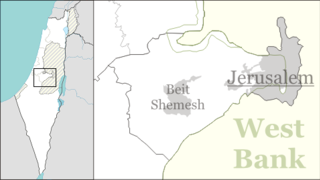
The Yeshivat Beit Yisrael massacre was a Palestinian suicide bombing which occurred in the Beit Yisrael neighborhood in downtown Jerusalem on March 2, 2002. Eleven Israeli civilians were killed in the attack, including two infants, three children and two teenagers. Over 50 people were injured in the attack, four of them critically. The bombing took place at the entrance of the Haredi yeshiva "Beit Yisrael" in central Jerusalem where people had gathered for a bar mitzvah celebration. The suicide bomber detonated the bomb full of shrapnel alongside a group of women with their baby strollers, waiting for the services in a nearby synagogue to conclude. The Palestinian militant organization al-Aqsa Martyrs' Brigades claimed responsibility for the attack.
The Jaffa Street bombing was a suicide bombing on January 27, 2002, in which Wafa Idris, a 28-year-old female Palestinian suicide bomber, blew herself up in the center of Jerusalem, killing one person and injuring about 100 others.
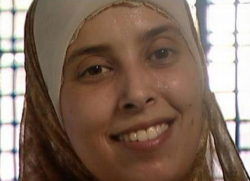
Ahlam Ahmad al-Tamimi is a Jordanian terrorist known for assisting in carrying out the Sbarro restaurant suicide bombing in Jerusalem, in 2001. She was convicted by an Israeli military tribunal and received multiple life sentences, but was released in 2011 as part of the Gilad Shalit prisoner exchange. She hosts a television show about Palestinians in Israeli prisons.

Palestinian stone-throwing refers to a Palestinian practice of throwing stones at people or property. It is a tactic with both a symbolic and military dimension when used against heavily armed troops. Proponents, sympathizers, as well as analysts have characterized stone throwing by Palestinians as a form of "limited", "restrained", "non-lethal" violence. The majority of Palestinian youths engaged in the practice appear to regard it as symbolic and non-violent, given the disparity in power and equipment between the Israeli forces and the Palestinian stone-throwers, with many considering it a method of deterring Israeli military forces and civilians from the occupation of Palestinian lands. The state of Israel considers the act to be criminal, on the grounds that it is potentially lethal. In some cases, Israelis have argued that it should be treated as a form of terrorism, or that, in terms of the psychology of those who hurl stones, even in defense or in protest, it is intrinsically aggressive.

On 3 October 2015, a Palestinian resident of al-Bireh attacked the Benita family near the Lions' Gate in Jerusalem, as they were on their way to the Western Wall to pray. The attacker murdered Aaron Benita, the father of the family, and injured the mother Adele and their 2-year-old son Matan. Nehemia Lavi, a resident who heard screams and came to help was also murdered and his gun taken by the assailant. The attacker, 19 year old Muhanad Shafeq Halabi was shot and killed by police as he was firing on pedestrians.
References
- Rozenberg, Dorothee. "Our Focus on Movies by and about Women". Boston Jewish Film Festival . Retrieved September 19, 2007.
- "Lullaby". Ruth Diskin Films.
{{cite web}}: Missing or empty|url=(help)