
The Birmingham Small Arms Company Limited (BSA) was a major British industrial combine, a group of businesses manufacturing military and sporting firearms; bicycles; motorcycles; cars; buses and bodies; steel; iron castings; hand, power, and machine tools; coal cleaning and handling plants; sintered metals; and hard chrome process.

Bolt-action is a type of manual firearm action that is operated by directly manipulating the bolt via a bolt handle, most commonly placed on the right-hand side of the firearm. The majority of bolt-action firearms are rifles, but there are also some variants of shotguns and handguns that are bolt-action.

The Lee–Enfield is a bolt-action, magazine-fed repeating rifle that served as the main firearm of the military forces of the British Empire and Commonwealth during the first half of the 20th century, and was the standard service rifle of the British Armed Forces from its official adoption in 1895 until 1957.

The Martini–Henry is a breech-loading single-shot rifle with a lever action that was used by the British Army. It first entered service in 1871, eventually replacing the Snider–Enfield, a muzzle-loader converted to the cartridge system. Martini–Henry variants were used throughout the British Empire for 47 years. It combined the dropping-block action first developed by Henry O. Peabody and improved by the Swiss designer Friedrich von Martini, combined with the polygonal rifling designed by Scotsman Alexander Henry.

Webley & Scott is an arms manufacturer founded in Birmingham, England. Webley produced handguns and long guns from 1834 to 1979, when the company ceased to manufacture firearms and instead turned its attention to producing air pistols and air rifles. In 2010 Webley & Scott restarted the production of shotguns for commercial sale.

Royal Enfield was a brand name under which The Enfield Cycle Company Limited of Redditch, Worcestershire, England, sold motorcycles, bicycles, lawnmowers and stationary engines which it manufactured. Enfield Cycle Company also used the brand name "Enfield" without the "Royal". Later in 1994, Eicher Motors an Indian multinational automobile manufacturing company took over the company's full ownership.

The Lee–Metford is a British bolt action rifle which combined James Paris Lee's rear-locking bolt system and detachable magazine with an innovative seven-groove rifled barrel designed by William Ellis Metford. It replaced the Martini–Henry as the standard service rifle of the British Empire in 1888, following nine years of development and trials, but remained in service for only a short time until replaced by the Lee–Enfield.

The Royal Small Arms Factory (RSAF), also known by the metonym Enfield, was a UK government-owned rifle factory in Enfield, adjoining the Lee Navigation in the Lea Valley. Some parts were in Waltham Abbey. The factory produced British military rifles, muskets and swords from 1816. It closed in 1988, but some of its work was transferred to other sites.

The Gun Quarter is a district of the city of Birmingham, England, which was for many years a centre of the world's gun-manufacturing industry, specialising in the production of military firearms and sporting guns. It is an industrial area to the north of the city centre, bounded by Steelhouse Lane, Shadwell Street and Loveday Street.

Parker-Hale Ltd. was a British firearms, air rifle and firearms accessory manufacturer, located in the Gun Quarter of the city of Birmingham, England. It was founded by Alfred Gray Parker and Arthur Hale.
The Pattern 1913 Enfield (P'13) was an experimental rifle developed by the Royal Small Arms Factory for the British Army as a result of its combat experience in the Second Boer War from 1899 to 1902. The weapon was to serve as a replacement for the Short Magazine Lee–Enfield (SMLE). An advanced chamber design allowed for a high-velocity .276 Enfield rimless round, which was more powerful than the service-issued .303 British cartridge. Introduction of the P'13 was rendered impractical by the outbreak of the First World War.
The British .577 Snider–Enfield was a breech-loading rifle. The American inventor, Jacob Snider created this firearm action, and the Snider–Enfield was one of the most widely used of the Snider varieties. The British Army adopted it in 1866 as a conversion system for its ubiquitous Pattern 1853 Enfield muzzle-loading rifles, and used it until 1880 when the Martini–Henry rifle began to supersede it. The British Indian Army used the Snider–Enfield until the end of the nineteenth century.

The origins of the modern British military rifle are within its predecessor the Brown Bess musket. While a musket was largely inaccurate over 100 yards (91 m), due to a lack of rifling and a generous tolerance to allow for muzzle-loading, it was cheap to produce and could be loaded quickly. The use of volley or mass firing by troops meant that the rate of fire took precedence over accuracy.

Martini–Enfield rifles were, by and large, conversions of the .577/450 Martini–Henry rifle, rechambered for use with the newly introduced .303 British cartridge. Whilst most Martini–Enfields were converted rifles, a number were newly manufactured as well.
The Rifle 7.62mm 2A/2A1 is a 7.62×51mm NATO calibre bolt-action rifle adopted as a reserve arm by the Indian Armed Forces in 1963. The rifle is a variant of the Lee–Enfield rifle. The design of the rifle – initially the Rifle 7.62mm 2A – began at the Rifle Factory Ishapore of the Ordnance Factories Board in India, soon after the Sino-Indian War of 1962.
Sporterising, sporterisation or sporterization is the practice of modifying military-type firearms, either to make them more suitable for civilian hunting or sporting use, or to make them legal under gun law.
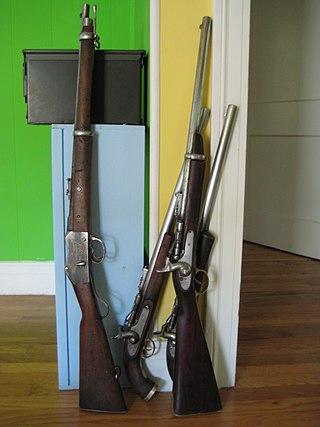
A Khyber Pass copy is a firearm manufactured by cottage gunsmiths in the Khyber Pass region in Pakistan.
Royal Ordnance plc was formed on 2 January 1985 as a public corporation, owning the majority of what until then were the remaining United Kingdom government-owned Royal Ordnance Factories which manufactured explosives, ammunition, small arms including the Lee–Enfield rifle, guns and military vehicles such as tanks. It owned some 16 factories; and employed about 19,000 staff.
ROF Maltby was a Royal Ordnance Factory rifle manufacturing plant near Maltby, South Yorkshire which manufactured weapons such as the Lee–Enfield rifle and Sten submachine gun. During World War II, ROF Maltby manufactured over 737,000 weapons. Rifles manufactured at Maltby were marked either with and M, RM or ROF(M) to distinguish them from rifles made at other ROF plants.

A cadet rifle is a rifle used by military cadets and others for basic firearms and marksmanship training. Generally .22 caliber and bolt-action, they also come in semi-automatic versions. They are often miniature .22 caliber versions of standard issue service rifles.


