
Mbira are a family of musical instruments, traditional to the Shona people of Zimbabwe. They consist of a wooden board with attached staggered metal tines, played by holding the instrument in the hands and plucking the tines with the thumbs, the right forefinger, and sometimes the left forefinger. Musicologists classify it as a lamellaphone, part of the plucked idiophone family of musical instruments. In Eastern and Southern Africa, there are many kinds of mbira, often accompanied by the hosho, a percussion instrument. It is often an important instrument played at religious ceremonies, weddings, and other social gatherings. The "Art of crafting and playing Mbira/Sansi, the finger-plucking traditional musical instrument in Malawi and Zimbabwe" was added to the UNESCO Representative List of the Intangible Cultural Heritage of Humanity in 2020.

Oxygen isotope ratio cycles are cyclical variations in the ratio of the abundance of oxygen with an atomic mass of 18 to the abundance of oxygen with an atomic mass of 16 present in some substances, such as polar ice or calcite in ocean core samples, measured with the isotope fractionation. The ratio is linked to water temperature of ancient oceans, which in turn reflects ancient climates. Cycles in the ratio mirror climate changes in geologic history.
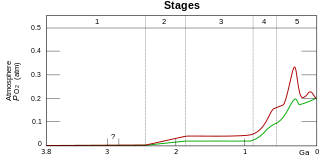
The Great Oxidation Event (GOE), sometimes also called the Great Oxygenation Event, was a time period when the Earth's atmosphere and the shallow ocean first experienced a rise in oxygen, approximately 2.4–2.0 Ga (billion years ago) during the Paleoproterozoic era. Geological, isotopic, and chemical evidence suggest that biologically-produced molecular oxygen (dioxygen, O2) started to accumulate in Earth's atmosphere and changed it from a weakly reducing atmosphere to an oxidizing atmosphere, causing many existing species on Earth to die out. The cyanobacteria producing the oxygen caused the event, which enabled the subsequent development of multicellular life forms.

Darwendale is a small town in southern Zvimba District of Mashonaland West, Zimbabwe, on the Gwebi River. It is located about 62 kilometres (39 mi) west of Harare. According to the 1982 census, the village had a population of 3,264. Darwendale is regarded as one of Zimbabwe's fastest growing towns.
Chinhoyi, known until 1982 as Sinoia, is a city in Zimbabwe.
Avondale is a affluent suburb in north and northwest Harare, Zimbabwe, located about 3.5 kilometres (2 mi) north of Harare city centre and just west of Mount Pleasant. It is the earliest suburb established in Harare, having been laid out in 1903. Prior to becoming a suburb Avondale was a dairy farm and was named after Avondale, County Wicklow, Ireland the home of the 19th-century Irish politician Charles Stewart Parnell. Avondale was incorporated into Harare Municipality in 1934.

Mutorashanga is a small ferrochrome mining town in Mashonaland West province in Zimbabwe. Situated on Zimbabwe's Great Dyke mountain range, about 100 kilometers north of the capital, Harare. The mines at Mutorashanga are largely owned by Zimasco, a chrome mining company owned in turn by Sinosteel Corporation, although some are operated by contractors. The area is well known for its abundant aloes, now threatened by mining, and other endemic flora. Aloe Ortholopha is endemic to the section of the Great Dyke mountain range in the Mutorashanga area.

Lomagundi College is an independent, co-educational, boarding and day, senior school in Zimbabwe which is situated about 130 km northwest of the capital Harare along the Harare-Chirundu highway on the outskirts of Chinhoyi the provincial capital of Mashonaland West.
The Lau event was the last of three relatively minor mass extinctions during the Silurian period. It had a major effect on the conodont fauna, but barely scathed the graptolites. It coincided with a global low point in sea level, is closely followed by an excursion in geochemical isotopes in the ensuing late Ludfordian faunal stage and a change in depositional regime.
Tongayi Arnold Chirisa is a Zimbabwean actor known for playing Man Friday on NBC's Crusoe television series, Father Nicholas on The Jim Gaffigan Show, and Hekule on Leon Schuster's Mr. Bones 2: Back from the Past movie. He is experienced in theatre, film, and television, and is also an occasional singer.
Craig Richard Ervine is a Zimbabwean international cricketer who plays all formats of the game. Ervine is a left-handed batsman. he was born at Harare and has played Test and limited overs cricket for the Zimbabwe national cricket team and first-class cricket for a variety of Zimbabwean sides in the Logan Cup.
Nemakonde High School is a Government high school located in Chinhoyi, Mashonaland West province, Zimbabwe. The school is located in Chikonohono Township on the southern part of the town.
Makonde District is a district in Zimbabwe.

The Francevillian biota is a group of 2.1-billion-year-old Palaeoproterozoic, macroscopic organisms known from fossils found in Gabon in the Palaeoproterozoic Francevillian B Formation, a black shale province. The fossils are postulated to be evidence of the earliest form of multicellular life. The fossils were discovered by an international team led by the Moroccan-French geologist Abderrazak El Albani, of the University of Poitiers, France. While the fossils have yet to be assigned to a formal taxonomic position, they have been informally and collectively referred to as the "Gabonionta" by the Natural History Museum Vienna in 2014.

The Association of Trust Schools (ATS) is an organisation of independent primary and secondary schools in Zimbabwe that was founded in 1962. Each of these schools are run by their own Board of Governors and are not for profit entities. The Heads of ATS schools are eligible for membership in the CHISZ. There are 66 schools in the ATS.
R3 Highway is a primary road in Zimbabwe from the capital city Harare to the Chirundu Border Post with Zambia. It is also known as the A1 Highway.
Avonlea is a suburb and an unincorporated area in northwest Harare. It lies just west of Avondale southwest of Emerald Hill, southeast of Marlborough, and north of the greater Mabelreign area. Avonlea is home to approximately 15,600 people.
