
Westphalia is a region of northwestern Germany and one of the three historic parts of the state of North Rhine-Westphalia. It has an area of 20,210 square kilometres (7,800 sq mi) and 7.9 million inhabitants.

North Rhine-Westphalia or North-Rhine/Westphalia, commonly shortened to NRW, is a state (Land) in Western Germany. With more than 18 million inhabitants, it is the most populous state in Germany. Apart from the city-states, it is also the most densely populated state in Germany. Covering an area of 34,084 km2 (13,160 sq mi), it is the fourth-largest German state by size.

The Teutoburg Forest is a range of low, forested hills in the German states of Lower Saxony and North Rhine-Westphalia. Until the 17th century, the official name of the hill ridge was Osning. It was first renamed the Teutoburg Forest in 1616 in commemoration of the Battle of the Teutoburg Forest in 9 AD, which most likely took place at Kalkriese instead.
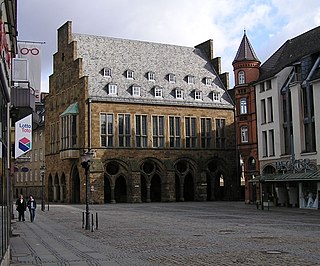
Minden is a middle-sized town in the very north-east of North Rhine-Westphalia, Germany, the largest town in population between Bielefeld and Hanover. It is the capital of the district of Minden-Lübbecke, which is part of the region of Detmold. The town extends along both sides of the River Weser, and is crossed by the Mittelland Canal, which is led over the river on the Minden Aqueduct.

Bad Salzuflen is a town and thermal spa resort in the Lippe district of North Rhine-Westphalia, Germany. At the end of 2013, it had 52,121 inhabitants.

Halle, officially Halle (Westf.) or Halle Westfalen to distinguish it from the larger Halle (Saale), is a town in the German state of North Rhine-Westphalia, 15 km west of Bielefeld. It belongs to the district of Gütersloh in the region of Detmold.

Quảng Ninh, anglicized as Quangninh, is a province along the northeastern coast of Vietnam. It is about 153 km (95 mi) east of Hanoi, comprising four cities, two district-level towns and seven rural districts. The provincial capital is Hạ Long. The province covers an area of 6,207.95 km2 (2,396.90 sq mi) and, as of 2023, had a population of 1,413,452. Nearly 80% of the province is mountainous with abundant land, forest, water and mineral resources, with 90% of Vietnam's coal output extracted from the province. The province is also home to Hạ Long Bay, a World Heritage Site that has 1,969 islands, out of which 989 have been given names.

Lübbecke is a town in northeast North Rhine-Westphalia in north Germany. This former county town lies on the northern slopes of the Wiehen Hills (Wiehengebirge) and has around 26,000 inhabitants. The town is part of district of Minden-Lübbecke within the Regierungsbezirk of Detmold in the Ostwestfalen-Lippe region. Lübbecke was first mentioned in the records in 775 as hlidbeki and was given town rights in 1279.

The Else is a left tributary of the river Werre in the northeast of North Rhine-Westphalia and in southern Lower Saxony. The Else is a distributary of the river Hase and begins at a river bifurcation near Melle.

The Olympic–Wallowa lineament (OWL) is a series of geologic structures oriented from northwest to southeast for 650 km (400 mi) across Washington and northeast Oregon in the United States, passing through the Seattle area and including notable features east of the Cascade Range such as the Yakima Fold Belt and Wallowa Mountains. It was first reported by cartographer Erwin Raisz in 1945 on a relief map of the continental United States. Some geologists have questioned the existence of a geological relationship between the individual structures along the lineament suggesting it is an optical illusion. The origin of this feature in its entirety is not well understood with multiple hypotheses on the subject. The Olympic–Wallowa lineament likely predates the Columbia River Basalt Group.

The West Hesse Depression is part of the West Hesse Highlands and Lowlands region in the north of the German state of Hesse. Like the East Hesse Depression, it is a series of separate depressions that form a natural corridor and have been an important historical trade route.

The Bückeberg is a small hill range, up to 375 metres (1,230 ft) high, in the Calenberg Uplands between the Harrl and the Deister in central Germany, and is often considered part of the Weser Uplands. It lies in the district of Schaumburg, and stretches for some 20 km (12 mi) from west to east from Bückeburg and the village of Bad Eilsen towards Bad Nenndorf.

The Große Aue is an 88-kilometre-long (55 mi), southwestern, left tributary of the River Weser in northern North Rhine-Westphalia and central Lower Saxony in Germany.
This page is based on this
Wikipedia article Text is available under the
CC BY-SA 4.0 license; additional terms may apply.
Images, videos and audio are available under their respective licenses.

