List of Glenn Miller Orchestra (1937–1942) members
Last updated
The Glenn Miller Orchestra onstage in 1941.
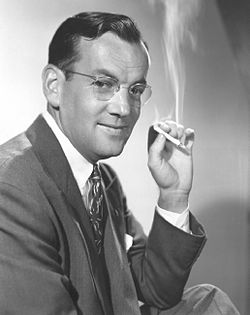
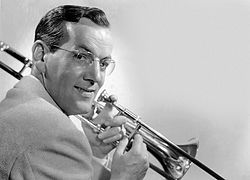
The Glenn Miller Orchestra was an American big band fronted by trombonist Glenn Miller. First formed in early 1937 as a spin-off of Ray Noble's band, the group included numerous musicians during its five-year existence, before disbanding in September 1942 when Miller enlisted in the U.S. Army. Some of the longest-standing members in the band included alto saxophonist Hal McIntyre, who was a constant member from its formation until October 1941; pianist John "Chummy" MacGregor, the only member from the first band who remained in September 1942; trombonist Paul Tanner, who joined in September 1938 and remained until the end; trumpeter Johnny Best, a mainstay for over three years; and vocalist Ray Eberle, who was featured on more recordings than any other singer between 1938 and 1942.
After a stint as a member of pianist Ray Noble's band, Glenn Miller started the process of forming his own group during late-1936.[1] Working with drummer and Metronome magazine writer George T. Simon, three of the earliest musicians he enlisted were alto saxophonist Hal McIntyre, tenor saxophonist Johnny Harrell and trumpeter Sterling "Bozo" Bose.[2] The rest of the lineup consisted of a range of "young musicians", who started rehearsing together during early 1937.[3] In March, the band completed its first recording session for Decca Records, for which Miller brought in a range of experienced performers to stand in for some of his newer recruits. A lineup composed of trumpeters Charlie Spivak, Mannie Klein and Bose, trombonists Jesse Ralph and Harry Rodgers, saxophonists George Siravo, McIntyre (both alto), Jerry Jerome and Carl Biesecker (both tenor), pianist Howard Smith, guitarist Dick McDonough, bassist Ted Kotsoftis and drummer Smith recorded six songs, which were released across three singles later that year.[4]
Miller's band performed live for the first time at the beginning of May, by which time Klein, Smith and Simon had been replaced by Chuck "Tweet" Peterson, John "Chummy" MacGregor and Emery "Eak" Kenyon, respectively.[5] For a Brunswick Records session early the next month, Ralph Capelli, Cassius "Bud" Smith, Bill Peyser and Roland "Rolly" Bundock took over from Bose, Rodgers, McDonough and Kotsoftis, respectively.[6] The group started its first live residency in mid-June, by which time Spivak had been replaced by Jimmy Troutman and Kathleen Lane had joined on vocals, replacing Violet "Vi" Mele after a brief stint.[7] Before the end of the ten-week residency, Irving "Fazola" Prestopnik joined as a fifth saxophonist in place of the band's guitarist; and by the end of August, Capelli had been replaced by Bob Price.[8] During the band's next residency, Adolph "Buddy" Schultz replaced Kenyon, although by October his place had been taken by Ennis "Doc" Carney; at the same time, Ardell Garrett replaced Troutman.[9]
After the band recorded six tracks for three singles on Brunswick in November and December,[10] Garrett and Siravo were replaced by Tommy DiCarlo and Tony Viola, respectively.[11] On December 17, Peterson was replaced by Les Beigel, and on Christmas Day, Maurice "Moe" Purtill took over Carney's place; when he had to return to Tommy Dorsey's band the next day, however, the drummer was replaced by Vic Angle.[12] With his band's popularity at an all-time low, Miller informed his bandmates that he would be disbanding his orchestra in the new year, with a final show taking place on January 2, 1938.[12]
Second band
Tex Beneke played in Miller's second band for its entire four-year tenure, 1938–1942.
By March 1938, Miller had started rehearsing with a new lineup of musicians — lead trumpet Bob Price returned, joined by Johnny "Zulu" Austin and Gasparre Rebito; Miller's trombone section included Bob "Brad" Jenney and Al Mastren; lead alto Hal McIntyre was retained, with the rest of the saxophone section completed by Wilbur Schwartz, Sol Kane (both alto), Gordon "Tex" Beneke and Bernie "Josh" Billings (both tenor); and in the rhythm section, returning pianist Chummy MacGregor and bassist Rolly Bundock were joined by drummer Bob Spangler, and vocalists Ray Eberle and Gail Reese.[13] Before the new band's first show in mid-April, Billings was replaced by Stan "Moose" Aronson.[14]
In May, the band recorded its first new single, "Sold American".[15] By July, Kane and Reese had been replaced by Bill Stegmeyer and Virginia Vonne, respectively.[16] The following month, Rebito and Vonne were replaced by Lou Mucci and Linda Keene, respectively.[17] Both new members were replaced within a month, by Bob Peck and Marion Hutton, while Paul Tanner came in for Jenny.[18] The band recorded "My Reverie" and "By the Waters of Minnetonka" at the end of September 1938.[19] During October, former saxophonist Tony Viola filled in for Schwartz on several occasions.[20] Peck was replaced by Jack Kimble at the end of the month,[21] followed by Claude Bowen around a month later.[22] In mid-December, Legh Knowles, Claude Lakey and Cody Sandifer took over from Bowen, Stegmeyer and Spangler, respectively.[23][24] Bowen returned after a week, replacing Austin.[25]
At the end of January 1939, Al Klink and Charlie Hill replaced Lakey and Bowen, respectively (Austin returned for two days before Hill's arrival).[26] This lineup recorded the orchestra's first singles of the year at the beginning of February: "(Gotta Get Some) Shut-Eye" and "Cuckoo in the Clock".[27] At the end of the month, Lee Castaldo replaced Hill,[28] before Dale "Mickey" McMickle took over a couple of weeks later.[29] Sandifer left the band at the beginning of April — he was replaced for one show by Andy Picard,[30] then for a recording session by stand-in Frank Carlson,[31] and finally by a returning Maurice "Moe" Purtill.[32] The next week, the band added Arthur Ens as its first guitarist in almost two years.[33] Another week later, Joseph "Gabe" Gelinas joined the saxophone section in place of Aronson, who left for Will Osborne's band.[34] This lineup recorded "Stairway to the Stars" in May.[35]
Towards the end of May, long-term lead trumpet Bob Price left the band, with McMickle taking his place and Clyde Hurley joining.[34] After another session spawning three singles, Ens was replaced by Dick Fisher at the start of June.[36] A week later, Gelinas was replaced by Hal Tennyson.[37] In the middle of the month, Knowles was temporarily replaced for a week by Johnny McGhee, during which time the band recorded "Oh, You Crazy Moon".[38] Hutton was also absent for a week at the end of July, after collapsing onstage due to exhaustion, with 16-year-old Kay Starr filling in for the singer for a few shows and a session.[39] Gerald Yelverton replaced Tennyson in mid-August, performing on the singles "My Isle of Golden Dreams" and "Blue Moonlight".[34]
Ray Eberle was the main vocalist for Miller's band from March 1938 to July 1942.
1939–1941: Expansion of the brass section
Towards the end of summer 1939, Miller planned to expand the brass section of his band from six performers to eight, complaining that "Three-part harmony sounds too thin".[40] He first enlisted Johnny Best as his fourth trumpeter at the end of August, followed by promoting road manager Tommy Mack to part-time fourth trombonist at the start of September.[41] After the first week of September, Yelverton was replaced by Jimmy Abato.[42] As a temporary member initially, Mack did not feature at recording sessions during his first month, with Walter Barrow and Lloyd "Toby" Tyler filling in for the singles "Melancholy Lullaby" and "Out of Space", respectively.[43] Mack featured at later sessions, before he was replaced by Frank D'Annolfo in early-November.[44] The new lineup remained stable for over two months, recording a string of singles through January 1940.[45]
In late-January 1940, long-term trombonist Al Mastren left due to "trouble with his arm".[46] Mack filled in for a few days, before Howard Gibeling took over at the end of the month.[47] After just a few days, however, Gibeling left again and Mack stepped back in.[48] In the second week of February, Jimmy Priddy took over the role, and less than a week later, Ernie Caceres replaced Abato, who had left following months of tensions with Miller.[49] This lineup remained in place for the next two months, before at the end of April the band saw Fisher replaced by Jack Lathrop and McMickle temporarily replaced by Rubin "Zeke" Zarchy, after McMickle got a cyst on his lip.[50] When McMickle returned a couple of weeks later, Miller chose to retain Zarchy and dismiss Knowles.[51] At the end of May, Hurley also left the trumpet section, replaced by Charles Frankhauser.[52]
The band's lineup remained stable all through the summer, before long-time bassist Rolly Bundock left at the end of August to study at the Juilliard School.[53] He was initially replaced by Tony Carlson, followed by Herman "Trigger" Alpert a couple of weeks later.[53] In mid-October, Zarchy was replaced by Phil Rommel,[54] who left after just over a week and was temporarily replaced by Max Kaminsky.[55] A week later, Ray Anthony took over as Rommel's permanent replacement.[56] Just a few days later, Frankhauser was also replaced by Billy May.[57] In early-January 1941, singer Marion Hutton left Miller's band after nearly three years when she became pregnant, with Dorothy Claire taking her place.[58] A few days later, vocal quartet The Modernaires also officially joined the orchestra.[59] Claire only stayed until late-March, when she returned to Bobby Byrne's band and was replaced by Paula Kelly.[60]
1941–1942: The final year of the band
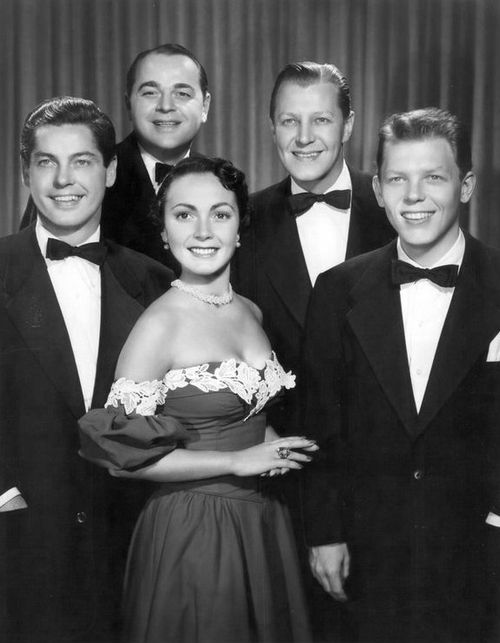
The Modernaires were official members of Miller's band starting in January 1941.
The lineup of Miller's band remained stable for the next two months, before Jack Lathrop left at the end of May, at which point Modernaires member Bill Conway took over on guitar.[61] A few weeks later, Trigger Alpert was drafted and forced to leave the band; he enlisted Edward "Doc" Goldberg to take his place, although for two weeks Meyer "Mike" Rubin stood in as Goldberg was not yet available.[62] At the same time as Goldberg's arrival in late-June, Warren Smith briefly filled in for Frank D'Annolfo for a few days, including a recording session.[63] Early the next month, Ray Anthony was replaced by Alec Fila.[64] Two days later, trumpeter Bobby Hackett also joined the band, replacing Conway on guitar.[65] Shortly after a recording session in mid-August, Marion Hutton returned to the band (four months after giving birth), replacing her successor Paula Kelly.[66]
In early-October, lead alto saxophonist Hal McIntyre — who had played with Miller constantly since 1937 — left to start his own band.[67] He was replaced by Benny Feman for a few weeks, before Tex Beneke switched to lead alto at the end of the month and his place on tenor was taken by Irving "Babe" Russin.[68] His tenure was similarly short, however, and within a few weeks Beneke was back on tenor after Russin left to form his own group, at which point Miller brought in Lloyd "Skip" Martin from Benny Goodman's band as his new lead alto player, sending Fila in return (Hackett switched to trumpet, with Conway taking over guitar again).[69] For studio sessions in November and December, Hackett switched back to guitar and former member Zeke Zarchy took his place in the trumpet section.[70] Bill Graham took over from Zarchy at a session in January.[71]
Steve Lipkins joined as the permanent replacement for Alec Fila in late-January 1942.[72] The band's lineup remained stable for the next six months, before long-time vocalist Ray Eberle left in July after a string of disagreements with Miller and reported issues with alcohol abuse.[73] He was replaced by Skip Nelson, with whom the band recorded a string of singles later that month ahead of the 1942–1944 musicians' strike.[74] In mid-September, shortly after Miller announced to his bandmates that he would be joining the U.S. Army in October, Lipkins moved to Jimmy Dorsey's band, with Hackett and Conway reverting to their former roles on trumpet and guitar, respectively.[75] The band played its final show on September 27, 1942.[76] Miller led a new band during his years in the army, before disappearing during a flight over the English Channel on December 15, 1944.[77]
all from "I'd Know You Anywhere" (1940) to "The Cowboy Serenade (While I'm Rollin' My Last Cigarette)" (1941)B, except "Under Blue Canadian Skies" (1942)
Lane replaced Mele in June 1937 and remained with Miller's band until its initial breakup in January 1938.[78] During her tenure, she recorded the singles "My Fine Feathered Friend" and "Every Day's a Holiday", and the "Humoresque" B-side "Doin' the Jive".[79]
Miller brought in Eberle as his first full-time male singer when he reformed his band in March 1938.[80] He performed on numerous recordings with the orchestra and remained a member until July 1942, when he was dismissed due to "many acts of misconduct", according to Miller.[81]
Gail Reese (1917–1998)
1938
Reese joined at the same time as Eberle, performing on "Why'd Ya Make Me Fall in Love" before leaving just a few months later.[82]
Virginia Vonne
Vonne had a short-lived spell in the Glenn Miller Orchestra during the summer of 1938, but did not contribute to any recordings.[82]
Linda Keene (1911–1981)
Keene replaced Vonne and performed a few shows with Miller's band, but left after a similarly short tenure around August 1938.[83]
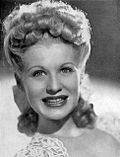
Hutton replaced Keene as Miller's female vocalist during September 1938.[83] She remained until January 1941, when she left after becoming pregnant.[58] Seven months later, she returned to the band, remaining until its disbandment in September 1942.[66]
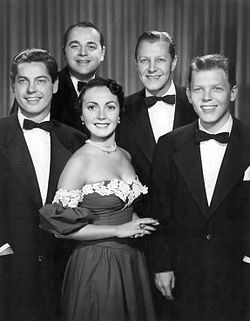
A few days after Claire replaced Hutton in January 1941, Miller also added The Modernaires (Brewster, Conway, Dickinson and Goldstein) as official members of his band.[59] They had previously performed at a recording session in October 1940.[85] During their tenure with the band, Brewster also briefly doubled on trumpet,[86] while Conway doubled on guitar from May 1941.[61]
McGhee filled in for Legh Knowles during the week of June 18–25, 1939. He is featured on both songs recorded at the one session during that period: "Oh, You Crazy Moon" and B-side "Ain't Cha Comin' Out?"[87]
Starr filled in for Marion Hutton in late-July 1939 after the vocalist collapsed onstage. During her tenure, she appeared at one recording session, performing on the B-sides "Baby Me" and "Love with a Capital "You"".[39]
Kaminsky filled in on trumpet for a week, following Phil Rommel's departure after a tenure of just ten days.[56]
Meyer "Mike" Rubin (1912–2001)
1941
bass
Rubin stood in on bass for a couple of weeks after Trigger Alpert left, whilst Doc Goldberg was unavailable.[62]
Session musicians
Image
Name
Years active
Instruments
Details
Doris Kerr
1937
vocals
Kerr and the Tune Twisters worked with Miller's band at their first recording session in March 1937. Kerr is featured on "Wistful and Blue" and "How Am I to Know?"; the Tune Twisters on "Anytime, Anyday, Anywhere".[88]
Reuss performed at three sessions, in February and April 1939, appearing on the singles "(Gotta Get Some) Shut-Eye", "Cuckoo in the Clock", "And the Angels Sing", "Sunrise Serenade", "Three Little Fishies" and "My Last Goodbye".[27][31][89]
Frank Carlson (1914–1996)
drums
After Cody Sandifer's departure on April 2, 1939, Carlson stood in for a session on April 4, recording "And the Angels Sing" (and B-side "The Chestnut Tree"), "Moonlight Serenade" and "The Lady's in Love with You".[31]
Walter Barrow
trombone
During the first month of Tommy Mack's tenure in the band, he did not perform at recording sessions; he was replaced by Barrow (for "Melancholy Lullaby") and Tyler (for "Out of Space") on September 11 and 25, 1939, respectively.[43]
This article has not been added to any content categories. Please help out by adding categories to it so that it can be listed with similar articles. (February 2026)
This page is based on this Wikipedia article Text is available under the CC BY-SA 4.0 license; additional terms may apply. Images, videos and audio are available under their respective licenses.