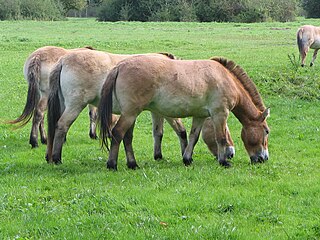
Equidae is the taxonomic family of horses and related animals, including the extant horses, donkeys, and zebras, and many other species known only from fossils. All extant species are in the genus Equus. Equidae belongs to the order Perissodactyla, which includes the extant tapirs and rhinoceros, and several extinct families.

The thrushes are a family, Turdidae, of passerine birds with a worldwide distribution. The family was once much larger before biologists determined the subfamily Saxicolinae, which includes the chats and European robins, were Old World flycatchers. Thrushes are small to medium-sized ground living birds that feed on insects, other invertebrates and fruit. Some unrelated species around the world have been named after thrushes due to their similarity to birds in this family.

The Gruiformes are an order containing a considerable number of living and extinct bird families, with a widespread geographical diversity. Gruiform means "crane-like".

Anseriformes is an order of birds that comprise about 180 living species in three families: Anhimidae, Anseranatidae, and Anatidae, the largest family, which includes over 170 species of waterfowl, among them the ducks, geese, and swans. Most modern species in the order are highly adapted for an aquatic existence at the water surface. With the exception of screamers, all have phalli, a trait that has been lost in the Neoaves. Due to their aquatic nature, most species are web-footed.

Emydidae is a family of testudines (turtles) which includes close to 50 species in 10 genera. Members of this family are commonly called terrapins, pond turtles, or marsh turtles. Several species of Asian box turtle were formerly classified in the family; however, revised taxonomy has separated them to a different family. As currently defined, Emydidae is entirely a Western Hemisphere family, with the exception of two species of pond turtle.

In biology, a monotypic taxon is a taxonomic group (taxon) that contains only one immediately subordinate taxon.

In zoological nomenclature, a type species is the species name with which the name of a genus or subgenus is considered to be permanently taxonomically associated, i.e., the species that contains the biological type specimen(s). A similar concept is used for suprageneric groups called a type genus.

In biological classification, especially zoology, the type genus is the genus which defines a biological family and the root of the family name.

A botanical name is a formal scientific name conforming to the International Code of Nomenclature for algae, fungi, and plants (ICN) and, if it concerns a plant cultigen, the additional cultivar or Group epithets must conform to the International Code of Nomenclature for Cultivated Plants (ICNCP). The code of nomenclature covers "all organisms traditionally treated as algae, fungi, or plants, whether fossil or non-fossil, including blue-green algae (Cyanobacteria), chytrids, oomycetes, slime moulds and photosynthetic protists with their taxonomically related non-photosynthetic groups ."

Grosbeak is a form taxon containing various species of seed-eating passerine birds with large beaks. Although they all belong to the superfamily Passeroidea, these birds are not part of a natural group but rather a polyphyletic assemblage of distantly related songbirds. Some are cardueline finches in the family Fringillidae, while others are cardinals in the family Cardinalidae; one is a member of the weaver family Ploceidae. The word "grosbeak", first applied in the late 1670s, is a partial translation of the French grosbec, where gros means "large" and bec means "beak".
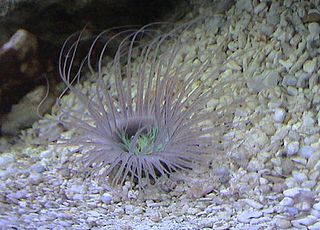
Tube-dwelling anemones or ceriantharians look very similar to sea anemones but belong to an entirely different subclass of anthozoans. They are solitary, living buried in soft sediments. Tube anemones live inside and can withdraw into tubes, which are composed of a fibrous material made from secreted mucus and threads of nematocyst-like organelles known as ptychocysts. Ceriantharians were formerly classified in the taxon Ceriantipatharia along with the black corals but have since been moved to their own subclass, Ceriantharia.

The Saccharomycetaceae are a family of yeasts in the order Saccharomycetales that reproduce by budding. Species in the family have a cosmopolitan distribution, and are present in a wide variety of habitats, especially those with a plentiful supply of carbohydrate sources. The family contains the species Saccharomyces cerevisiae, perhaps the most economically important fungus.

In biological classification, taxonomic rank is the relative level of a group of organisms in a taxonomic hierarchy. Examples of taxonomic ranks are species, genus, family, order, class, phylum, kingdom, domain, etc.
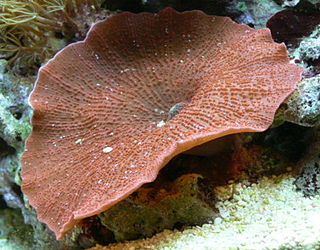
Corallimorpharia is an order of marine cnidarians closely related to stony or reef building corals (Scleractinia). They are mostly tropical, with a narrow column topped with a wide oral disc. The tentacles are usually short or very short, arranged in rows radiating from the mouth. Many species occur together in large groups. In many respects, they resemble the stony corals, except for the absence of a stony skeleton.
Saccharomyces telluris is a species of yeast also known as Kazachstania telluris. Strains of the species have been isolated from microbiota colonizing birds, though the serotype of a particular strain may differ by species.

Holotheria are a diverse group of mammals that are descendants of the last common ancestor of Kuehneotherium and Theria.
Kazachstania exigua is a yeast species that commonly occurs in olive brine and in some kefir cultures. It is one of the yeast species used in the production of sourdough. It is acid-tolerant and maltose-negative.
