
Johnstown is a city in Cambria County, Pennsylvania, west-southwest of Altoona and 56 miles (90 km) east of Pittsburgh. The population was 20,978 at the time of the 2010 census and estimated to be 19,195 in 2019. It is the principal city of the Johnstown, Pennsylvania, Metropolitan Statistical Area, which includes Cambria County. It is also part of the Johnstown-Somerset, PA Combined Statistical Area, which includes both Cambria and Somerset Counties.
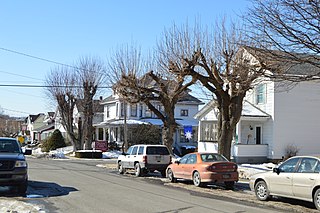
Portage is a borough with home rule status in Cambria County, Pennsylvania, United States. It is 10 miles (16 km) southeast of Ebensburg and 22 miles (35 km) southwest of Altoona. It is part of the Johnstown, Pennsylvania Metropolitan Statistical Area. The population was 2,638 at the 2010 US census.
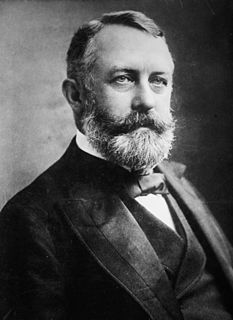
Henry Clay Frick was an American industrialist, financier, union-buster, and art patron. He founded the H. C. Frick & Company coke manufacturing company, was chairman of the Carnegie Steel Company, and played a major role in the formation of the giant U.S. Steel manufacturing concern. He also financed the construction of the Pennsylvania Railroad and the Reading Company, and had extensive real estate holdings in Pittsburgh and throughout the state of Pennsylvania. He later built the historic neoclassical Frick Mansion, and upon his death donated his extensive collection of old master paintings and fine furniture to create the celebrated Frick Collection and art museum. However, as a founding member of the South Fork Fishing and Hunting Club, he was also in large part responsible for the alterations to the South Fork Dam that caused its failure, leading to the catastrophic Johnstown Flood. His vehement opposition to unions also caused violent conflict, most notably in the Homestead Strike.

The Johnstown Flood occurred on Friday, May 31, 1889, after the catastrophic failure of the South Fork Dam, located on the south fork of the Little Conemaugh River, 14 miles (23 km) upstream of the town of Johnstown, Pennsylvania. The dam ruptured after several days of extremely heavy rainfall, releasing 14.55 million cubic meters of water. With a volumetric flow rate that temporarily equaled the average flow rate of the Mississippi River, the flood killed 2,209 people and accounted for $17 million of damage.

Johnstown Flood National Memorial commemorates the more than 2,200 people who died and the thousands injured in the Johnstown Flood on May 31, 1889. The flood was caused by a break in the South Fork Dam, an earthen structure known to be structurally lacking. The memorial is located at 733 Lake Road near South Fork, Pennsylvania, about 10 miles (16 km) northeast of Johnstown, Pennsylvania. The memorial preserves the remains of the dam and portions of the former Lake Conemaugh bed, along with the farm of Elias Unger and the clubhouse of the South Fork Fishing and Hunting Club which owned the dam and reservoir. Hiking trails connect various parts of the memorial, and picnicking areas are present throughout. The United States Congress authorized the national memorial on August 31, 1964.

The Johnstown Inclined Plane is a 896.5-foot (273.3 m) funicular in Johnstown, Cambria County, in the U.S. state of Pennsylvania. The incline and its two stations connect the city of Johnstown, situated in a valley at the confluence of the Stonycreek and the Little Conemaugh rivers, to the borough of Westmont on Yoder Hill. The Johnstown Inclined Plane is billed as the "world's steepest vehicular inclined plane". It can carry automobiles and passengers, up or down a slope with a grade of 71.9%. The travel time between stations is 90 seconds.
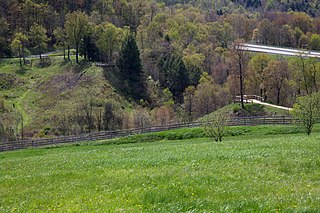
The South Fork Dam was an earthenwork dam forming Lake Conemaugh, an artificial body of water near South Fork, Pennsylvania, United States. On May 31, 1889, the South Fork Dam failed catastrophically and 20 million tons of water from Lake Conemaugh burst through and raced 14 miles (23 km) downstream, causing the Johnstown Flood.
Livermore, Pennsylvania is an abandoned town that was located on the Conemaugh River between Blairsville and Saltsburg in Derry Township, Westmoreland County, Pennsylvania. The town was abandoned and partially razed in the early 1950s following authorization by the Flood Control Act of 1936 and Flood Control Act of 1938 for construction of the Conemaugh Dam and Lake to prevent flooding of Pittsburgh. Much of the former town site now lies under the reservoir and floodplains.

The South Fork Fishing and Hunting Club was a Pennsylvania corporation which operated an exclusive and secretive retreat at a mountain lake near South Fork, Pennsylvania, for more than fifty extremely wealthy men and their families. The club was the owner of the South Fork Dam, which failed during an unprecedented period of heavy rains, resulting in the disastrous Johnstown Flood on May 31, 1889.

The Cambria Iron Company of Johnstown, Pennsylvania was a major 19th-century industrial producer of iron and steel. Founded in 1852, it had the nation's largest steel foundry in the 1870s, and was renamed the Cambria Steel Company in 1898. The company used many innovations in the steelmaking process, including those of William Kelly and Henry Bessemer. The company was acquired in 1923 by the Bethlehem Steel Company. The company's historic facilities, extending some 12 miles (19 km) along the Conemaugh and Little Conemaugh Rivers, are a National Historic Landmark District.

Daniel Johnson Morrell was a Republican member of the U.S. House of Representatives from Pennsylvania.

The Johnstown Flood (1926) is an American silent epic film drama directed by Irving Cummings, that addresses the Great Flood of 1889 in Johnstown, Pennsylvania. The film stars George O'Brien, Florence Gilbert and Janet Gaynor. This is a surviving film with a print held at the George Eastman Museum.
James Hay Reed was a United States District Judge of the United States District Court for the Western District of Pennsylvania. With partner Philander C. Knox, he formed the law firm of Knox and Reed.

The Johnstown Flood Museum is a history museum located in Johnstown, Pennsylvania, dedicated to the Johnstown Flood of 1889. The museum is housed in the former Cambria Public Library, which is part of the Downtown Johnstown Historic District.
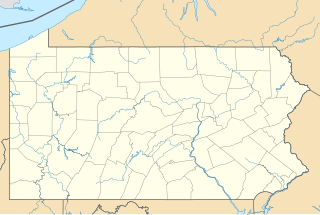
Mineral Point is an unincorporated community in Cambria County, Pennsylvania, United States.

The Johnstown flood of 1977, also known as the second great flood of Johnstown and the Johnstown disaster, was a major flood which began on the night of July 19, 1977, when heavy rainfall caused widespread flash flooding in Cambria County, Pennsylvania, United States, including the city of Johnstown and the Conemaugh Valley.

Victor Heiser was born Victor George Heiser in Johnstown, Cambria County, Pennsylvania. He was an American physician and author, and was known as Dr. Victor Heiser. He was a survivor of the Johnstown flood of 1889.
The Johnstown flood of 1936, also collectively with other areas referred to as the Saint Patrick's Day Flood, was a devastating flood in Cambria County, and Johnstown, Pennsylvania proper, referred to as "Greater Johnstown".

The Mammoth Mine disaster or Frick Mine explosion occurred on January 27, 1891 just after 9:00 AM in the Mammoth No. 1 mine in Mount Pleasant Township, Westmoreland County, Pennsylvania. Newspapers reported that firedamp was ignited by a miner's oil lamp, resulting in the deaths of 109 men and boys. Most of the miners were not killed by the force of the explosion, but rather were suffocated by the effects of afterdamp.

The Johnstown Flood: The Incredible Story Behind One of the Most Devastating Disasters America Has Ever Known is a 1968 book written by popular historian David McCullough about the Great Flood of 1889 which devastated the town of Johnstown, Pennsylvania. His first book, McCullough spent time speaking with individuals who lived through the flood on top of his other research in preparation for writing. Upon its publication The Johnstown Flood rekindled national interest in the flood and was the catalyst to McCullough's accomplished career. Following the success of his book, McCullough decided to devote his time entirely towards writing.
