
Julie Nixon Eisenhower is an American author who is the younger daughter of former U.S. president Richard Nixon and his wife, Pat Nixon. Her husband, David, is the grandson of former U.S. president Dwight D. Eisenhower and his wife, Mamie Eisenhower.

The oath of office of the president of the United States is the oath or affirmation that the president of the United States takes upon assuming office. The wording of the oath is specified in Article II, Section One, Clause 8, of the United States Constitution, and a new president must take it before exercising or carrying out any official powers or duties.

Between 73 and 79 days after the presidential election, the president-elect of the United States is inaugurated as president by taking the presidential oath of office. The inauguration takes place for each new presidential term, even if the president is continuing in office for a second term.

The 1956 Republican National Convention was held by the Republican Party of the United States at the Cow Palace in San Francisco, California, from August 20 to August 23, 1956. U.S. Senator William F. Knowland was temporary chairman and former speaker of the House Joseph W. Martin Jr. served as permanent chairman. It renominated President Dwight D. Eisenhower and Vice President Richard M. Nixon as the party's candidates for the 1956 presidential election.

The inauguration of George H. W. Bush as the 41st president of the United States was held on Friday, January 20, 1989, at the West Front of the United States Capitol in Washington, D.C. This was the 51st inauguration and marked the commencement of the only term of both George H. W. Bush as president and Dan Quayle as vice president. Chief Justice William Rehnquist administered the presidential oath of office to Bush and Justice Sandra Day O'Connor administered the vice presidential oath of office to Quayle. Bush was the first sitting vice president to be inaugurated as president since Martin Van Buren in 1837 and the last World War II combat veteran. Bush composed his own prayer for the ceremony which he recited at the start of his inaugural address; the last president to do so was Dwight D. Eisenhower at his first inauguration in 1953.

The second inauguration of Richard Nixon as president of the United States was held on Saturday, January 20, 1973, at the East Portico of the United States Capitol in Washington, D.C. This was the 47th inauguration and marked the commencement of the second and final term of both Richard Nixon as president and Spiro Agnew as vice president. Both Agnew and Nixon resigned within two years of this term. In December 1973, Gerald Ford replaced Agnew as vice president and in the following year, replaced Nixon as president. This made Nixon the first and, as of 2024, only person to be inaugurated four times as both president and vice president. Chief Justice Warren E. Burger administered both the presidential and vice presidential oaths of office. During the ceremony, Look With Pride On Our Flag, a song dedicated to President Nixon and composed by Hank Fort, was played.

The first inauguration of Richard Nixon as the 37th president of the United States was held on Monday, January 20, 1969, at the East Portico of the United States Capitol in Washington, D.C. This was the 46th inauguration and marked the commencement of the first and eventually only full term of both Richard Nixon as president and Spiro Agnew as vice president. Chief Justice Earl Warren administered the presidential oath of office to Nixon, and Senate Minority Leader Everett Dirksen administered the vice presidential oath to Agnew. Nixon had narrowly defeated Hubert Humphrey, the incumbent vice president, in the presidential election. Nixon became the first non-incumbent vice president to be inaugurated as president, something that would not happen again until Joe Biden in 2021. This was also the last presidential oath administered by Chief Justice Warren.

The second inauguration of Lyndon B. Johnson as president of the United States was held on Wednesday, January 20, 1965, at the East Portico of the United States Capitol in Washington, D.C. This was the 45th inauguration and marked the second and only full term of Lyndon B. Johnson as president and the only term of Hubert Humphrey as vice president. Chief Justice Earl Warren administered the oath of office. Lady Bird Johnson founded the tradition of incoming first ladies participating in the ceremony by holding the sworn-in president's Bible. Vice President Humphrey was sworn in by John W. McCormack, the speaker of the House of Representatives. This was the first inauguration when the president rode in a bulletproof limousine.

The second inauguration of Dwight D. Eisenhower as president of the United States was held privately on Sunday, January 20, 1957, at the White House and publicly on the following day, Monday, January 21, 1957, at the East Portico of the United States Capitol; both located in Washington, D.C. This was the 43rd inauguration and marked the commencement of the second and final four-year term of both Dwight D. Eisenhower as president and Richard Nixon as vice president. Chief Justice Earl Warren administered the presidential oath of office after the Senate Minority Leader William Knowland swore in the vice president.

The first inauguration of Dwight D. Eisenhower as the 34th president of the United States was held on Tuesday, January 20, 1953, at the East Portico of the United States Capitol in Washington, D.C. This was the 42nd inauguration and marked the commencement of the first term of Dwight D. Eisenhower as president and of Richard Nixon as vice president. Chief Justice Fred M. Vinson administered the presidential oath of office to Eisenhower. The vice presidential oath was administered to Nixon by Senator William Knowland.

The second inauguration of Harry S. Truman as president of the United States was held on Thursday, January 20, 1949, at the East Portico of the United States Capitol in Washington, D.C. This was the 41st inauguration and marked the commencement of the second and only full term of Harry S. Truman as president as well as the only term of Alben W. Barkley as vice president. Chief Justice Fred M. Vinson administered the presidential oath of office while Justice Stanley Forman Reed administered the vice-presidential oath of office.

The inauguration of John F. Kennedy as the 35th president of the United States was held on Friday, January 20, 1961, at the East Portico of the United States Capitol in Washington, D.C. This was the 44th inauguration and marked the commencement of John F. Kennedy's and Lyndon B. Johnson's only term as president and vice president. Kennedy was assassinated 2 years, 306 days into this term, and Johnson succeeded to the presidency.

The second inauguration of Calvin Coolidge as president of the United States, was held on Wednesday, March 4, 1925, at the East Portico of the United States Capitol in Washington, D.C. This was the 35th presidential inauguration and marked the commencement of the second and only full term of Calvin Coolidge as president and the only term of Charles G. Dawes as vice president. Chief Justice William Howard Taft, who had served as president from 1909 to 1913, administered the oath of office. This was the first inauguration on which a former U.S. president administered the Oath and the first to be broadcast nationally on radio.
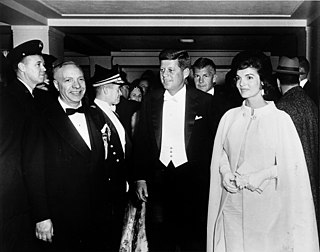
United States presidential inaugural balls are large social gatherings, both white tie and black tie, held to celebrate the commencement of a new term of the president of the United States. Planned and sanctioned by the Presidential Inaugural Committee, the official inaugural balls occur throughout the evening of Inauguration Day in the Washington D.C. area and are invitation-only, attended by guests who are issued pre-paid tickets. The president, first lady, vice president, and second lady or gentleman all make personal appearances at each of the inaugural balls held in their honor. Catered food, beverages, and live entertainment performed by national and globally acclaimed musicians are provided at the inaugural balls.
Inauguration of Franklin D. Roosevelt may refer to:
Inauguration of Thomas Jefferson may refer to:
Inauguration of Dwight D. Eisenhower may refer to:
The 1955 State of the Union Address was given by the 34th president of the United States, Dwight D. Eisenhower, on Thursday, January 6, 1955, to the 84th United States Congress. He said, "Every citizen wants to give full expression to his God-given talents and abilities and to have the recognition and respect accorded under our religious and political traditions." He also said, "To protect our nations and our peoples from the catastrophe of a "nuclear holocaust", free nations must maintain countervailing military power to persuade the Communists of the futility of seeking their ends through aggression." He is referring to what seemed to be the high likelihood of nuclear warfare of the time. He ended with, "And so, I know with all my heart--and I deeply believe that all Americans know--that, despite the anxieties of this divided world, our faith, and the cause in which we all believe, will surely prevail." This address was given in his first term (1953-1957), in Washington, D.C.
The 1958 State of the Union Address was given by Dwight D. Eisenhower, the 34th president of the United States, on Thursday, January 9, 1958, to the 85th United States Congress in the chamber of the United States House of Representatives. It was Eisenhower's sixth State of the Union Address. Presiding over this joint session was House speaker Sam Rayburn, accompanied by Vice President Richard Nixon, in his capacity as the president of the Senate.
The February 1953 State of the Union Address was given by newly inaugurated president Dwight D. Eisenhower, the 34th president of the United States, on Monday, February 2, 1953, to the 83rd United States Congress in the chamber of the United States House of Representatives. It was Eisenhower's first State of the Union Address. Presiding over this joint session was House speaker Joseph W. Martin Jr., accompanied by recently inaugurated Vice President Richard Nixon in his capacity as the president of the Senate. This address was broadcast live on both radio and television.
 The full text of Richard Nixon's First Inaugural Address at Wikisource
