
The president of Austria is the head of state of the Republic of Austria.

The Gulfstream V is a large, long-range business jet aircraft produced by Gulfstream Aerospace, derived from the previous Gulfstream IV. It flies up to Mach 0.885, up to 51,000 feet (16,000 m) and has a 6,500 nmi (12,000 km) range. It typically accommodates four crew and 14 passengers. It first flew on November 28, 1995, and entered service in June 1997. It is used by the US military under the designation C-37A. It is followed by an improved version, the Gulfstream 550.
The districts of Vienna are the 23 named city sections of Vienna, Austria, which are numbered for easy reference. They were created from 1850 onwards, when the city area was enlarged by the inclusion of surrounding communities. Although they fill a similar role, Vienna's municipal districts are not administrative districts (Bezirke) as defined by the federal constitution; Vienna is a statutory city and as such is a single administrative district in its entirety.
Austrian car number plates are mandatory vehicle registration plates displaying the registration mark of motor vehicles in Austria. They are used to verify street legality, proof of a valid liability insurance and to identify and recognise the vehicle.
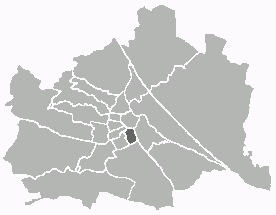
Wieden is the 4th municipal district of Vienna, Austria. It is near the centre of Vienna and was established as a district in 1850, but its borders were changed later. Wieden is a small region near the city centre. After World War II, Wieden was part of the Soviet sector of Vienna for 10 years.

The Austrian Parliament is the bicameral federal legislature of Austria. It consists of two chambers – the National Council and the Federal Council. In specific cases, both houses convene as the Federal Assembly. The legislature meets in the Austrian Parliament Building in Vienna.

In Austria, the Ministry of the Interior is a federal government agency serving as the interior ministry of the Austrian government. It is chiefly responsible for the public security, but also deals with matters relating to citizenship, elections, referendums, plebiscites and the alternative civilian service. The Ministry of the Interior is considered one of the most important ministries in Austria

The Chamber of Labour, is an organisation that represents the interests of 4 million Austrian employees and consumers. Membership is compulsory for all employees working in Austria, and it is thus not to be confused with Austrian labour unions, where membership is voluntary and which are organized in an umbrella organisation, the ÖGB. Together, the ÖGB and the Arbeiterkammer represent the interests of employees in the Austrian system of Sozialpartnerschaft, which plays a major role in the regulation of wages and prices.

An Austrian passport is an identity document issued to citizens of Austria to facilitate international travel. Every Austrian citizen is also a citizen of the European Union. The passport, along with the national identity card, allows for free rights of movement and residence in any of the states of the European Economic Area and Switzerland.

The Ministry of Foreign Affairs is the government ministry of Austria responsible for diplomatic missions and immigration, the administration of foreign policy, and the maintenance of the country's relations with international organisations, especially the European Union. It oversees the Austrian embassies, consular representatives and other emissaries, and administers the naturalisation process and handles citizenship questions along with the Interior Ministry.

Diplomatic relations between Austria and Bulgaria were established in 1879. Austria has an embassy in Sofia and an honorary consulate in Burgas while Bulgaria has an embassy in Vienna and an honorary consulate in Salzburg.

The Political Academy of the Austrian People's Party is the educational institution of the Austrian People's Party.

nic.at GmbH, based in Salzburg, is the domain name registry for the country code top-level domain .at. "AT" is the ISO 3166 country code for Austria. Nic.at is owned by the Internet Foundation Austria and has 30 employees. From 1988 until 1998, the University of Vienna was the domain name registry for .at domains.

The Austrian Federal Computing Centre or Bundesrechenzentrum (BRZ) is a public information technology (IT) service provider based in Vienna. The organisation develops and operates e-government services for the Austrian Federal Government, including the Federal Ministries and the Federal Chancellery. In 1997 the BRZ was outsourced from the Ministry of Finance as an organisational spin-off on the basis of a Federal Law, since then it acts as a limited liability company. The Austrian Federal Computing Centre is owned by the Republic of Austria, represented by the Ministry of Finance.

Bilateral relations exist between Austria and Kazakhstan.
The once-only principle is an e-government concept that aims to ensure that citizens, institutions, and companies only have to provide certain standard information to the authorities and administrations once. By incorporating data protection regulations and the explicit consent of the users, the public administration is allowed to re-use and exchange the data with each other. The once-only principle is part of the European Union's (EU) plans to further develop the Digital Single Market by reducing the administrative burden on citizens and businesses.

Susanne Raab is an Austrian politician of the Austrian People's Party (ÖVP) who serves at the cabinet level. She has been instrumental for integration of the country's immigrant population, which is ruled by the "Amended Ministerial Law 1986".
The Ministry of Labour and Economy is a ministry of the Government of Austria. From January 2020 to January 2021, the ministry was officially called the Federal Ministry of Labour, Family and Youth. The current Minister of Labour is Martin Kocher, who has served in the role in the Second Kurz government and the Schallenberg government since January 2020.


