Curtis Bros. & Co. was a leading producer of doors, sashes, blinds and general house finishings between 1866 and 1966. The company was the first to produce pre-glazed window units.
The firm was started in 1866 by Charles F. Curtis and W.G. Hemingway; they had been engaged in the grocery business for a short time in Clinton, Iowa. They bought out the Claussen and Thornburg interests in the firm of Claussen, Thornburg & Smith, a small sash and door factory. (The original firm was known as Curtis, Hemingway & Co.)
In 1867 George M. Curtis bought out the company holding of Mr. Smith, and in 1868 Charles F. Curtis and George M. Curtis bought out Hemmingway's interest.
In the fall of 1868 Judson E. Carpenter, who was an uncle of Charles F. and George M., came to Clinton, Iowa, from Rochelle, Illinois, and invested with them, and the firm name, adopted at that time, was Curtis Bros. & Co. Their business at that time was the manufacturing of sash, doors, blinds, mouldings, stair work and everything pertaining to that class of manufacturing.
Incorporation
On June 1, 1881, the business was incorporated without changing the name of the concern. The incorporators were Judson S. Carpenter, George M. Curtis, Charles F. Curtis, Cornelius S. Curtis, Fowler P. Stone and George W. Allen. At the time of the incorporation, they immediately started to build a factory at Wausau, Wisconsin, which was completed by January 1, 1882, and started to manufacture goods at that time, under the management of Cornelius S. Curtis and Fowler P. Stone.
A few years later, Mr. Stone retired from the company and became a member of the Stone & Mortenson Lumber Co. at Wausau, Wisconsin.
The Wausau business was a branch of the original house at Clinton until January 1, 1893, when it was sold to the Curtis & Yale Co., the new company, at the same time, buying out Carpenter Bros. & Co. of Minneapolis, who were engaged in the jobbing of sash and doors at that point.
The business at Wausau was later managed by Cornelius S. Curtis and their branch distributing house at Minneapolis, by Stephen M. Yale.
In January, 1898, Curtis & Yale Co. established a warehouse at Milwaukee, which was under the management of A.L. Annes.
In January, 1894, Curtis Bros. & Co. opened a branch house, for the distribution of their goods, at Lincoln, Nebraska, which became known as the Curtis & Bartlett Co. and was under the management of Paul Bartlett.
In May, 1897, they opened a branch house at Sioux City, Iowa, which was a part of the original house at Clinton, while the Lincoln house became a separate company.
From 1881 to 1895, Curtis Bros. & Co. indirectly operated a large saw mill at Rib Lake, Wisconsin, having in that locality a large tract of pine land. The lumber manufactured there was largely used at the factories in Clinton and Wausau.
Charles F. Curtis
Charles F. Curtis, the founder of the business, was born at Oxford, New York, in 1846, and moved with his parents, John S. Curtis and Elizabeth Carpenter Curtis, to Rochelle, Illinois, in 1856, where he lived and worked on a farm, attending the country schools until he was 19 years old. He then attended school in Chicago one year, came to Clinton, engaging in the grocery business a short time and then started the sash and door business. While the manufacture of sash, doors, etc., had been the business which has occupied the most of his time, he was prominently identified with other business enterprises, and was a director in the City National bank of Clinton for many years.
George M. Curtis
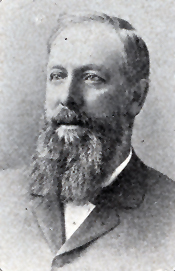
George M. Curtis was born at Oxford, New York, in 1844, moving with his parents to Rochelle, Illinois, where he lived and worked on a farm, attended and taught school until 1865, when he engaged in the coal business at Cortland, Illinois, coming from there to Clinton in 1867 and associated himself with his brother, Charles F., in the sash and door business. Mr. Curtis was very prominent in the business and political circles of the state of Iowa, he like his brother, was very interested in other business enterprises and, for a number of years, was vice-president of the City National bank of Clinton.
In 1887 he was elected to the legislature of Iowa and served one term.
In 1894 he was elected to represent the second congressional district of Iowa in congress and again reelected in 1896.
Cornelius S. Curtis
Cornelius S. Curtis was born in Oxford, New York, in 1851, and moved with his parents to Rochelle and again, with his parents, to Clinton in 1869. He was engaged in the grocery business in Clinton for a while and later in business at Denison, Iowa, returning to Clinton to take a position with Curtis Bros. & Co. and in 1881, when the firm was incorporated, went to Wausau, Wisconsin as manager of the Wausau business.
He like his brothers, was also interested in other enterprises, the principal one being the Fenwood Lumber Co. near Wausau, Wisconsin.
Judson E. Carpenter
Judson E. Carpenter, who was an uncle of the Curtis brothers, was born in Oxford, New York, in 1835, where he lived on a farm, taught school until 1855, when he moved to Rochelle, Illinois, where he bought and operated a farm for a few years, when he went into the coal business at Rochelle, retiring from that business to engage with the Curtis brothers at Clinton, Iowa, in 1866 and was the president of Curtis Bros. & Co.
In 1893, he engaged in the lumber business with his sons at Minneapolis, the firm known as the Carpenter-Lamb Co. He was, vice-president of the Brainard & Northern Minnesota Railroad, which had its headquarters at Minneapolis, Minnesota.
George W. Allen
George W. Allen was born in Rochester, New York in 1844, moving with his parents to Boston in 1846, where he attended school until 1862, when he went to Rochelle, Illinois, and immediately commenced working at the carpenter's trade, continuing same until 1868, when he went to Clinton, Iowa, and took a position in the factory of Curtis Bros. & Co., where he remained until 1876, when he went into the office and in 1881 became a member of the company. He supervised the odd work department of Curtis Bros. & Co.
Related Research Articles
Clinton is a city in and the county seat of Clinton County, Iowa, United States. The population was 24,469 as of 2020. Clinton, along with DeWitt, was named in honor of the sixth governor of New York, DeWitt Clinton. Clinton is the principal city of the Clinton Micropolitan Statistical Area, which is coterminous with Clinton County. Clinton was incorporated on January 26, 1857.
The architectural firm now known as Holabird & Root was founded in Chicago in 1880. Over the years, the firm has changed its name several times and adapted to the architectural style then current — from Chicago School to Art Deco to Modern Architecture to Sustainable Architecture.
Rousseau Owen Crump was a politician and businessman from the U.S. state of Michigan.
Mississippi Valley Airlines (IATA--XV) was a regional air carrier serving the Upper Midwestern region of the United States. It was founded by Herb Lee, Norm Elsy and Charles A. ("Chuck") Draine as Gateway Aviation, and had its headquarters in La Crosse, Wisconsin. Chuck Draine served as chairman and chief executive officer. It began scheduled flight operations on July 22, 1968 between La Crosse Municipal Airport and both Chicago and Milwaukee. The carrier changed its name to Mississippi Valley Airways in October 1969. It became Mississippi Valley Airlines (MVA) and moved its headquarters to Quad City Airport in Moline, Illinois in January 1982. The airline merged into Air Wisconsin on May 17, 1985 in a $10 million share exchange transaction. At the time of the merger, Mississippi Valley Airlines was the United States' eighth-largest regional airline in terms of ridership.
Claude and Starck was an architectural firm in Madison, Wisconsin, at the turn of the twentieth century. The firm was a partnership of Louis W. Claude (1868-1951) and Edward F. Starck (1868-1947). Established in 1896, the firm dissolved in 1928. The firm designed over 175 buildings in Madison.
Richard Teller Crane I was the founder of R.T. Crane & Bro., a Chicago-based manufacturer, later Crane Co.
Chancy Lamb was a pioneer in the lumber industry in Clinton, Iowa.
William John Young was the founder of the W.J. Young Company. He revolutionized the slow system of rafting logs by floatage with the current of the river in 1865 by a successful experiment of pushing log rafts ahead of a steam boat, independent of the river currents, and this with his introduction of the system of brail rafting, facilitated the movement of log stock while greatly lessening the expense of delivering them from the booms at Reef Slough and other points, to the mills at various points on the lower river; but for these advantages, the work of the mills would never have reached the vast volume to which they soon attained. Mr. Young was one of the original members of the Mississippi River Logging Company, his interest in which he sold in 1893, after being for many years one of the most active and influential members of the company.
David Joyce was an American "lumber baron" and industrialist. His fortune was eventually inherited by Beatrice Joyce Kean who used it to establish the Joyce Foundation in 1948.
Albert Foster Dawson was a three-term Republican U.S. Representative from Iowa's 2nd congressional district.
George Martin Curtis was a two-term Republican U.S. Representative from Iowa's 2nd congressional district.
The IXL Historical Museum is a historic office building, residence, and museum complex in Hermansville, Michigan, United States. The main building was constructed as the headquarters for the Wisconsin Land & Lumber Company before it became a museum. The museum was organized in 1982, and the main building, also known as the Wisconsin Land and Lumber Company Office, was designated a Michigan State Historic Site in 1973 and listed on the National Register of Historic Places in 1991.
Cyrus Carpenter Yawkey, commonly known as C. C. Yawkey, was an American business executive in lumber, and politician in Wisconsin.
The Mount Emily Lumber Company operated in La Grande, Oregon from 1920 until 1956. After becoming a subsidiary of the Valsetz Lumber Company in 1955, the name was changed to Templeton Lumber Company. In 1960, the company was again sold and the name changed to Boise Cascade, La Grande.
Allen Perry Lovejoy was a Wisconsin politician, lumber merchant and manufacturer, and generally influential business leader from Janesville, Wisconsin.
The Phoenix Manufacturing Company, later the Phoenix Steel Company, was one of Eau Claire, Wisconsin's oldest manufacturing firms. It manufactured equipment predominantly for the sawmill and logging equipment industries, which were vital to the establishment and growth of Eau Claire.
George Werheim, Sr. was an American politician and businessman.
Carlton Foster was an American businessman, Republican politician, and Wisconsin pioneer. He was the 10th and 26th mayor of Oshkosh, Wisconsin, and served three terms in the Wisconsin State Assembly.
Arfst Frederich Frudden (1854-1931) was a German-American politician and businessman from Föhr. Emigrating to Iowa in the 1870s, he co-founded a lumber company in 1888. He advocated for lumbermen in several trade organizations, then was nominated by the Democrats to serve in the Iowa House of Representatives and later the Iowa Senate.
The Pas Lumber Company was a forestry company that owned and operated several sawmills and logging operations in Manitoba, Saskatchewan, and British Columbia.
This page is based on this Wikipedia article Text is available under the CC BY-SA 4.0 license; additional terms may apply. Images, videos and audio are available under their respective licenses.