| Cubic-triangular tiling honeycomb | |
|---|---|
| Type | Paracompact uniform honeycomb |
| Schläfli symbol | {(3,6,3,4)} or {(4,3,6,3)} |
| Coxeter diagrams |      or or  |
| Cells | {4,3}  {3,6}  r{4,3}  |
| Faces | triangular {3} square {4} hexagon {6} |
| Vertex figure | 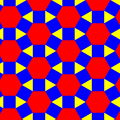 rhombitrihexagonal tiling |
| Coxeter group | [(6,3,4,3)] |
| Properties | Vertex-transitive, edge-transitive |
In the geometry of hyperbolic 3-space, the cubic-triangular tiling honeycomb is a paracompact uniform honeycomb, constructed from cube, triangular tiling, and cuboctahedron cells, in a rhombitrihexagonal tiling vertex figure. It has a single-ring Coxeter diagram, , and is named by its two regular cells.
A geometric honeycomb is a space-filling of polyhedral or higher-dimensional cells, so that there are no gaps. It is an example of the more general mathematical tiling or tessellation in any number of dimensions.
Honeycombs are usually constructed in ordinary Euclidean ("flat") space, like the convex uniform honeycombs. They may also be constructed in non-Euclidean spaces, such as hyperbolic uniform honeycombs. Any finite uniform polytope can be projected to its circumsphere to form a uniform honeycomb in spherical space.