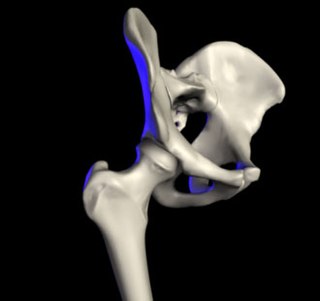
A cushion is a soft bag of some ornamental material, stuffed with wool, hair, feathers, polyester staple fiber, non-woven material, or even paper torn into fragments. It may be used for sitting or kneeling upon, or to soften the hardness or angularity of a chair or couch. Decorative cushions often have a patterned cover material, and are used as decoration for furniture.
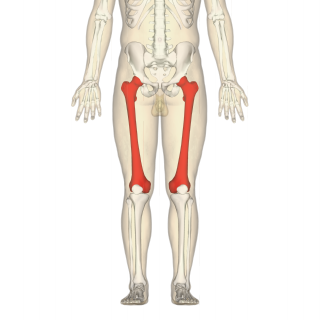
The femur or thigh bone, is the proximal bone of the hindlimb in tetrapod vertebrates. The head of the femur articulates with the acetabulum in the pelvic bone forming the hip joint, while the distal part of the femur articulates with the tibia and kneecap forming the knee joint. By most measures the femur is the strongest bone in the body. The femur is also the longest bone in the human body.

Coxa vara is a deformity of the hip, whereby the angle between the head and the shaft of the femur is reduced to less than 120 degrees. This results in the leg being shortened, and the development of a limp. It is commonly caused by injury, such as a fracture. It can also occur when the bone tissue in the neck of the femur is softer than normal, causing it to bend under the weight of the body. This may either be congenital or the result of a bone disorder. The most common cause of coxa vara is either congenital or developmental. Other common causes include metabolic bone diseases, post-Perthes deformity, osteomyelitis, and post traumatic. Shepherd's Crook deformity is a severe form of coxa vara where the proximal femur is severely deformed with a reduction in the neck shaft angle beyond 90 degrees. It is most commonly a sequela of osteogenesis imperfecta, Pagets disease, osteomyelitis, tumour and tumour-like conditions.

A varus deformity is an inward angulation of the distal segment of a bone or joint. The opposite of varus is called valgus. EX: Varus deformity results in a decreased Q angle of the knee joint.
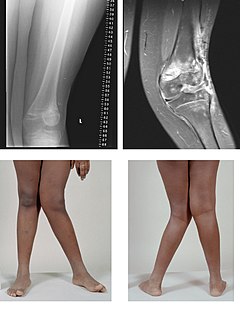
A valgus deformity is a condition in which the bone segment distal to a joint is angled outward, that is, angled laterally, away from the body's midline. The opposite deformation, where the twist or angulation is directed medially, toward the center of the body, is called varus. Common causes of valgus knee in adults include arthritis of the knee and traumatic injuries.

The upper extremity, proximal extremity or superior epiphysis of the femur is the part of the femur closest to the pelvic bone and the trunk. It contains the following structures:
The arthropod leg is a form of jointed appendage of arthropods, usually used for walking. Many of the terms used for arthropod leg segments are of Latin origin, and may be confused with terms for bones: coxa, trochanter, femur, tibia, tarsus, ischium, metatarsus, carpus, dactylus, patella.
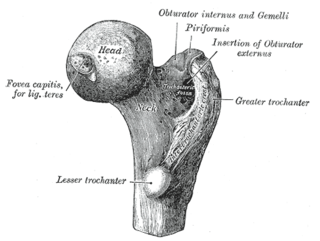
The femur neck is a flattened pyramidal process of bone, connecting the femoral head with the femoral shaft, and forming with the latter a wide angle opening medialward.
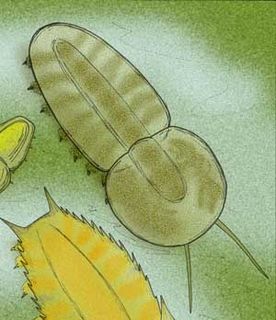
Misszhouia is a genus of small to average sized marine arthropods within the Naraoiidae family, that lived during the early Cambrian period. The only species presently known is Misszhouia longicaudata.
Coxa valga is a deformity of the hip where the angle formed between the head and neck of the femur and its shaft is increased, usually above 135 degrees. It is caused by a slipped epiphysis of the femoral head.

The mandible of an arthropod is a pair of mouthparts used either for biting or cutting and holding food. Mandibles are often simply referred to as jaws. Mandibles are present in the extant subphyla Myriapoda, Crustacea and Hexapoda. These groups make up the clade Mandibulata, which is currently believed to be the sister group to the rest of arthropods, the clade Arachnomorpha.

An arthropod is an invertebrate animal having an exoskeleton, a segmented body, and paired jointed appendages. Arthropods form the phylum Euarthropoda, which includes insects, arachnids, myriapods, and crustaceans. The term Arthropoda as originally proposed refers to a proposed grouping of Euarthropods and the phylum Onychophora.
Arthropods are characterized by their jointed limbs and cuticle made of chitin, often mineralised with calcium carbonate. The arthropod body plan consists of segments, each with a pair of appendages. The rigid cuticle inhibits growth, so arthropods replace it periodically by moulting. Arthopods are bilaterally symmetrical and their body possesses an external skeleton. Some species have wings.
This glossary describes the terms used in formal descriptions of spiders; where applicable these terms are used in describing other arachnids.
Sellacoxa is a genus of iguanodont dinosaur which existed in what is now England during the Early Cretaceous period.
Mongolicosa glupovi is a species of wolf spider found in the Russian republics of Altai, Khakassia and Tuva.
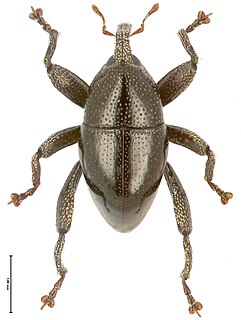
Trigonopterus is a genus of flightless weevils placed in the Cryptorhynchinae of Curculionidae. It is distributed in the area between Sumatra, Samoa, the Philippines, and New Caledonia. About 90 species had been formally described until March 2013, when a single paper more than doubled this number, agreeing with previous studies and a systematic barcoding study that many more species have yet to be described. As of March 2019, there were 444 described species.
The biological screw joint is a naturally occurring form of the screw joint, a mechanical device that combines rotational movement with single-axis translation. Alexander Riedel of the State Museum of Natural History Karlsruhe and Thomas van de Kamp of the Karlsruhe Institute of Technology discovered it in specimens of Trigonopterus oblongus, a weevil found in Papua.
Camptodactyly-arthropathy-coxa vara-pericarditis syndrome is a rare genetic condition due to a mutation in the gene proteoglycan 4 (PRG4) - a chondroitin sulfate proteoglycan that acts as a lubricant for the cartilage surfaces. This gene is also known as lubricin.

Pentecopterus is a genus of eurypterid, an extinct group of aquatic arthropods. Fossils have been registered from the Darriwilian age of the Middle Ordovician period, as early as 467.3 million years ago. The genus contains only one species, P. decorahensis, that is the oldest known eurypterid, surpassing other Ordovician eurypterids, such as Brachyopterus, in age by almost 9 million years. The generic name derives from the penteconter, a warship from ancient Greece, and the suffix -pterus, which means "wing" and is often used in other genus of eurypterids. The specific name refers to Decorah, Iowa, where Pentecopterus was discovered.