Origins
The origins of the district go back to the 1950s when Catholic parents in Drumheller and Oyen separately formed Catholic school districts and each opened a school, St. Anthony's School in Drumheller and Assumption School in Oyen. The then parish priest in Oyen, Father Molnar, was instrumental in helping with the foundation of the Oyen School. As the law stood in Alberta, a public meeting of all Catholics in the area (called a four by four from the size of the original school districts into which Alberta was divided) was called and a vote taken to see if a quorum was present (25%) and if a majority of eligible voters approved of the project.
St. Anthony's School in Drumheller originally offered high school classes, but the declining population in Drumheller due to the closing of the coal mines and the end of the baby boom made the high school a precarious proposition. After a few years, the school reverted to a kindergarten to Grade 9 configuration. Oyen originally offered Grades 1 to 9 at Assumption School, but the end of the baby boom and rural depopulation caused the offering to be restricted to Grades 1 to 6. Kindergarten classes were started in 1995.
By the late 1980s, Okotoks was growing fast and Catholic parents formed an exploratory group to study the feasibility of establishing a Catholic school. They were encouraged by the local parish priest, Fr. Greg McLellan. Among the key parents were Joanne Mercier, Mannie Fink-Fraser, Bev Palko, John Walsh, Ted Tatem, Jim Lewis and Paula Ford {the last five subsequently trustees and the last three chairmen of the board}. The new parish priest in Okotoks, Father Michael Storey, appointed in 1988, became a strong supporter of the project. Following a successful vote in Okotoks and a number of surrounding rural four by fours, the Okotoks Catholic School District was proclaimed in September 1988. The first institution, Good Shepherd School, opened in September 1990, in temporary facilities until a new facility opened in January, 1991. Kindergarten and Grade 1 were held at St. James Church in Okotoks while Grades 2 to 8 were held at Mossleigh School, a 45-minute bus ride east of town. The school opened with about 200 students. Growth was rapid and a high school Holy Trinity Academy opened in 1992 in shared facilities. In 2009 there are four Catholic schools in the town of 20,000.
By 1990, parents in High River began to be interested in a Catholic school, and working in cooperation with the Okotoks Catholic School District, they won a vote in 1992 to establish a Catholic school district. It was merged with the Okotoks Catholic School District into the Foothills Catholic School District and its first school, Holy Spirit Academy, opened in the old High River Hospital, a building that had served for many years as a nursing residence. There are now two Catholic schools in High River.
The Conservative provincial Government of Ralph Klein decided in 1994 to reduce the total number of school jurisdictions in Alberta from about 165 to around 60. It was left to individual districts to seek partners voluntarily or face a government solution. It certainly looked as if the Foothills Catholic District would be absorbed into the Calgary Catholic District, the solution for two other Catholic districts in Airdrie and Cochrane, both in the metro Calgary area. In fact, tentative approaches were made by a Calgary Catholic senior administrator to his counterpart in the Foothills Catholic District along these lines and Drumheller Catholic was slated to join Red Deer Catholic. It was expected that the Catholic school in Oyen would be closed and the district dissolved.
However, at a meeting at Lethbridge in January 1994, a consensus was reached between representatives from Drumheller Catholic and Foothills Catholic for a new type of decentralized regional division which left significant decision making in local hands. Representatives from Oyen were soon approached and found the plan attractive as well. Final details were worked out in a meeting at St. Anthony's Parish Hall in Drumheller on the Saturday after Easter of 1994. The Christ The Redeemer School Division came into existence on January 1, 1995. The first superintendent was Ron Wallace, who had been superintendent in Okotoks since its inception in 1989. Deputy superintendent was Dr. Bertha Wilson, who had been superintendent in Drumheller for some years. The superintendent in Oyen, Len Miller, retired, but was later elected as a trustee for the board from High River, subsequently serving a term as chairman. The first chairman of the board was Virginia Haahr of Okotoks.
Amalgamation
The history of Christ The Redeemer School Division since its inception has been one of innovation, rapid growth and academic achievement. The jurisdiction now serves over 7300 students in sixteen schools in seven communities and recently received the Minister's Education Leadership Award (MELRA) in an unprecedented seventeen categories.
The jurisdiction's vision, mission and fundamental beliefs are brought to life by four foundational school community pillars including: faith; learning; safety and care; and stewardship.
As faith communities, schools embrace the teaching of the Magisterium of the Church. The Catholic faith permeates all that is done. Schools become faith communities when staff and students give witness to their faith. Jesus is the source of morals and values. Prayer is essential. As learning communities, schools believe the family is the fundamental unit of society and that parents are the primary educators of their children. The educational needs of all students must be met in a manner that does not deprive others of access to quality education. As safe and caring communities, schools believe that the infinite value of each person in God's eyes must be reflected in all that is done. This calls for respect in all relationships. As good stewards of resources, schools are called to be faithful stewards of God's creation. The board of trustees is accountable to the Bishop of the Diocese of Calgary, the Minister of Education, and parents and supporters. The board provides direction to its staff and students.
From earliest days, the division had a commitment to the needs of exceptional children. Within two years of its foundation, two new take out programs were introduced in all schools: Early Intervention programs (Kindergarten to Grade 3) targeting the needs of children at risk of academic delay; and, skills programs (Grades 4 to 12) designed to help students who were behind in academic performance. Teachers at common grade levels meet weekly to share strategies and compare student performance. And the metaresearch findings on effective teaching and classroom were endlessly repeated and incorporated into the working practices of the teachers and principals. As a result of this, Christ The Redeemer Catholic Schools soon emerged as the top academic performer of all the school jurisdictions in Alberta, a position it holds to this day as measured by Alberta Education's Accountability Pillar Report Card.
As part of its stewardship of resources pillar, the jurisdiction has become a national leader in designing and constructing "green" school facilities. Most recently (2008), the newly constructed Holy Trinity Academy (Okotoks, Alberta, Canada) was built to LEED Gold standards; the first high school to receive this prestigious recognition in Canada. LEED refers to the Leadership in Energy and Environmental Design Green Building Rating System, developed by the U.S. Green Building Council (USGBC). It provides a suite of standards for environmentally sustainable construction. The recently opened Our Lady of the Snows Catholic Academy (Canmore, Alberta, Canada) was also designed and built to LEED Gold standards. It is anticipated that the new St. Anthony's School (Drumheller, Alberta, Canada), currently under construction, will receive the same designation.

Okotoks is a town in the Calgary Region of Alberta, Canada. It is on the Sheep River, approximately 38 km (24 mi) south of Downtown Calgary. Okotoks has emerged as a bedroom community of Calgary. According to the 2021 Federal Census, the town has a population of 30,214, making it the largest town in Alberta.
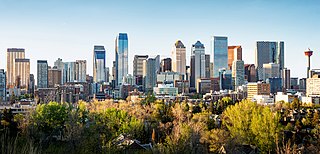
The Calgary Metropolitan Region (CMR), also commonly referred to as the Calgary Region, is a conglomeration of municipalities centred on Calgary, the largest city in Alberta.

Oyen is a town in east-central Alberta, Canada near the Saskatchewan boundary and north of Medicine Hat. It is on Highway 41, 4 km (2.5 mi) south of its junction with Highway 9.

Drumheller-Stettler is a provincial electoral district (riding) in Alberta, Canada. The electoral district is mandated to return a single member to the Legislative Assembly of Alberta using the first past the post method of voting. The district was created in the 2003 boundary redistribution and came into force in 2004 from the old districts of Drumheller-Chinook and Lacombe-Stettler.

Calgary School District No. 19 or the Calgary Board of Education (CBE) is the public school board in Calgary, Alberta, Canada. As a public system, the CBE is required to accept any students who meet age and residency requirements, regardless of religion. Calgary Board of Education (CBE) was founded in 1885 as the Calgary Protestant Public School District No. 19.
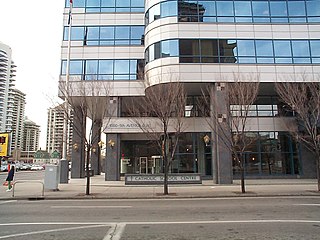
Calgary Roman Catholic Separate School District No. 1 or the Calgary Catholic School District (CCSD) is the Roman Catholic separate school board in Calgary, Alberta, Canada. It also serves the neighbouring communities of Airdrie, Chestermere, Cochrane and Rocky View County. The CSSD receives funding for students from the provincial government of Alberta.
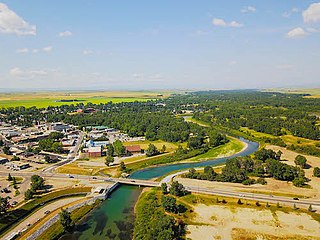
High River is a town within the Calgary Metropolitan Region of Alberta, Canada. It is approximately 68 kilometres (42 mi) south of Calgary, at the junction of Alberta Highways 2 and 23. High River had a population of 14,324 in 2021.
Indus is a hamlet in southern Alberta, Canada under the jurisdiction of Rocky View County. It is home to the Bill Herron Arena

Wheatland County is a municipal district in south-central Alberta, Canada that is east of Calgary. Located in Census Division No. 5, its municipal office is located east of the Town of Strathmore on Highway 1.
Education in Alberta is provided mainly through funding from the provincial government. The earliest form of formal education in Alberta is usually preschool which is not mandatory and is then followed by the partially-mandatory kindergarten to Grade 12. This is managed by Alberta Education which has divided the province into 379 school authorities. Higher education in the province is managed by Alberta Advanced Education.
Saddle Ridge is a residential neighbourhood in the northeast quadrant of Calgary, Alberta. It is located at the northeastern edge of the city, and it is bounded to the north by Airport Trail NE, to the east by Stoney Trail NE, to the south by 80 Avenue NE and to the west by Métis Trail. The Saddle Ridge Industrial Area and Calgary International Airport are located west of the neighbourhood.
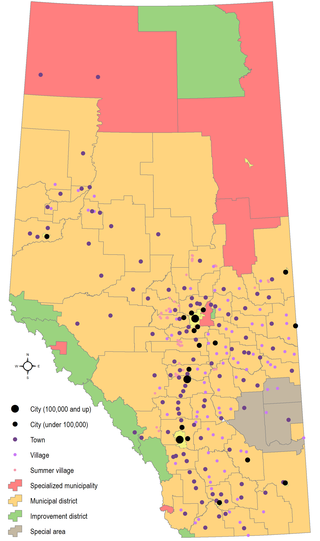
Municipal elections were held in Alberta, Canada on Monday, October 15, 2007. Since 1968, provincial legislation has required every municipality to hold triennial elections. Mayors (reeves), councillors (aldermen), and trustees were elected to office in 15 of the 16 cities, all 111 towns, all 99 villages, all 4 specialized municipalities, all 64 municipal districts, 3 of the 7 improvement districts, and the advisory councils of the 3 special areas. The City of Lloydminster is on the Saskatchewan schedule, and held elections on October 25, 2006 and October 28, 2009, while 4 improvement districts have no councils and are led solely by the Minister of Municipal Affairs. Since the 2004 municipal elections, the Town of Lac La Biche and Lakeland County amalgamated to form Lac La Biche County, the villages of Irricana and Onoway became towns, the Town of Brooks became a city, and the Village of Sangudo was dissolved.
Municipal elections were held in Alberta, Canada on Monday, October 18, 2010. Since 1968, provincial legislation has required every municipality to hold triennial elections. Mayors (reeves), councillors (aldermen), and trustees were elected to office in 16 of the 17 cities, all 108 towns, all 95 villages, all 5 specialized municipalities, all 64 municipal districts, 3 of the 7 improvement districts, and the advisory councils of the 3 special areas. The City of Lloydminster is on the Saskatchewan schedule, and held elections on October 28, 2009 and October 24, 2012, while 4 improvement districts have no councils and are led solely by the Minister of Municipal Affairs. Since the 2007 municipal elections, the villages of Derwent, Kinuso, New Sarepta, and Thorhild were dissolved, the Municipality of Crowsnest Pass changed from town to specialized municipality status, and the Town of Lacombe became a city.
Rocky View School Division No. 41 or Rocky View Schools (RVS) is the public school authority that serves students to the west, north and east of the City of Calgary in the province of Alberta.
Greater St. Albert Catholic Schools or Greater St. Albert Roman Catholic Separate School District No. 734 is a separate school board serving St. Albert, Morinville, and Legal, Alberta, Canada.
Bishop O'Byrne High School is a Roman Catholic high school located in Calgary, Alberta operated under the jurisdiction of the Calgary Catholic School District. The school's designated boundaries include the deep southwest communities of Calgary like Bridlewood, Millrise, and Shawnessy, and southeast quadrants of Calgary like Midnapore, McKenzie Lake, and Sundance.
St. Anne Academic Centre is a Roman Catholic school located in the community of Ramsay in the city of Calgary, Alberta. The school is operated the jurisdiction of the Calgary Catholic School District.
All Saints High School is a Roman Catholic high school located in Calgary, Alberta operated under the jurisdiction of the Calgary Catholic School District. The school's designated boundaries include the deep south communities of Calgary like Auburn Bay, Belmont, Chaparral, Cranston, Legacy, Mahogany, Seton, Silverado, Walden, Wolf Willow, and Yorkville
