Chebyshev's sum inequality Last updated October 05, 2025 Mathematical inequality
In mathematics , Chebyshev's sum inequality , named after Pafnuty Chebyshev , states that if
a 1 ≥ a 2 ≥ ⋯ ≥ a n {\displaystyle a_{1}\geq a_{2}\geq \cdots \geq a_{n}\quad } b 1 ≥ b 2 ≥ ⋯ ≥ b n , {\displaystyle \quad b_{1}\geq b_{2}\geq \cdots \geq b_{n},} then
1 n ∑ k = 1 n a k b k ≥ ( 1 n ∑ k = 1 n a k ) ( 1 n ∑ k = 1 n b k ) . {\displaystyle {1 \over n}\sum _{k=1}^{n}a_{k}b_{k}\geq \left({1 \over n}\sum _{k=1}^{n}a_{k}\right)\!\!\left({1 \over n}\sum _{k=1}^{n}b_{k}\right)\!.} In words, if we are given two sequences that are both non-increasing or non-decreasing, then the product of their averages is less than the average of their (termwise) product.
Similarly, if
a 1 ≤ a 2 ≤ ⋯ ≤ a n {\displaystyle a_{1}\leq a_{2}\leq \cdots \leq a_{n}\quad } b 1 ≥ b 2 ≥ ⋯ ≥ b n , {\displaystyle \quad b_{1}\geq b_{2}\geq \cdots \geq b_{n},} then
1 n ∑ k = 1 n a k b k ≤ ( 1 n ∑ k = 1 n a k ) ( 1 n ∑ k = 1 n b k ) . {\displaystyle {1 \over n}\sum _{k=1}^{n}a_{k}b_{k}\leq \left({1 \over n}\sum _{k=1}^{n}a_{k}\right)\!\!\left({1 \over n}\sum _{k=1}^{n}b_{k}\right)\!.} [ 1] Proof Consider the sum
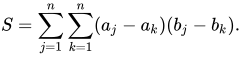
S = ∑ j = 1 n ∑ k = 1 n ( a j − a k ) ( b j − b k ) . {\displaystyle S=\sum _{j=1}^{n}\sum _{k=1}^{n}(a_{j}-a_{k})(b_{j}-b_{k}).} The two sequences are non-increasing , therefore a j − a k b j − b k j , k S ≥ 0
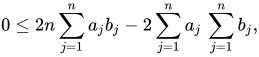
Opening the brackets, we deduce:
0 ≤ 2 n ∑ j = 1 n a j b j − 2 ∑ j = 1 n a j ∑ j = 1 n b j , {\displaystyle 0\leq 2n\sum _{j=1}^{n}a_{j}b_{j}-2\sum _{j=1}^{n}a_{j}\,\sum _{j=1}^{n}b_{j},} hence
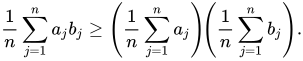
1 n ∑ j = 1 n a j b j ≥ ( 1 n ∑ j = 1 n a j ) ( 1 n ∑ j = 1 n b j ) . {\displaystyle {\frac {1}{n}}\sum _{j=1}^{n}a_{j}b_{j}\geq \left({\frac {1}{n}}\sum _{j=1}^{n}a_{j}\right)\!\!\left({\frac {1}{n}}\sum _{j=1}^{n}b_{j}\right)\!.} An alternative proof is simply obtained with the rearrangement inequality , writing that
∑ i = 0 n − 1 a i ∑ j = 0 n − 1 b j = ∑ i = 0 n − 1 ∑ j = 0 n − 1 a i b j = ∑ i = 0 n − 1 ∑ k = 0 n − 1 a i b i + k mod n = ∑ k = 0 n − 1 ∑ i = 0 n − 1 a i b i + k mod n ≤ ∑ k = 0 n − 1 ∑ i = 0 n − 1 a i b i = n ∑ i a i b i . {\displaystyle \sum _{i=0}^{n-1}a_{i}\sum _{j=0}^{n-1}b_{j}=\sum _{i=0}^{n-1}\sum _{j=0}^{n-1}a_{i}b_{j}=\sum _{i=0}^{n-1}\sum _{k=0}^{n-1}a_{i}b_{i+k~{\text{mod}}~n}=\sum _{k=0}^{n-1}\sum _{i=0}^{n-1}a_{i}b_{i+k~{\text{mod}}~n}\leq \sum _{k=0}^{n-1}\sum _{i=0}^{n-1}a_{i}b_{i}=n\sum _{i}a_{i}b_{i}.} Continuous version There is also a continuous version of Chebyshev's sum inequality:
If f and g are real -valued, integrable functions over [a , b ], both non-increasing or both non-decreasing, then
1 b − a ∫ a b f ( x ) g ( x ) d x ≥ ( 1 b − a ∫ a b f ( x ) d x ) ( 1 b − a ∫ a b g ( x ) d x ) {\displaystyle {\frac {1}{b-a}}\int _{a}^{b}f(x)g(x)\,dx\geq \!\left({\frac {1}{b-a}}\int _{a}^{b}f(x)\,dx\right)\!\!\left({\frac {1}{b-a}}\int _{a}^{b}g(x)\,dx\right)} with the inequality reversed if one is non-increasing and the other is non-decreasing.
Notes ↑ Hardy, G. H.; Littlewood, J. E.; Pólya, G. (1988). Inequalities . Cambridge Mathematical Library. Cambridge: Cambridge University Press. ISBN 0-521-35880-9 MR 0944909 . This page is based on this
Wikipedia article Text is available under the
CC BY-SA 4.0 license; additional terms may apply.
Images, videos and audio are available under their respective licenses.
网站复制工具
网站克隆
霸屏SEO镜像站群
网页镜像工具
自动镜像站群