Related Research Articles

The SPAD S.XIII was a French biplane fighter aircraft of the First World War, developed by Société Pour L'Aviation et ses Dérivés (SPAD) from the earlier and highly successful SPAD S.VII.
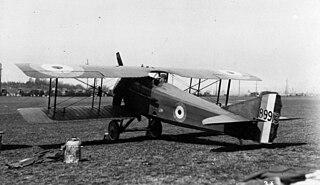
The SPAD S.VII was the first of a series of highly successful biplane fighter aircraft produced by Société Pour L'Aviation et ses Dérivés (SPAD) during the First World War. Like its successors, the S.VII was renowned as a sturdy and rugged aircraft with good climbing and diving characteristics. It was also a stable gun platform, although pilots used to the more manoeuvrable Nieuport fighters found it heavy on the controls. It was flown by a number of the famous aces, such as France's Georges Guynemer, Italy's Francesco Baracca and Australia's Alexander Pentland.

The Nieuport 28 C.1, a French biplane fighter aircraft flown during World War I, was built by Nieuport and designed by Gustave Delage. Owing its lineage to the successful line of sesquiplane fighters that included the Nieuport 17, the Nieuport 28 continued a similar design philosophy of a lightweight and highly maneuverable aircraft.
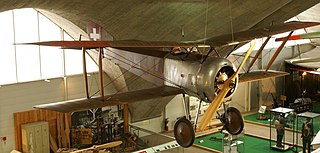
The Hanriot HD.1 was a French World War I single-seat fighter aircraft. Rejected for service with French squadrons in favour of the SPAD S.VII, the type was supplied to the Belgian Army′s Aviation Militaire Belge and the Royal Italian Army′s Corpo Aeronautico Militare, with both of which it proved highly successful. Of a total of about 1,200 examples built, 831 were produced by Italian companies under licence.

The Nieuport 24 was a World War I French sesquiplane fighter aircraft designed by Gustave Delage as a development of the successful Nieuport 17.

The Bleriot-SPAD S.51 was a French fighter aircraft developed in 1924 in response to a French Air Force requirement for an aircraft to replace their obsolete Nieuport-Delage NiD.29s.

The Blériot-SPAD S.61 was a French fighter aircraft developed in 1923. Designed by André Herbemont, the S.61 was a conventional biplane, abandoning the swept upper wing used by Herbemont in several previous designs. The prototype S.61 was evaluated by the French Air Force alongside the S.51 as a potential new fighter, but like its stablemate, was rejected. The Polish Air Force was impressed enough to order 250, as well as purchase licences for local production. The Romanian Air Force also ordered 100 aircraft. About 30 were built in Poland, by the CWL.
The Blériot-SPAD S.81 was a French fighter aircraft developed in 1923 to a requirement by the French Air Force. It was flown competitively against the Dewoitine D.1 and was selected over that aircraft due to the Dewoitine's more radical design, leading to an order for 80 aircraft. The S.81 was a single-bay biplane of conventional configuration with I-shaped interplane struts and lacking Herbemont's usual swept upper wing. It featured a wooden fuselage of monocoque construction and metal wings skinned in fabric. Production versions differed from the prototypes in having a lengthened fuselage and larger tail fin.

The SPAD S.A was a French two-seat tractor biplane first flown in 1915. It was used by France and Russia in the early stages of the First World War in the fighter and reconnaissance roles. It was a somewhat unusual aircraft that carried its observer in a nacelle ahead of both wing and engine.

The SPAD S.XII or SPAD 12 was a French single-seat biplane fighter aircraft of the First World War developed from the successful SPAD VII by Louis Béchereau, chief designer of the Société Pour L'Aviation et ses Dérivés (SPAD).

The SPAD S.XI or SPAD 11 was a French two-seat biplane reconnaissance aircraft of the First World War. The SPAD 11 was the work of Louis Béchereau, chief designer of the Société Pour L'Aviation et ses Dérivés (SPAD), who also designed the highly successful SPAD 7 and SPAD 13 single-seat fighter aircraft. It was developed under military specification C2, which called for a two-seat fighter aircraft. As a result of its failure to meet the levels of performance and agility demanded by the C2 specification, the SPAD 11 was used, along with the more successful Salmson 2 and Breguet 14, to replace aging Sopwith 1½ Strutter and Dorand AR reconnaissance aircraft. Persistent problems with the SPAD 11 led to its early replacement by the SPAD S.XVI or SPAD 16 variant.

The Levasseur PL.6 C.2, also known as Levasseur VI C.2, was a two-seat fighter aircraft built in France in 1926 in order to meet a 1925 C.2 Service Technique de l'Aéronautique (STAé) specification,. Constructed along the same lines as Levasseur's naval aircraft of the same era, it was a conventional, single-bay biplane with seating for the pilot and tail gunner in separate, open cockpits. Flight testing of the prototype commenced in 1926, and it was exhibited at the Salon de l'Aéronautique at the end of the year.
The SPAD XIV was a French biplane floatplane fighter aircraft built by Société Pour L'Aviation et ses Dérivés (SPAD) and flown by the French Navy during World War I.

The Blériot-SPAD S.91 was a French light-weight fighter aircraft. It would be later developed into the Blériot-SPAD S.510, the last biplane produced by the French aeronautic industries.
The Blériot-SPAD S.41 was a French fighter aircraft developed in the early 1920s.

The SPAD S.42 was a French biplane trainer aircraft of the early 1920s, developed by Société Pour L'Aviation et ses Dérivés (SPAD) from prolific SPAD S.XIII fighter.
The Blériot-SPAD S.70 was a French fighter aircraft developed in the late 1920s.
The Blériot-SPAD S.71 was a French fighter aircraft developed in the early 1920s.
The SPAD S.XXII was a prototype fighter plane built by SPAD shortly World War I.
Escadrille Spa.97 was a French fighter squadron active during the World War I years of 1917 and 1918. It was credited with destroying 17 enemy airplanes and eight observation balloons.
References
- ↑ "SPAD S-XXIV - SPAD 24 - Chasseur - Un siècle d'aviation française". Aviafrance.com. 2002-12-14. Retrieved 2019-02-04.