
Luiz Gonzaga do Nascimento was a Brazilian singer, songwriter, musician and poet and one of the most influential figures of Brazilian popular music in the twentieth century. He has been credited with having presented the rich universe of Northeastern musical genres to all of Brazil, having popularized the musical genre baião and has been called a "revolutionary" by Antônio Carlos Jobim. According to Caetano Veloso, he was the first significant cultural event with mass appeal in Brazil. Luiz Gonzaga received the Shell prize for Brazilian Popular Music in 1984 and was only the fourth artist to receive this prize after Pixinguinha, Antônio Carlos Jobim and Dorival Caymmi. The Luiz Gonzaga Dam was named in his honor.
Baião is a Northeastern Brazilian music genre and dance style based on a syncopated duple meter rhythm, based around the pulse of the zabumba, a flat, double-headed bass drum played with a mallet in one hand and a stick in the other, each striking the opposite head of the drum for alternating high and low notes, frequently accompanied by an accordion and a triangle pattern. The baião rhythm is integral to the genres of forró, repente and coco. It is mostly associated with the state of Pernambuco. Baião was popularized via radio in the 1940s, reaching peak popularity in the 1950s.
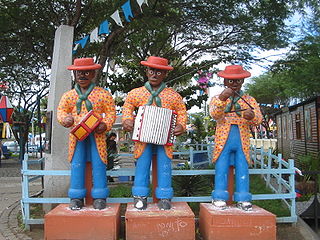
The term forró refers to a musical genre, a rhythm, a dance and the event itself where forró music is played and danced. Forró is an important part of the culture of the Northeastern Region of Brazil. It encompasses various dance types as well as a number of different musical genres. Their music genres and dances have gained widespread popularity in all regions of Brazil, especially during the Brazilian June Festivals. Forró has also become increasingly popular all over the world, with a well-established forró scene in Europe.

Marco de Canaveses is a city and municipality on Porto district, in northern Portugal. The population in 2011 was 53,450, in an area of 201.89 km². The city itself had a population of 9,042 in 2001.
The following are the association football events of the year 2004 throughout the world.

Baião is a municipality in Porto District in Portugal. The population in 2011 was 20,522, in an area of 174.53 km².
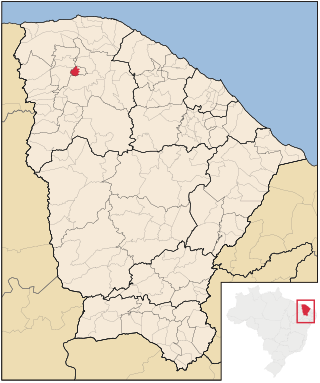
Alcântaras is a municipality in the state of Ceará in the Northeast region of Brazil.
Baião, Pará is a municipality in the state of Pará in the Northern region of Brazil.
Noise Viola is a Brazilian instrumental group formed by Fred Andrade, Paulo Barros, Leonardo César, Renato Monteiro (bass), Rafael Santiago and Cacau (percussion), which presents a fusion of classical music and Brazilian rhythms, such as frevo, maracatu and baião.

Nheengatu is the fourteenth studio album by Brazilian rock band Titãs, released on May 12, 2014. It is their first studio album with session drummer Mario Fabre, who replaced Charles Gavin, their last with vocalist and guitarist Paulo Miklos, who left the then quartet in 2016, and also their first release through Som Livre and producer Rafael Ramos. The album was dedicated to Rachel Salém, Miklos' wife who died on July 23, 2013, of lung cancer.

The District of Porto is located on the north-west coast of Portugal. The district capital is the city of Porto, the second largest city in the country. It is bordered by the Aveiro and Viseu districts to the south, Braga district to the north and Vila Real district to the east.

The rabeca or rabeca chuleira is a fiddle originating in Portugal, commonly used in Portugal, Northeastern Brazil, where it is most commonly used in Brazilian forró music, and Cape Verde. It is descended from the medieval rebec.

Humberto Cavalcanti de Albuquerque Teixeira was a Brazilian lawyer, politician, musician, and composer, mostly known for his partnership with musician Luiz Gonzaga. Together, they wrote one of the most important songs of their era, Asa Branca, in 1947. Teixeira is recognized as a specialist in baião as well as "master of costumes and popular North-Eastern trends."

Quarteto Novo was a group formed in São Paulo, Brazil in 1966 which released one landmark instrumental album and launched the careers of some of the band's members. The eponymous 1967 album has been influential in jazz and pop music.

The escala nordestina are a body of musical scales commonly used in the music of the Nordeste, the northeastern region of Brazil. The term can apply to several different scales, including the Mixolydian, the Lydian with a flattened seventh, and the Dorian. These three modes have in common the rejection of the use of the major seventh as the leading-tone, generally preferring the more "acoustic and natural" minor seventh. The term northeastern scale is most commonly used to refer to the Mixolydian mode, which is extensively used in baião and frevo music. In Brazilian music, the Dorian mode is formed from the Mixolydian mode, by the lowering of the third, thus being a minor version of the former. The Brazilian Lydian, somewhat less common in practice, is a synthetic scale closely related to the harmonic series.
Rui Miguel Marques Baião is a Portuguese former footballer who played as a midfielder.

Antônio Carlos Moreira Pires, better known as Moraes Moreira[moˈɾajz muˈɾejɾa], was a Brazilian musician and songwriter. During the 1970s he played guitar and sang in the band Novos Baianos, after which he embarked on a solo career recording 29 albums. Moreira was involved in recording 40 full-length albums with Novos Baianos and Trio Elétrico Dodô e Osmar, and two more albums with guitarist Pepeu Gomes. Moreira was one of the most versatile composers of Brazil, mixing the genres of rock, samba, choro, frevo, baião, and classical.

Baião de dois is a dish originating from the Brazilian state of Ceará, typical of the Northeast Region and parts of the North Region, such as Rondônia, Acre, Amazonas and Pará. It consists of a preparation of rice and beans, preferably Brazilian beans such as "feijão verde" or "feijão novo". It is common to add queijo coalho. Dried meat is not added in Ceará. In Paraíba and in Pernambuco, there is a variant called rubacão, a dish that is very popular in the Sertão.
