
A carpet is a textile floor covering typically consisting of an upper layer of pile attached to a backing. The pile was traditionally made from wool, but since the 20th century, synthetic fibers such as polypropylene, nylon or polyester are often used, as these fibers are less expensive than wool. The pile usually consists of twisted tufts that are typically heat-treated to maintain their structure. The term carpet is often used in a similar context to the term rug, but rugs are typically considered to be smaller than a room and not attached to the floor.

A Persian carpet or Persian rug, also known as Iranian carpet, is a heavy textile made for a wide variety of utilitarian and symbolic purposes and produced in Iran, for home use, local sale, and export. Carpet weaving is an essential part of Persian culture and Iranian art. Within the group of Oriental rugs produced by the countries of the "rug belt", the Persian carpet stands out by the variety and elaborateness of its manifold designs.

A kilim is a flat tapestry-woven carpet or rug traditionally produced in countries of the former Persian Empire, including Iran, Azerbaijan, the Balkans and the Turkic countries of Central Asia. Kilims can be purely decorative or can function as prayer rugs. Modern kilims are popular floor coverings in Western households.

Uşak carpets, Ushak carpets or Oushak Carpets are Turkish carpets that use a particular family of designs, called by convention after the city of Uşak, Turkey – one of the larger towns in Western Anatolia, which was a major center of rug production from the early days of the Ottoman Empire, into the early 20th century.

Rug hooking is both an art and a craft where rugs are made by pulling loops of yarn or fabric through a stiff woven base such as burlap, linen, or rug warp. The loops are pulled through the backing material by using a crochet-type hook mounted in a handle for leverage. In contrast latch-hooking uses a hinged hook to form a knotted pile from short, pre-cut pieces of yarn.
An oriental rug is a heavy textile made for a wide variety of utilitarian and symbolic purposes and produced in “Oriental countries” for home use, local sale, and export.

Anatolian rug is a term of convenience, commonly used today to denote rugs and carpets woven in Anatolia and its adjacent regions. Geographically, its area of production can be compared to the territories which were historically dominated by the Ottoman Empire. It denotes a knotted, pile-woven floor or wall covering which is produced for home use, local sale, and export. Together with the flat-woven kilim, Anatolian rugs represent an essential part of the regional culture, which is officially understood as the Culture of Turkey today, and derives from the ethnic, religious and cultural pluralism of one of the most ancient centres of human civilisation.

A Lotto carpet is a hand-knotted, patterned carpet that was produced primarily during the 16th and 17th centuries along the Aegean coast of Anatolia, Turkey, although it was also copied in various parts of Europe. It is characterized by a lacy arabesque, usually in yellow on a red ground, often with blue details. The name "Lotto carpet" refers to the inclusion of carpets with this pattern in paintings by the 16th-century Venetian painter Lorenzo Lotto, although they appear in many earlier Oriental carpets in Renaissance painting.

Carpets of Middle-Eastern origin, either from Anatolia, Persia, Armenia, Azerbaijan, the Levant, the Mamluk state of Egypt or Northern Africa, were used as decorative features in Western European paintings from the 14th century onwards. More depictions of Oriental carpets in Renaissance painting survive than actual carpets contemporary with these paintings. Few Middle-Eastern carpets produced before the 17th century remain, though the number of these known has increased in recent decades. Therefore, comparative art-historical research has from its onset in the late 19th century relied on carpets represented in datable European paintings.

After 1500, and following the expulsion of the Moors by King Ferdinand and Queen Isabella, Spanish carpet design began to prefer classically inspired European Renaissance styles to the middle eastern designs they had known.1Although the exact region to begin to produce the new style is not yet known, historians have attributed the move towards European design primarily to the Alcaraz in southern Castile.2 When executed by the Alcaraz designers, European Renaissance styles over-took the carpet field in the form of acanthus vinescrolls. On occasion, carpets motifs also included animal features within detailed design. 3 With the advance of European design, colors became more muted. 4 The shift in color palette was due to two main factors: the loss of the Moors saw the loss of master dyers and new dyes on the market were being experimented with. Popular color schemes of 16th century Alcaraz design include dark green on green and dark yellow on yellow.5

Bakshaish rugs and carpets are a type of tapestry found in north-west Iran. Bakshaish, Heris County, is a town on the banks of the Aji Chay in the Heris region. Situated in the mountainous region 60 miles east of the large city of Tabriz, Bakshaish is the oldest rug weaving village in the district, noted for carpets with diverse abstract adaptations of age-old tribal and classical Persian motifs.

Bessarabian rugs and carpets are the commonly given name for rugs in pile and tapestry technique originating in Russian provinces as well as Ukraine and Moldova during the late 19th and early 20th centuries.1 Some scholars will classify flat-woven carpets as Bessarabian, while referring to knotted-pile carpets as Ukrainian.2 They are predominantly from an area corresponding to modern Bulgaria and Romania.3 Produced under late Ottoman rule, they stand right on the cusp of European and Oriental carpet weaving.

In 1292, Marco Polo was the first to make mention of the Konya carpets in writing when he called them the most beautiful in the world. Konya carpets are named for the region in which they were made. Renamed from the Greek “Iconium” when the Seljuk Sultans of Rum made it their capital, Konya is one of the largest, oldest and continuously occupied cities in Asia Minor. When Polo wrote of the Konyas, he had probably seen them in manufactories that were attached to the Seljuk courts. In the early 20th century, large carpets were found in the Alaadin Mosque in Konya; they are now housed in the Museum of Turkish and Islamic Arts in Istanbul. Scholars and collectors alike, primarily for their bold tribal designs and magnificent color combinations not to mention their rarity, covet Konya rugs.

Caucasian rugs are primarily produced as village productions rather than city pieces. Made from materials particular to individual tribal provinces, the rugs of the Caucasus normally display bold geometric designs in primary colours. Styles typical to the Caucasus region are Daghestan, Shirvan, Gendje rugs, Kazakh and Quba rugs. Several carpet styles from contemporary northwestern Iran also fall largely into this bracket, such as the Ardabil rugs.

A gul is a medallion-like design element typical of traditional hand-woven carpets from Central and West Asia. In Turkmen weavings they are often repeated to form the pattern in the main field.

Kerman carpets are one of the traditional classifications of Persian carpets. Kerman is both a city and a province located in south central Iran, though the term sometimes describes a type which may have been made elsewhere. Kerman rugs are prized for a wide range of designs, a broad palette, use of natural dyes and fibers, great tensile strength and abrasion resistance, and expert color combinations. Typical manufacturing used an asymmetrical knot on cotton foundation, but rare examples include silk or part silk piles, or silk foundations with wool pile.
The Bakhtiari rug, along with other weavings, is a major artform of the Bakhtiari tribe, located in Chahar Mahaal and Bakhtiari, Iran. Since the early 19th century, Bakhtiari rugs have been exported around the world.
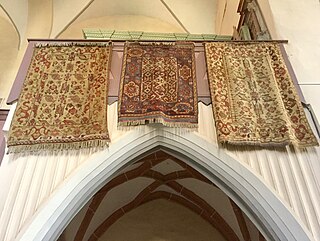
The name Transylvanian rug is used as a term of convenience to denote a cultural heritage of 15th–17th century Islamic rugs, mainly of Ottoman origin, which have been preserved in Transylvanian Protestant churches. The corpus of Transylvanian rugs constitutes one of the largest collections of Ottoman Anatolian rugs outside the Islamic world.

Anatolian animal carpets represent a special type of pile-woven carpet, woven in the geographical region of Anatolia during the Seljuq and early Ottoman period, corresponding to the 14th–16th century. Very few animal-style carpets still exist today, and most of them are in a fragmentary state. Animal carpets were frequently depicted by Western European painters of the 14th–16th century. By comparison of the few surviving carpets with their painted counterparts, these paintings helped to establish a timeline of their production, and support our knowledge about the early Turkish carpet.

The Oriental Carpet Manufacturers (OCM) was a London-based company involved in the production of, and trade with, Oriental carpets. Established in 1907/8 in Istanbul, the company set up and controlled their own carpet manufactures in the central Anatolian region around the town of Konya, and from 1911 onwards, in the Hamadan Province in northwestern Iran. In 1968 it was sold, and merged with one of its former affiliates, the Eastern Kayyam Company. From 1924 until 1948, OCM was led by Arthur Cecil Edwards, who, after retiring, wrote a text book on Persian Carpets, which is still in print today.


