Design & Development
Born from the same Regia Aeronautica requirement that spawned the Caproni-Vizzola F.5, FIAT G.50, Macchi C.200, Meridionali Ro 51 and Reggiane Re 2000 fighters, the A.U.T.18 flew for the first time on 22 April 1939, powered by a 779 kW (1,044 hp) Fiat A.80 R.C.41 radial engine. The fighter had an all-metal stressed-skin structure, covered in duralumin, featuring an inwardly-retracting undercarriage and retractable tail-wheel and was armed with two 12.7 mm (0.50 in) Breda-SAFAT machine-guns mounted in the wings just outboard of the undercarriage.
Flight trials proved disappointing and lagged behind the other fighters in Progetto R - the modernisation (riammodernamento) of the Regia Aeronautica. With no production orders forthcoming, despite the prototype being returned to the Umbra factory at Foligno for modifications on 20 February 1940 and a second flight test series from 5 November 1940, no improvement was demonstrated over fighters already in production so the A.U.T.18 was abandoned.

The Macchi C.200 Saetta, or MC.200, was a fighter aircraft developed and manufactured by Aeronautica Macchi in Italy. Various versions were flown by the Regia Aeronautica who used the type throughout the Second World War.

The Macchi C.202 Folgore was an Italian fighter aircraft developed and manufactured by Macchi Aeronautica. It was operated mainly by the Regia Aeronautica in and around the Second World War. According to aviation author David Mondey, the Folgore has been considered to be one of the best wartime fighters to serve in large numbers with the Regia Aeronautica.

The Fiat G.50 Freccia (“Arrow”) was a World War II Italian fighter aircraft that was developed and manufactured by the aviation company Fiat. Upon entering service, the type became Italy's first single-seat, all-metal monoplane that had an enclosed cockpit and retractable undercarriage. On 26 February 1937, the G.50 conducted its maiden flight. During early 1938, the Freccias served in the Regia Aeronautica and with its expeditionary arm, the Aviazione Legionaria, in Spain, where they compared well in speed and manoeuvrability with their adversaries in the theatre.

The Fiat G.55 Centauro was a single-engine single-seat World War II fighter aircraft used by the Regia Aeronautica and the Aeronautica Nazionale Repubblicana in 1943–1945. It was designed and built in Turin by Fiat. The Fiat G.55 was arguably the best type produced in Italy during World War II, but it did not enter production until 1943, when, after comparative tests against the Messerschmitt Bf 109G and the Focke-Wulf Fw 190, the Luftwaffe itself regarded the Fiat G.55 as "the best Axis fighter".

The Breda Ba.88 Lince ("Lynx") was a ground-attack aircraft used by the Italian Regia Aeronautica during World War II. Its streamlined design and retractable undercarriage were advanced for the time, and after its debut in 1937 the aircraft established several world speed records. However, when military equipment was installed on production examples, problems of instability developed and the aeroplane's general performance deteriorated. Eventually its operational career was cut short, and the remaining Ba.88 airframes were used as fixed installations on airfields to mislead enemy reconnaissance. It represented, perhaps, the most remarkable failure of any operational aircraft to see service in World War II.

The CANT Z.1007 Alcione (Kingfisher) was an Italian three-engined medium bomber, with wooden structure. It was designed by Filippo Zappata, who also designed the CANT Z.506 and had "excellent flying characteristics and good stability". It was regarded by some as "the best Italian bomber of World War II" although its wooden structure was easily damaged by the climate, as experienced in North Africa and in Russia. It was used by the Italian Regia Aeronautica, Italian Co-Belligerent Air Force, Aeronautica Nazionale Repubblicana and Luftwaffe during World War II.
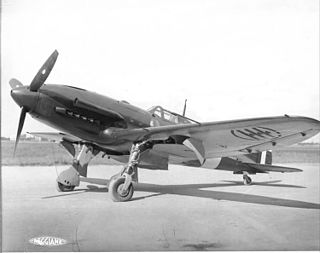
The Reggiane Re.2005 Sagittario was an Italian monoplane fighter and fighter-bomber produced for the Regia Aeronautica during the later years of World War II. Along with the Macchi C.202/C.205 and Fiat G.55, the Reggiane Re.2005 was one of the three Serie 5 Italian fighters. The lines of the fuselage were aerodynamically efficient, and the design was intended to exploit the famous Daimler-Benz DB 605 engine. The only drawback was a certain structural weakness in the rear section of the fuselage. Only 48 examples had been delivered before the Armistice, and these fighters took part in the defence of Naples, Rome and Sicily, with the survivors battling above the crumbling ruins of Berlin, in German insignia. British ace and military observer, Group Captain Duncan Smith, DSO DFC, said that "The Re.2005 was altogether a superb, potent aeroplane".
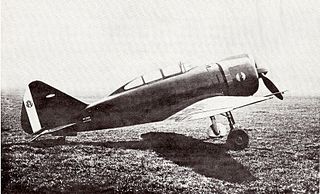
The Reggiane Re.2000 Falco I was an Italian all metal, low-wing monoplane developed and manufactured by aircraft company Reggiane. The type was used by the Regia Aeronautica and the Swedish Air Force during the first part of the Second World War.
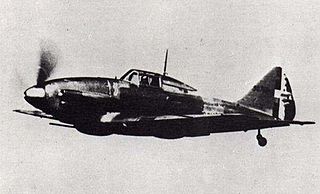
The Reggiane Re.2001 Falco II was an Italian fighter aircraft, serving in the Regia Aeronautica during World War II. A contemporary of the renowned Macchi C.202, the production of this type was to be limited to only 252, but it was a flexible design that proved to be able to undertake a number of roles. Thanks to its maneuverability it could dogfight with more powerful opponents like the Supermarine Spitfire. The Re.2001 became the basis of a later, more formidable fighter, the Re.2005.
Breda-SAFAT was an Italian weapons manufacturer of the 1930s and 1940s that designed and produced a range of machine-guns and cannon primarily for use in aircraft. Based on the M1919 Browning machine gun, the Italian guns were chambered to fire indigenous ammunition with 7.7 mm (0.303 in) and 12.7 mm (0.500 in) calibres, predominantly ball, tracer for the 7.7mm, including high explosive incendiary tracer (HEI-T), or armour-piercing (AP) for the 12.7mm.
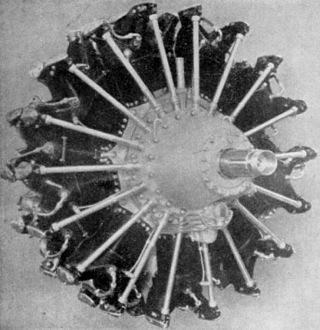
The Fiat A.80 was an 18-cylinder, twin-row, air-cooled, radial aircraft engine produced during World War II. Rated at 750 kW (1,000 hp), it was a more powerful development of the 14-cylinder Fiat A.74.

The CRDA CANT Z.1018 Leone (Lion) was an Italian medium bomber of the 1940s.

The Breda Ba.201 was an Italian dive bomber designed during World War II, that never entered production.

The Caproni Vizzola F.5 was an Italian fighter aircraft that was built by Caproni. It was a single-seat, low-wing cantilever monoplane with retractable landing gear.
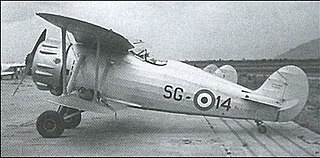
The IMAM Ro.41 was an Italian light biplane fighter aircraft, serving in the Regia Aeronautica in the 1930s-1940s, mainly as a trainer.

The Piaggio P.119 was an Italian experimental fighter of World War II. It had a relatively novel layout, with a "buried" radial engine mounted mid-fuselage. Only a single prototype was built before the Armistice between Italy and the allied armed forces, which ended the project.

The IMAM Ro.51 was an Italian fighter aircraft that first flew in 1937. It was designed for the 1936 new fighter contest for the Regia Aeronautica, with practically all the Italian aircraft builders involved.

The IMAM Ro.57 was an Italian twin-engined, single-seat monoplane fighter of the Regia Aeronautica. Based on a 1939 design by Giovanni Galasso the aircraft did not enter production until 1943.

The Caproni Ca.355 Tuffo was a low-wing single-engine dive bomber, designed and built by the Italian Caproni company in 1941, which never proceeded beyond a single prototype. Derived from Ca.335 Mistral, the Ca.355 was proposed to equip the Regia Aeronautica, but it was found to offer little advantage over the German Junkers Ju 87 "Stuka" and the project was abandoned.

The Caproni Vizzola F.6 was a World War II-era Italian fighter aircraft built by Caproni. It was a single-seat, low-wing cantilever monoplane with retractable landing gear. Only two prototypes were built, one designated F.6M and the other designated F.6Z.


