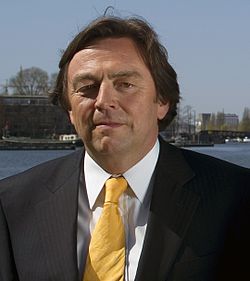
On Koolmees' advice, D66 and Christian Democratic Appeal (CDA) started substantial negotiations on 13 November 2025. They were guided by informateurSybrand Buma (CDA), with Hans Wijers (D66) having resigned on the second day after doubts emerged regarding his neutrality. The document drawn up by D66 and CDA was unable to break the deadlock.
Buma subsequently advised continuing negotiations with the VVD included. The talks took place under the guidance of informateur Rianne Letschert (D66) from 10 December 2025. D66, VVD and CDA decided to form a minority cabinet together and presented their coalition agreement on 30 January 2026. Selection of ministers and state secretaries began on 3 February 2026 with formateurRob Jetten (D66). The Jetten cabinet is expected to be sworn in on 23 February 2026.
During the campaign, possible coalitions were discussed. GL-PvdA, D66, CDA, and smaller parties continued to exclude the PVV. The VVD ruled out governing with the PVV, and also repeatedly made clear it did not want to join a coalition with the GL-PvdA.[1]
Election results
D66 and PVV won 26 seats each, with D66 winning more votes. 26 seats was the lowest number of seats ever won by the largest party.[2] Based on the results, a centrist cabinet of D66, VVD, CDA, and GroenLinks-PvdA would have a majority of 86 seats in the House. The VVD's preferred "centre-right" cabinet of D66, VVD, CDA, and JA21 would have 75 seats, and would require a fifth party to reach a majority.
Because of uncertainty over which party would end up as the largest, the selection of a scout was postponed until 4 November.[3] President of the Nederlandse Spoorwegen and former minister Wouter Koolmees was selected as scout, as proposed by his party, D66.[4] Koolmees met the party leaders on 5 and 6 November.
D66 party leader Rob Jetten expressed a preference for a centrist coalition.[1] He was open to negotiating with JA21 if not together with VVD.[5] GroenLinks–PvdA parliamentary leader Jesse Klaver, who was chosen after lead candidate Frans Timmermans retired following the electoral loss, was open to either governing or remaining in opposition. PVV leader Geert Wilders wanted to join a coalition, and ruled out providing confidence and supply.[6] VVD leader Dilan Yeşilgöz reiterated that the VVD did not want to form a coalition with GroenLinks–PvdA, instead favouring a centre-right coalition with JA21. CDA leader Henri Bontenbal refused to express a preference.[7] JA21 leader Joost Eerdmans preferred a right-wing coalition with a majority, and said there was no chance of a coalition with GroenLinks–PvdA.[8]
BBB leader Caroline van der Plas said she did not want to join a cabinet but was "not opposed" to a coalition of D66, VVD, CDA, and JA21.[9] SP leader Jimmy Dijk and CU leader Mirjam Bikker saw no role for their parties in a cabinet, and predicted the centrist cabinet as the most logical option.[10][11] SGP leader Chris Stoffer favoured the formation of a right-wing coalition, possibly with PVV, and ruled out joining or supporting a cabinet with D66.[12]
On 7 November, Koolmees met with Jetten and Eerdmans, and separately with Yeşilgöz and Klaver. Neither meeting changed the positions of VVD or D66 regarding GroenLinks–PvdA and JA21 respectively.[13] At the end of his assignment on 11 November, Koolmees advised that D66 and CDA should negotiate for three weeks. Their negotiations should focus on housing, nitrogen, the economy, international security, and migration.[5]
On 13 November, mayor of Leeuwarden and former CDA leader Sybrand Buma and former D66 minister Hans Wijers were appointed as informateurs, with the assignment proposed by Koolmees.[14] On the same day, NRC and De Telegraaf reported that Wijers had expressed a preference for a centrist cabinet on election night, and had called Yeşilgöz a liar. At a press conference on 13 November, he retracted his comments and apologised. On 14 November, NRC confronted Wijers with an older private message in which he called Yeşilgöz "a witch", at which point he resigned. Two weeks later, NRCcorrected their first story, after journalist Eric Smit came forward to say that he, not Wijers, had called Yeşilgöz a liar.[15]
Jetten, Bontenbal, and Buma invited experts and interest groups to update them on the five themes,[16] accompanied by co-negotiators Jan Paternotte (D66) and Bart van den Brink (CDA).[17] They composed a joint document parallel to the meetings,[16] intended as an outreach to other parties, which was presented along with Buma's interim report on 2 December.[18] The document included, among other things, a strict asylum policy, the retention of the Dispersal Act, and a phase-out of the mortgage interest deduction.[19]
Buma presented the document to the other party leaders over the next two days. Although most parties saw points of agreement, the deadlocks persisted. On 5 December, Buma met with the leaders of D66, VVD, GL-PvdA, CDA, and JA21. His proposal for a five-party coalition was not received enthusiastically and was blocked by the VVD. GL-PvdA also ruled out providing confidence and supply to a minority government.[20]
Over the weekend, it was decided that D66, VVD, and CDA would continue negotiations on a "basic governing agreement", while still keeping the option of a majority coalition open. On 8 December, Buma presented his recommendation for the three parties to proceed with negotiations.[21]
On 10 December, president of Maastricht UniversityRianne Letschert was appointed as informateur, with the assignment proposed by Buma and a deadline of 30 January.[22] On 13 and 14 December, negotiations took place between the party leaders of D66, CDA, and VVD at De Zwaluwenberg[nl].[23] The negotiators took a break from 24 December to 5 January due to the holidays.[24][25]
Minority cabinet
On 8 and 9 January, they met again at De Zwaluwenberg. On the morning of 9 January, Letschert forced the party leaders to make a choice for the coalition form, otherwise she would resign as informateur. As a result, they decided to form a three-party minority cabinet. After Yeşilgöz consulted her parliamentary group for approval, the decision was made public in the afternoon.[26]
Letschert and the negotiators then met with the other parliamentary leaders separately. Eerdmans expressed disappointment that his party was not allowed to participate, but said he was positive towards the idea of a minority cabinet. 50Plus also indicated it would adopt a cooperative stance. The SGP and ChristianUnion were also willing to offer support, but warned about their red lines regarding medical ethics and freedom of education.[27]
Klaver stated that he intended to be a responsible opposition. After the conversation, he said that, in his view, the negotiators still had no idea how they intended to secure a majority.[28] A week later, during his New Year's speech, Klaver announced that the party was open to deals with the minority cabinet, particularly on issues such as the nitrogen crisis, housing construction, and nature restoration. He stipulated as a condition that the cabinet must not dismantle the welfare state.[29]
The only parliamentary leader who did not attend was Wilders.[30] Within the parliamentary party, some MPs wanted the group to cooperate constructively with the minority government. When this and other grievances were not addressed, seven members of parliament, led by Gidi Markuszower, decided to split and form the Markuszower Group. The new group then informed Letschert that they were willing to meet the negotiators for talks.[31]
Coalition agreement
In the week before the deadline, the parties discussed finances, which they failed to reach an agreement on for a long time. On 26 January, Letschert again threatens to resign if they don't reach a breakthrough within an hour. Letschert's intervention was succesful, and the evening of 27 January, the negiotiators reached an agreement.[32] The next day, the parliamentary groups of D66, VVD and CDA approved the agreement.[33]
On 30 January, the party leaders presented the agreement with the title Aan de slag (Get started). The agreement included increase in spending for defence (to meet the 5% NATO pledge) and education, paid for by higher taxes and cuts to health care and unemployment benefits.[34]
On 3 February 2026, the House debated the agreement. The opposition focused on the faster increase of the state pension (AOW) age in the coalition agreement. With a narrow majority, a motion against it was rejected because the coalition was supported by the SGP and the Markuszower Group. At the end of the evening, the House passed a motion to appoint Jetten as formateur.[35]
On 16 February, de Volkskrant revealed that Nathalie van Berkel, the D66 candidate for State Secretary of Finance, had included incorrect information about her education on her CV. Van Berkel subsequently withdrew.[38]
This page is based on this Wikipedia article Text is available under the CC BY-SA 4.0 license; additional terms may apply. Images, videos and audio are available under their respective licenses.